





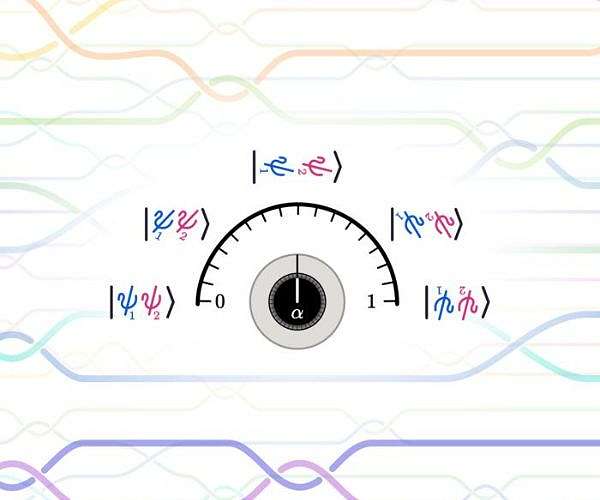
This distinction stems from the principle of indistinguishability in quantum physics, which states that two identical quantum particles cannot be labeled or tracked individually, unlike classical objects such as marbles painted different colors. Because swapping indistinguishable particles leads to a configuration that cannot be told apart from the original, the overall physical state must remain the same, which constrains the mathematical exchange factor to values whose square is equal to 1. Only +1, associated with bosons, and -1, associated with fermions, satisfy this rule, so all known elementary particles in three dimensions have been understood to fall into one of these two classes.
The boson fermion distinction has clear physical consequences. Bosons tend to occupy the same quantum state and act collectively, as seen in lasers, where photons with the same wavelength propagate in lockstep, or in Bose Einstein condensates, where ultracold atoms collapse into a single shared state. Fermions, by contrast, obey the Pauli exclusion principle, which prevents electrons, protons, and neutrons from sharing the same state and underpins the electronic shell structure that gives rise to the periodic table and the diversity of chemical elements.
In lower dimensional systems, however, the simple boson fermion picture breaks down because particles have fewer paths available to move past each other. Since the 1970s, theorists have predicted that in two dimensional systems, a broader family of particles called anyons can appear, with exchange factors that can take on values continuously between the bosonic and fermionic cases. In 2020, experimental groups confirmed this prediction by observing anyonic behavior at the interface of supercooled, strongly magnetized, one atom thick semiconductor structures, validating decades of theoretical work on exotic low dimensional quantum statistics.
Now, two new joint papers from researchers at the Okinawa Institute of Science and Technology Graduate University (OIST) and the University of Oklahoma extend this idea into one dimension and show that the boson fermion binary can be broken even when particles are confined to move along a line. Writing in Physical Review A, the team identifies a concrete one dimensional setting in which anyons can exist and explores their theoretical properties, while also outlining how present day cold atom experiments can realize and probe these particles. Their analysis demonstrates that one dimensional anyons form a new class of quantum particles whose exchange statistics are directly linked to the strength of short range interactions.
In three dimensions, two particles can interchange their positions by looping around each other in space, and the exchange operation can be continuously deformed back to doing nothing, reinforcing the binary constraint on the exchange factor. In lower dimensions, the geometry is different: paths in two dimensions can braid around one another so that exchanges are no longer topologically equivalent to no motion at all, which allows more general exchange factors. In one dimension, particles cannot pass around each other at all, so if they are to trade places they must instead move through each other, which changes the nature of the exchange process and the mathematical rules it must satisfy.
Raul Hidalgo Sacoto, a PhD student in the OIST Quantum Systems Unit led by Professor Thomas Busch, explains that the exchange factor in standard quantum theory must obey a simple rule when the exchange path can be undone, because exchanging identical particles is effectively the same as doing nothing to the system. In the lower dimensional scenarios considered in the new work, the team shows that this topological equivalence can be lost, so the exchange factor generalizes to a continuous range that depends on the detailed trajectories the particles follow. This more flexible description naturally gives rise to anyons, particles whose exchange factors are neither +1 nor -1 and therefore lie outside the conventional boson fermion dichotomy.
The new research demonstrates that in a one dimensional system with short range interactions, the exchange factor is no longer fixed but can be tuned by adjusting the interaction strength. In their model, particles confined to a line cannot side step one another and must cross through, and the resulting quantum mechanical scattering process imprints an effective exchange phase that encodes the anyonic character. Because the interaction strength is directly controllable in modern ultracold atom experiments, this provides a clear experimental knob for dialing the exchange statistics continuously between bosonic and fermionic limits.
According to the authors, recent advances in the control of individual atoms and their interactions in ultracold atomic setups make it realistic to realize these one dimensional anyons in the laboratory. Techniques such as optical lattices, tightly confining traps, and tunable interaction schemes offer the control needed to engineer the required one dimensional geometries and interaction regimes. The work therefore goes beyond abstract theory by mapping out a practical route for creating tunable anyons and identifying measurable signatures that can confirm their presence.
A central result of the study is the identification of how one dimensional anyonic statistics manifest in the momentum distribution of the particles. The researchers show that the nature of the exchange statistics leaves a distinctive imprint in the high momentum tail of the distribution, providing an experimental observable that can be used to infer the anyonic character. They find that this tail behaves universally for identical one dimensional anyons with two body interactions, which reinforces the idea that the underlying physics is robust and not tied to a specific microscopic realization.
Professor Busch emphasizes that the team has not only highlighted a one dimensional setting where anyons can exist, but has also described how to map out their exchange properties and observe their nature through experimentally accessible quantities. He notes that the necessary experimental infrastructure already exists in many ultracold atom laboratories around the world, suggesting that tests of the predictions may soon follow. With the ability to tune exchange statistics continuously, researchers will be able to explore how quantum systems interpolate between familiar bosonic and fermionic behavior and to ask new questions about correlations, dynamics, and phases in such systems.
Beyond their immediate implications for cold atom experiments, one dimensional anyons could open up broader avenues for exploring fundamental questions in quantum mechanics. Anyonic statistics have long been of interest in two dimensions, where they can underpin exotic phases of matter and offer potential routes to fault tolerant quantum computation through topologically protected operations. The one dimensional counterparts identified in the new work add a fresh twist by tying exchange properties directly to interaction strength, which may offer new strategies for controlling quantum information or engineering novel strongly correlated states.
The press release points out that every known particle in our three dimensional universe appears to obey either bosonic or fermionic statistics, and poses the question of why no other categories have been observed. By showing that in restricted geometries with carefully controlled interactions, entirely new classes of exchange behavior can arise, the researchers argue that the familiar binary may be a reflection of our three dimensional context rather than a fundamental limitation. Their results suggest that by looking in the right low dimensional settings, experimenters can uncover a richer landscape of quantum statistics.
The work involved a collaboration between theorists at OIST and the University of Oklahoma, combining expertise in quantum many body physics and ultracold atom theory. It builds on a broader effort to understand how dimensionality, topology, and interactions shape quantum behavior, and contributes to a growing body of research on nontrivial exchange statistics in engineered systems. Funding for the research came from the Okinawa Institute of Science and Technology Graduate University and the U.S. National Science Foundation.
Looking ahead, the team hopes that their theoretical predictions will motivate experiments that can confirm the existence and properties of one dimensional anyons. They anticipate that such experiments will not only validate the new models but also reveal unexpected phenomena when exchange statistics become a tunable resource. As Professor Busch notes, opening up a new way to interpolate between bosons and fermions in one dimension provides an opportunity to revisit many longstanding questions in quantum physics from a fresh perspective, and to deepen our understanding of the fundamental structure of the quantum world.
Research Report:Universal momentum tail of identical one-dimensional anyons with two-body interactions
Related Links
Okinawa Institute of Science and Technology Graduate University
Understanding Time and Space
| Subscribe Free To Our Daily Newsletters |

| Subscribe Free To Our Daily Newsletters |








