24/7 Space News
CLIMATE SCIENCE
Antarctic ice feedback limits Southern Ocean carbon sink
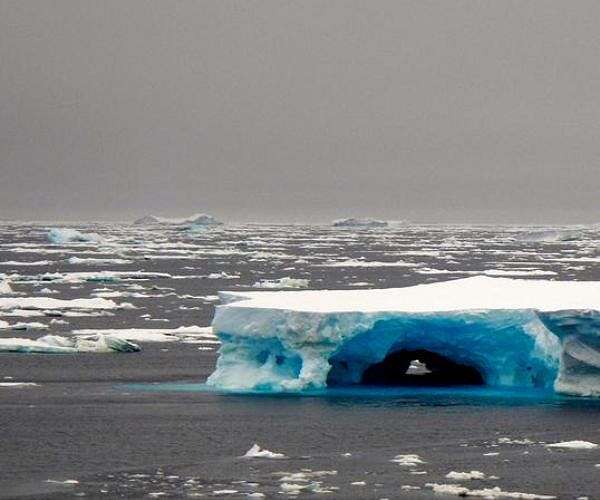
illustration only

Antarctic ice feedback limits Southern Ocean carbon sink

by Robert Schreiber
Berlin, Germany (SPX) Feb 03, 2026

A sediment core from the Pacific sector of the Southern Ocean has provided a research team led by geochemist Dr Torben Struve from the University of Oldenburg, Germany, with evidence of an unexpected climate feedback in Antarctica. The study, published in Nature Geoscience, links changes in the West Antarctic Ice Sheet to variations in marine algae growth over several glacial cycles, but in a way that contradicts conventional expectations about iron fertilisation and carbon uptake.

The core contains sediments spanning roughly 500,000 years and four glacial cycles. It was recovered in 2001 from nearly 5,000 meters water depth at 116 degrees west and 62 degrees south, south of the Antarctic Polar Front between South America and New Zealand. This region forms part of the Pacific sector of the Southern Ocean, a key area for global ocean circulation and carbon exchange with the atmosphere.

In the Southern Ocean, iron is generally thought to act as a fertiliser that promotes phytoplankton growth and enhances the ocean's capacity to absorb carbon dioxide. Earlier work suggested that during glacial periods strong winds transported iron-rich dust from continents to the ocean surface, stimulating algae growth north of the Polar Front. That process likely helped draw down atmospheric CO2 and reinforced global cooling at the onset of ice ages.

Analyses of the new core show a different pattern south of the Polar Front. Here, iron input was highest during warmer intervals rather than during peak glacial conditions. Grain size and composition indicate that the material arrived mainly via icebergs rather than wind-blown dust, and its geochemical signature points to a source in West Antarctica, the sector of the continent west of the Antarctic Peninsula where much of the ice sheet rests on bedrock below sea level and is therefore considered unstable.

The findings support other lines of evidence that the West Antarctic Ice Sheet retreated on a large scale during the last interglacial period about 130,000 years ago, when global temperatures were similar to those of today. As the ice sheet, which is several kilometers thick in places, broke up, it produced large numbers of icebergs that scraped sediments from the underlying bedrock and transported them into the South Pacific. According to the core data, iceberg discharge was especially strong near the ends of glacial periods and at the peaks of interglacials.

However, the elevated iron supply during these warm phases did not translate into a corresponding surge in algae growth. "The growth of phytoplankton - microalgae found in the light-flooded upper layers of the ocean - was either not stimulated or only weakly stimulated. This led to a sharp reduction in CO2 absorption," explains Dr Frank Lamy, a palaeoclimatologist at the Alfred Wegener Institute, Helmholtz Centre for Polar and Marine Research and co-author of the study. Laboratory analyses showed that the sediments were highly weathered and that the iron they contained was in a less soluble form that organisms can only use to a limited extent.

The researchers infer that beneath the West Antarctic Ice Sheet there is probably a layer of geologically ancient, strongly weathered rock. Whenever the ice sheet shrank during past interglacial periods and large numbers of icebergs calved, these ice masses carried weathered mineral grains into the adjacent South Pacific, yet phytoplankton productivity stayed relatively low. In this part of the Southern Ocean, total iron input was therefore not the controlling factor for algae growth; instead, the bioavailability and chemical form of the iron determined its fertilising effect.

This mechanism challenges the assumption that increased iron delivery to the Southern Ocean automatically enhances biological carbon uptake. The study shows that additional iron can fail to boost CO2 drawdown if it is delivered in a chemically unfavourable state, even when fluxes are high. In the Pacific sector south of the Antarctic Polar Front, high loads of poorly soluble iron from iceberg-borne sediments can coincide with reduced oceanic carbon uptake.

Looking ahead, the team warns that ongoing global warming and continued thinning of the West Antarctic Ice Sheet could create conditions similar to those of the last interglacial. Further retreat of the ice and intensified erosion of weathered bedrock by glaciers and icebergs may increase the supply of low-bioavailability iron to the Southern Ocean. This would likely weaken the regional carbon sink and act as a positive feedback that amplifies climate change rather than damping it.

To assess the strength and wider relevance of this feedback, Struve and colleagues call for more detailed work on additional sediment cores from across the South Pacific. Such records could clarify how broadly this process operates, how it varies over glacial-interglacial cycles and how it interacts with other factors such as ocean circulation changes, sea-ice dynamics and fluctuations in atmospheric dust transport.

Research Report:South Pacific carbon uptake controlled by West Antarctic Ice Sheet dynamics

Related Links
University of Oldenburg
Climate Science News - Modeling, Mitigation Adaptation

Subscribe Free To Our Daily Newsletters
Tweet

RELATED CONTENT
The following news reports may link to other Space Media Network websites.
CLIMATE SCIENCE
Climate setbacks mount as king warns, court acts, and floods worsen in Africa
Windsor, United Kingdom (AFP) Jan 28, 2026
King Charles III has warned the world is "rapidly going backwards" in curbing climate change and biodiversity loss, in an Amazon Prime documentary getting a Windsor Castle premiere Wednesday. The British monarch, a lifelong environmentalist who has rallied global leaders and institutions to the cause, called for greater mitigation efforts "as fast as we can". "It's rapidly going backwards," the king said of the current situation, in the feature-length film "Finding Harmony: A King's Vision". ... read more

CLIMATE SCIENCE
NASA astronaut stuck in space for nine months retires

Tourists hit record in Japan, despite plunge from China

What happens when fire ignites in space? 'A ball of flame'

ISS astronauts splash down on Earth after first-ever medical evacuation

CLIMATE SCIENCE
NASA and GE run hybrid jet engine test toward commercial flight

Starfighters completes key wind tunnel campaign for STARLAUNCH 1 air launch vehicle

Major equity deal backs Gilmour Space expansion of sovereign launch capability

Stratolaunch secures major funding to scale hypersonic flight services

CLIMATE SCIENCE
Ancient deltas reveal vast Martian ocean across northern hemisphere

Tiny Mars' big impact on Earth's climate

The electrifying science behind Martian dust

Sandblasting winds sculpt Mars landscape

CLIMATE SCIENCE
Retired EVA workhorse to guide China's next-gen spacesuit and lunar gear

Tiangong science program delivers data surge

China tallies record launch year as lunar and asteroid plans advance

China harnesses nationwide system to drive spaceflight and satellite navigation advances

CLIMATE SCIENCE
Aerospacelab expands Pulsar navigation constellation work with new Xona satellite order

ThinkOrbital raises seed funding to advance orbital defense and construction systems

China outlines mega constellations in ITU satellite filings

Multiple satellite filings demonstrate transparency, responsibility and ambition: China Daily editorial

CLIMATE SCIENCE
German software giant SAP's shares plunge on AI worries

Autonomous AI network boosts materials discovery efficiency

Desert sand mix points to new path for greener concrete

EU to show Google how to open up to rival AI services; Microsoft shares slide as AI spending surges

CLIMATE SCIENCE
Icy cycles may have driven early protocell evolution

Cosmic dust chemistry forges peptide building blocks in deep space

Hidden magma oceans could shield rocky exoplanets from harmful radiation

ALMA survey maps turbulent youth of distant planetary systems

CLIMATE SCIENCE
Polar weather on Jupiter and Saturn hints at the planets' interior details

Europa ice delamination may deliver nutrients to hidden ocean

Birth conditions fixed water contrast on Jupiters moons

Study links Europa's quiet seafloor to hidden potential for life

Subscribe Free To Our Daily Newsletters


The content herein, unless otherwise known to be public domain, are Copyright 1995-2024 - Space Media Network. All websites are published in Australia and are solely subject to Australian law and governed by Fair Use principals for news reporting and research purposes. AFP, UPI and IANS news wire stories are copyright Agence France-Presse, United Press International and Indo-Asia News Service. ESA news reports are copyright European Space Agency. All NASA sourced material is public domain. Additional copyrights may apply in whole or part to other bona fide parties. All articles labeled "by Staff Writers" include reports supplied to Space Media Network by industry news wires, PR agencies, corporate press officers and the like. Such articles are individually curated and edited by Space Media Network staff on the basis of the report's information value to our industry and professional readership. Advertising does not imply endorsement, agreement or approval of any opinions, statements or information provided by Space Media Network on any Web page published or hosted by Space Media Network. General Data Protection Regulation (GDPR) Statement Our advertisers use various cookies and the like to deliver the best ad banner available at one time. All network advertising suppliers have GDPR policies (Legitimate Interest) that conform with EU regulations for data collection. By using our websites you consent to cookie based advertising. If you do not agree with this then you must stop using the websites from May 25, 2018. Privacy Statement. Additional information can be found here at About Us.