What Makes Air Refrigeration Safer for Food Storage
by Clarence Oxford
Los Angeles CA (SPX) Jan 06, 2026
Food businesses rely on cold rooms and process chillers to keep products safe from farm to fork. When cooling systems fail or behave unpredictably, the result can be spoilage, recalls, or subtle quality drift that emerges only when products reach consumers. Cooling technology is therefore a core food-safety control, not a background utility.
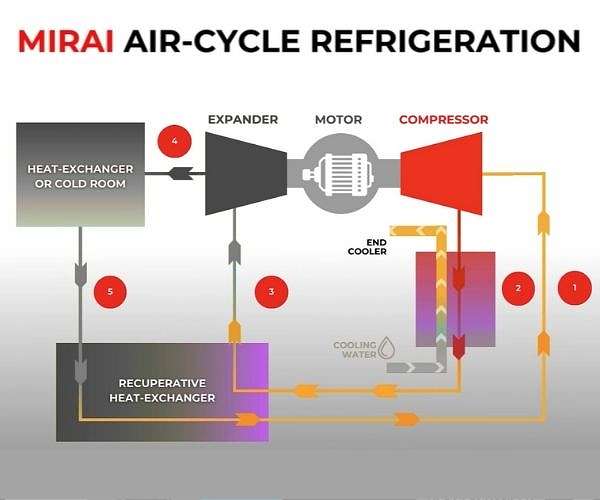
Modern air-based solutions add a new option to the familiar world of vapor-compression systems with synthetic refrigerants. Systems such as an air refrigeration system by Mirai Intex use air as the working fluid while still delivering low temperatures and tightly controlled conditions. Several characteristics of this approach align directly with safer, more robust food storage.
Working Fluid Risks and the Advantage of Air
Traditional systems carry an inventory of synthetic refrigerant throughout pipework and evaporators. Any leak near food, packaging, or staff can become both a maintenance event and a potential safety concern. As equipment ages and connections are serviced repeatedly, the probability of small leaks usually rises.
Air-based refrigeration largely removes this category of hazard, because the working fluid is the same air that already surrounds the equipment. There is no store of high-GWP refrigerant running above production lines or cold rooms. From a hazard-analysis perspective, the number of ways in which the cooling medium itself could contaminate food drops significantly.
This shift brings several safety-relevant advantages:
- Fewer scenarios in which refrigerant could enter a storage room or tunnel and interact with packaging or product.
- Simplified emergency planning, since accidental releases do not involve regulated fluorinated gases.
- Reduced regulatory exposure, where refrigerant phase-down and leak-reporting rules are tightening.
Air refrigeration does not replace good hygiene or inspection routines, but it removes one entire class of contamination risk from the cold side of the system.
Fewer Refrigerant-Linked Failure Scenarios
When the working fluid is ordinary air, a whole category of leak scenarios simply disappears from your hazard register. Incidents that would previously have triggered product holds, environmental reporting, and specialist clean-up shrink to routine mechanical issues that can be handled within standard maintenance.
This shift brings several safety-relevant advantages:
- Fewer scenarios in which refrigerant could enter a storage room or tunnel and interact with packaging or product.
- Simplified emergency planning, since accidental releases do not involve regulated fluorinated gases.
- Reduced regulatory exposure, where refrigerant phase-down and leak-reporting rules are tightening.
- Greater freedom in routing pipework, as long synthetic-refrigerant lines through ceilings become unnecessary.
Air refrigeration does not replace good hygiene or inspection routines, but it removes one entire class of contamination risk from the cold side of the system.
Temperature Control, Hygiene, and Product Integrity
Food-safety rules focus heavily on time-temperature combinations. A system that technically reaches a setpoint yet cycles widely around it can allow partial thawing, refreezing, or slow drift into marginal zones where microbes can grow. Air-based systems, especially when combined with well-designed secondary circuits, offer design features that support both hygienic operation and stable product temperatures.
Cleaner Cooling Circuits and Physical Separation
In many food facilities, oil management and refrigerant-side service create indirect contamination concerns. Work on lines above production or storage areas always carries a small chance that residue, insulation debris, or tools could reach food-contact surfaces.
Air-cycle equipment is typically oil-free on the primary side and can be installed in dedicated plant rooms, with a secondary heat-transfer loop serving cold rooms or process lines.
That arrangement has several hygiene benefits. Technical work happens away from open-product areas. Piping into food spaces can be simpler and easier to inspect. Zoning between "technical" and "hygiene-critical" areas becomes clearer, which supports both internal audits and external inspections. Over time, this cleaner physical arrangement helps keep sanitary standards consistent while still delivering reliable cooling.
Stable Temperature Profiles and Food-Safety Margins
Food safety depends on what products experience over hours and days, not on a brief reading during commissioning. Air refrigeration lends itself to precise control, with well-tuned logic that moderates temperature swings after door openings, loading events, or defrost cycles.
For stored food, this can translate into:
- Smaller deviations above target temperature when doors open frequently during busy shifts.
- More uniform conditions across racks and pallets, reducing "warm corners" or "cold spots."
- Repeatable blast-freezing profiles that preserve texture and quality when products are thawed.
- Logged temperatures that reflect actual product conditions closely, strengthening audit evidence.
When temperature behavior is predictable and narrowband, HACCP plans and shelf-life calculations can rest on real equipment performance rather than on large safety buffers introduced to cover uncertainties.
Safer Food Storage as a Long-Term Strategy
Air refrigeration is not a universal solution, yet its characteristics line up strongly with the needs of safety-conscious food businesses. Using air as the working fluid removes a whole category of refrigerant-related contamination and regulatory risk.
Design choices around oil-free circuits and plant-room installation support cleaner layouts and clearer zoning. Precise temperature control reinforces the time-temperature barriers on which food-safety plans depend.
For operators facing frequent refrigerant issues, tighter environmental rules, or demanding retail and audit requirements, air-based systems provide a technical foundation that aligns equipment behavior with safety priorities. When integrated thoughtfully into facility design, monitoring, and maintenance, they help keep cooling in the role it should occupy in a modern food operation: a quiet, consistently reliable guardian of product integrity and brand trust.
Related Links
Air Refrigeration at Mirai Intex
Space Technology News - Applications and Research