24/7 Space News
EXO WORLDS
Deep Arctic gas hydrate mounds host ultra deep cold seep ecosystem
illustration only

Deep Arctic gas hydrate mounds host ultra deep cold seep ecosystem

by Robert Schreiber
Berlin, Germany (SPX) Dec 26, 2025

A multinational research team led by UiT The Arctic University of Norway has identified the deepest known gas hydrate cold seep on Earth during the Ocean Census Arctic Deep - EXTREME24 expedition, documenting the Freya Hydrate Mounds at 3,640 meters depth on the Molloy Ridge in the Greenland Sea. The work reveals a previously unknown ecosystem on the Arctic seafloor where exposed gas hydrate, methane-rich fluids, and seep-associated fauna shape a structured environment with implications for Arctic governance and sustainable development.

The Freya Hydrate Mounds host active methane seepage, crude oil emissions, and chemosynthetic communities adapted to hydrocarbon-rich fluids at hadal depths. The team reports that these deposits extend the known depth range of gas hydrate outcrops by nearly 1,800 meters beyond the more common occurrences at less than 2,000 meters, prompting a reassessment of where such systems can form and persist in polar basins.

"This discovery rewrites the playbook for Arctic deep-sea ecosystems and carbon cycling," said Giuliana Panieri, Professor at UiT and now Director of CNR-ISP, and Chief Scientist of the expedition, together with Alex Rogers. "We found an ultra-deep system that is both geologically dynamic and biologically rich, with implications for biodiversity, climate processes, and future stewardship of the High North."

"There are likely to be more very deep gas hydrate cold seeps like the Freya mounds awaiting discovery in the region, and the marine life that thrives around them may be critical in contributing to the biodiversity of the deep Arctic" said Jon Copley of the University of Southampton, UK, who led the biogeographic analysis of the new discovery. "The links that we have found between life at this seep and hydrothermal vents in the Arctic indicate that these island-like habitats on the ocean floor will need to be protected from any future impacts of deep-sea mining in the region."

High-resolution remotely operated vehicle imagery shows partially collapsed gas hydrate mounds in the Molloy Deep, where exposed hydrates lie beneath sediment cover and support dense fields of frenulate worms, crustaceans, and small carbonate crusts. Fractures and structural failure within the mounds reflect the destabilizing effect of hydrate buoyancy and changing pressure-temperature conditions that can lead to progressive collapse.

Key findings from the Freya Hydrate Mounds include the documentation of hydrate deposits at 3,640 meters, far deeper than typical hydrate outcrops, and the observation of methane gas flares rising more than 3,300 meters through the water column. These tall flares rank among the highest reported globally and indicate focused fluid flow, while geochemical signatures show that thermogenic gas and crude oil originate from Miocene-aged sediments, evidencing long-lived deep fluid migration.

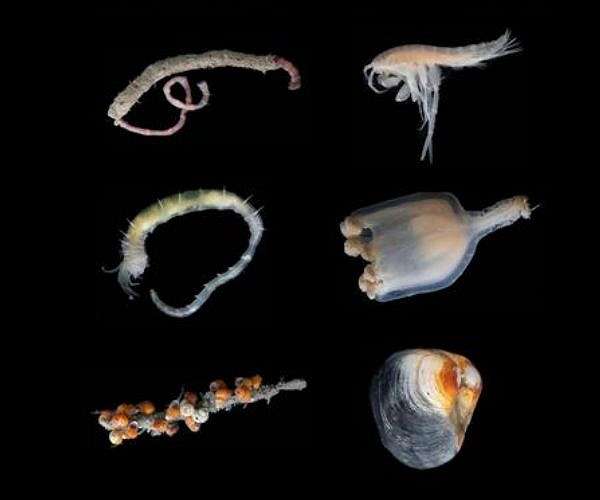
The ecological data reveal chemosynthetic communities dominated by siboglinid and maldanid tubeworms, snails, amphipods, and other invertebrates that rely on chemical energy from seeping fluids. Substantial overlap between fauna at Freya and communities near Arctic hydrothermal vents points to ecological connectivity between seep and vent habitats across the deep Arctic seafloor.

The hydrate mounds appear in different stages of growth, destabilisation, and collapse, demonstrating that the system evolves through cycles of hydrate formation, dissociation, and sediment reworking rather than remaining static structures. This dynamic behaviour, captured with advanced ROV imaging, shows how tectonics, heat flow, and ocean conditions can alter mound integrity and seepage pathways over time.

Freya provides an ultra-deep natural laboratory for investigating methane behaviour in the water column and the potential impacts of changing waters entering the Arctic through gateways such as the Fram Strait. Tracking hydrate stability and seepage at these depths can improve understanding of how deep carbon reservoirs respond to environmental change and how much methane may be transferred to overlying waters.

"These are not static deposits," Panieri added. "They are living geological features, responding to tectonics, deep heat flow, and environmental change."

The discovery comes at a time of increased international attention on the Arctic Ocean and its seabed resources, as ultra-deep environments are being considered for future resource exploration. The authors argue that evidence-based environmental assessments, detailed baseline studies, and long-term monitoring of seep activity, fluid fluxes, and faunal change will be essential to guide decisions affecting these deep habitats.

In their assessment, the scientists emphasize that sites such as Freya clarify how geological processes and biological communities interact across the Arctic deep sea and how these interactions may shift under natural variability and human-driven pressures. "Understanding these unique habitats is essential for safeguarding biodiversity and supporting responsible decision-making in polar regions," Panieri noted.

Research Report:Deepest gas hydrate cold seep ever discovered in the Arctic: international research team unveils Freya hydrate mounds at 3,640 m depth

Related Links
UiT The Arctic University of Norway
Lands Beyond Beyond - extra solar planets - news and science
Life Beyond Earth

Subscribe Free To Our Daily Newsletters
Tweet

RELATED CONTENT
The following news reports may link to other Space Media Network websites.
EXO WORLDS
Can scientists detect life without knowing what it looks like
Atlanta GA (SPX) Dec 16, 2025
When NASA scientists opened the sample return canister from the OSIRIS-REx asteroid sample mission in late 2023, they found something astonishing. Dust and rock collected from the asteroid Bennu contained many of life's building blocks, including all five nucleobases used in DNA and RNA, 14 of the 20 amino acids found in proteins, and a rich collection of other organic molecules ... read more

EXO WORLDS
ISS to change commanders before Soyuz crew leaves orbit

Lodestar Space wins SECP support to advance AI satellite awareness system

Micro nano robots aim to cut carbon buildup in closed life support systems

NASA extends ISS National Lab management contract through 2030

EXO WORLDS
Hydrogen from ethanol reforming mapped as aviation fuel-cell pathway

Southern Launch to host INNOSPACE missions from South Australian spaceports

Rocket Lab completes first dedicated JAXA mission with Electron launch

Musk signals plan to launch IPO for SpaceX

EXO WORLDS
GoMars model simulates Martian dust storms to improve mission safety

Maven stays silent after routine pass behind Mars

Ancient Martian brines left bromine rich fingerprints in jarosite minerals

NASA JPL Unveils Rover Operations Center for Moon, Mars Missions

EXO WORLDS
Foreign satellites ride Kinetica 1 on new CAS Space mission

Experts at Hainan symposium call for stronger global space partnership

Triple Long March launches mark record day for Chinese space program

China prepares Qingzhou cargo ship for low cost resupply flights

EXO WORLDS
K2 Space raises 250m to scale Mega class high power satellites

Beyond Gravity positions new modular satellite platform for European LEO missions

Private capital targets mission-critical software power and platforms in new space economy

Applied Aerospace and PCX create US flight and space hardware group

EXO WORLDS
Digital twin successfully launched and deployed into space

Bible 1.0: How Ancient Canon Became Our First Large Language Models

Modena team outlines staged roadmap to cut emissions from metal laser 3D printing

Light driven process prints biocompatible plastic electrodes

EXO WORLDS
Philosopher argues AI consciousness may remain unknowable

Can scientists detect life without knowing what it looks like

Ultra hot super Earth shows dense atmosphere over magma ocean

Hidden circumbinary giant planet emerges from decade old Gemini data

EXO WORLDS
Uranus and Neptune may be rock rich worlds

SwRI links Uranus radiation belt mystery to solar storm driven waves

Looking inside icy moons

Saturn moon mission planning shifts to flower constellation theory

Subscribe Free To Our Daily Newsletters


The content herein, unless otherwise known to be public domain, are Copyright 1995-2024 - Space Media Network. All websites are published in Australia and are solely subject to Australian law and governed by Fair Use principals for news reporting and research purposes. AFP, UPI and IANS news wire stories are copyright Agence France-Presse, United Press International and Indo-Asia News Service. ESA news reports are copyright European Space Agency. All NASA sourced material is public domain. Additional copyrights may apply in whole or part to other bona fide parties. All articles labeled "by Staff Writers" include reports supplied to Space Media Network by industry news wires, PR agencies, corporate press officers and the like. Such articles are individually curated and edited by Space Media Network staff on the basis of the report's information value to our industry and professional readership. Advertising does not imply endorsement, agreement or approval of any opinions, statements or information provided by Space Media Network on any Web page published or hosted by Space Media Network. General Data Protection Regulation (GDPR) Statement Our advertisers use various cookies and the like to deliver the best ad banner available at one time. All network advertising suppliers have GDPR policies (Legitimate Interest) that conform with EU regulations for data collection. By using our websites you consent to cookie based advertising. If you do not agree with this then you must stop using the websites from May 25, 2018. Privacy Statement. Additional information can be found here at About Us.