24/7 Space News
TECH SPACE
Space ground fluid AI framework targets satellite powered 6G edge intelligence
illustration only

Space ground fluid AI framework targets satellite powered 6G edge intelligence

by Riko Seibo
Tokyo, Japan (SPX) Dec 26, 2025
The race toward sixth generation 6G mobile networks is intensifying, with commercial deployment expected around 2030. The International Telecommunication Union ITU expects 6G systems to support scenarios such as integrated artificial intelligence and communication and ubiquitous connectivity. In this context, a recent article in the journal Engineering titled Space-Ground Fluid AI for 6G Edge Intelligence examines how edge AI can be combined with space-ground integrated networks SGINs to extend AI services on a global scale.

Researchers from the University of Hong Kong and Xidian University describe how modern satellites equipped with significant onboard computing can serve as both communication nodes and AI computing servers. This dual role responds to key challenges in SGINs, including high satellite mobility and limited space-ground link capacity, which can disrupt continuous AI service delivery.

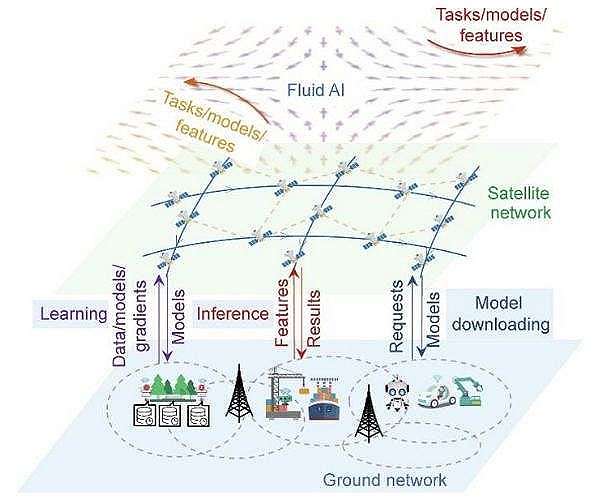
To address these constraints, the authors introduce a space-ground fluid AI framework that generalizes conventional two dimensional edge AI architectures into three dimensions by incorporating satellites. Inspired by the behavior of fluids, the framework allows AI model parameters and data features to move across and between space and ground segments as needed. The fluid AI concept is organized around three main techniques fluid learning, fluid inference, and fluid model downloading.

Fluid learning targets long model training times in SGINs with an infrastructure free model dispersal federated learning scheme. In this scheme, satellite motion helps mix model parameters across regions, converting orbital movement from a hindrance into a resource for training. According to the study, this approach can reach higher test accuracy in fewer training rounds than existing methods while avoiding reliance on expensive inter satellite links or dense ground infrastructure.

Fluid inference addresses how to run AI inference efficiently over space-ground networks by dividing neural networks into cascading sub models that reside on satellites and ground stations. This structure enables adaptive allocation of inference tasks according to processing resources and link conditions in different segments of the network. The authors also discuss early exiting methods that allow intermediate outputs to be used when latency or resource limits are tight, providing a tunable balance between accuracy and delay.

Fluid model downloading focuses on getting AI models to ground users with lower delay and better spectrum use. The framework uses parameter sharing caching where satellites store selected parameter blocks, which can then be migrated over inter satellite links to increase the chance that user requests hit local caches. Combined with multicasting of reusable model parameters, this design supports simultaneous delivery to multiple devices, improving download efficiency and spectrum utilization.

The article also highlights deployment challenges for fluid AI in SGINs, including exposure to radiation, extreme temperatures, and intermittent power on satellites. The authors discuss using radiation hardened components, fault tolerant computing techniques, and energy aware task scheduling so that AI workloads remain reliable while respecting limited power budgets.

Looking forward, the researchers point to several research priorities for fluid AI in 6G edge intelligence. These include energy efficient fluid AI that manages the tradeoff between energy consumption and operating time, low latency fluid AI that refines satellite-ground signaling and task placement, and secure fluid AI that strengthens defenses against evolving cyber and physical threats.

The study presents fluid AI as an early step in integrating edge AI with space-ground integrated networks for the 6G era. By exploiting features such as predictable satellite trajectories and repeated orbital patterns, the framework aims to extend AI services globally with more robust performance. The work outlines a direction for future systems that use SGINs as a core infrastructure for scalable edge intelligence.

Research Report:Space-Ground Fluid AI for 6G Edge Intelligence

Related Links
University of Hong Kong
Space Technology News - Applications and Research

Subscribe Free To Our Daily Newsletters
Tweet

RELATED CONTENT
TECH SPACE
Planet delivers first light image from Pelican 6 satellite capturing Lhasa Gonggar Airport
Los Angeles CA (SPX) Jan 01, 2026
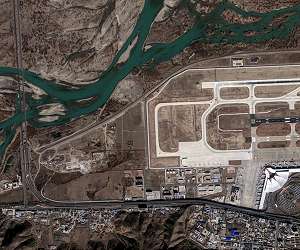
Planet Labs has released the first light image from its Pelican 6 Earth imaging satellite, highlighting Lhasa Gonggar International Airport in Tibet, China, and demonstrating the new spacecraft's imaging performance. The Pelican 6 satellite is part of Planet's Pelican constellation, a fleet of next generation Earth observation spacecraft designed to capture high resolution imagery with rapid revisit and broad global coverage. First light images are mission benchmarks that verify sensor calibration ... read more

TECH SPACE
ESA reaches new benchmark in autonomous formation flying

Hydrogen peroxide thruster qualifies for ESA launcher attitude control

China launches twin Shijian-29 satellites to test space-target detection tech

Billionaire Trump nominee confirmed to lead NASA amid Moon race

TECH SPACE
AI systems proposed to boost launch cadence reliability and traffic management

China debuts Long March 12A reusable rocket in Jiuquan test flight

Japan's flagship H3 rocket fails to launch satellite

North Korea tests hypersonic missiles, says nuclear forces ready for war

TECH SPACE
Curiosity Blog, Sols 4750-4762: See You on the Other Side of the Sun

Wind-Sculpted Landscapes: Investigating the Martian Megaripple 'Hazyview'

NASA team presses MAVEN recovery before Mars solar conjunction

Perseverance rover cleared for long distance Mars exploration

TECH SPACE
China harnesses nationwide system to drive spaceflight and satellite navigation advances

Shenzhou 21 crew complete eight hour spacewalk outside Tiangong station

Foreign satellites ride Kinetica 1 on new CAS Space mission

Experts at Hainan symposium call for stronger global space partnership

TECH SPACE
Southern Launch to Host Lux Aeterna Re-Entries South Australia

Smart modeling framework targets 6G spectrum chaos in space air and ground networks

Time-expanded network model cuts complexity in mega constellation launch planning

K2 Space raises 250m to scale Mega class high power satellites

TECH SPACE
India space agency launches its heaviest satellite

Space ground fluid AI framework targets satellite powered 6G edge intelligence

Engineered interlayers boost satellite insulation and flexible electronics

Planet delivers first light image from Pelican 6 satellite capturing Lhasa Gonggar Airport

TECH SPACE
Deep Arctic gas hydrate mounds host ultra deep cold seep ecosystem

Joint ground- and space-based observations reveal Saturn-mass rogue planet

Hubble pinpoints asteroid smash ups in nearby Fomalhaut system

Evolution study finds history and environment shifts can steer species in very different directions

TECH SPACE
Uranus and Neptune may be rock rich worlds

SwRI links Uranus radiation belt mystery to solar storm driven waves

Looking inside icy moons

Saturn moon mission planning shifts to flower constellation theory


The content herein, unless otherwise known to be public domain, are Copyright 1995-2026 - SpaceDaily.com. All websites are published in Australia and are solely subject to Australian law and governed by Fair Use principals for news reporting and research purposes. AFP, UPI and IANS news wire stories are copyright Agence France-Presse, United Press International and Indo-Asia News Service. ESA news reports are copyright European Space Agency. All NASA sourced material is public domain. Additional copyrights may apply in whole or part to other bona fide parties. All articles labeled "by Staff Writers" include reports supplied to Space Media Network by industry news wires, PR agencies, corporate press officers and the like. Such articles are individually curated and edited by Space Media Network staff on the basis of the report's information value to our industry and professional readership. Advertising does not imply endorsement, agreement or approval of any opinions, statements or information provided by Space Media Network on any Web page published or hosted by Space Media Network. General Data Protection Regulation (GDPR) Statement Our advertisers use various cookies and the like to deliver the best ad banner available at one time. All network advertising suppliers have GDPR policies (Legitimate Interest) that conform with EU regulations for data collection. By using our websites you consent to cookie based advertising. If you do not agree with this then you must stop using the websites from May 25, 2018. Privacy Statement. Additional information can be found here at About Us.
Subscribe Free To Our Daily Newsletters