





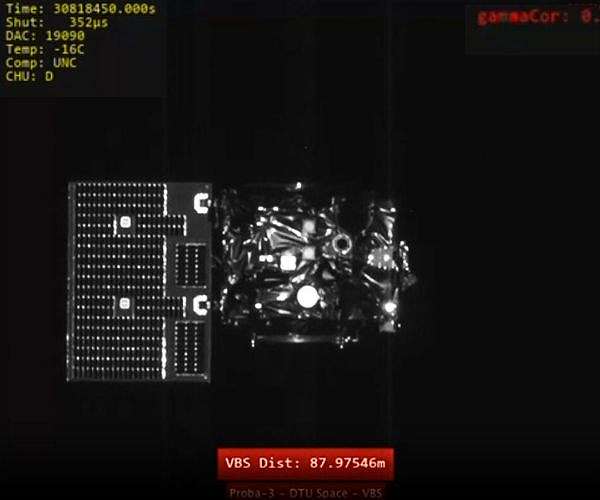
Ian Carnelli, ESA Head of Systems Department, stated: "Proba-3 proves that bold in-orbit experimentation is essential to turning breakthrough ideas into real space capabilities. ESA does not just design innovation, it flies it".
Proba-3 operates as two spacecraft flying as a single distributed system, running fully autonomously without guidance from ground controllers on Earth.
Using on-board autonomous vision systems together with optical and laser metrology, the two spacecraft detect each other over distances of kilometres, conduct rendezvous operations, and maintain an ultra-stable formation in orbit.
Key functions at the core of Proba-3 include cooperative and non-cooperative navigation, autonomous guidance, navigation and control, precise manoeuvring capability, on-board formation management, and autonomous collision avoidance between the spacecraft.
ESA describes the result as a virtual rigid structure in orbit that can be resized and reconfigured without continuous ground control or manual intervention, relying instead on trusted onboard intelligence. Proba-3 is presented not as a simple technology demonstration but as a blueprint for next-generation space systems and an example of how Europe is advancing autonomous spaceflight.
Damien, the Proba-3 mission manager, commented: "Proba-3 shows why in-orbit technology demonstration matters. ESA deliberately takes bold technical risks in space, pushes systems beyond what has ever flown before, and delivers. This is how ground-breaking technologies become operational capabilities , not on paper, but in orbit".
Related Links
European Space Agency (ESA)
Space Tourism, Space Transport and Space Exploration News
| Subscribe Free To Our Daily Newsletters |
| Subscribe Free To Our Daily Newsletters |







