24/7 Space News
SPACEMART
Time-expanded network model cuts complexity in mega constellation launch planning
illustration only

Time-expanded network model cuts complexity in mega constellation launch planning

by Riko Seibo
Tokyo, Japan (SPX) Dec 30, 2025
Large Low Earth Orbit (LEO) constellations promise continuous, high-capacity information services, but planners must work within limits set by launch cadence, payload capacity, and orbital mechanics to deploy satellites in batches at reasonable cost. Researchers Junru Lin, Tiantian Zhang, and Min Hu at Space Engineering University in Beijing have developed an optimization framework that keeps detailed timing information while shrinking the underlying mathematical problem, offering a practical tool for deployment of large constellations.

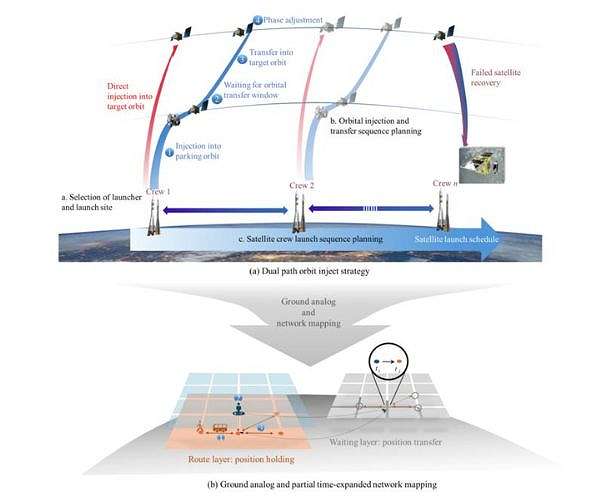
The study introduces a partial time-expanded network that removes more than 90 percent of redundant links using feasibility pruning and hierarchical aggregation and creates time nodes dynamically according to activity durations rather than a global time grid. This structure separates a transport layer for active transitions such as launches and orbital maneuvers from a waiting layer for phases like parking-orbit residence, and it incorporates a dual-channel strategy that combines direct injection with indirect injection from parking orbits to coordinate multi-configuration, multi-batch missions using both primary and auxiliary launch vehicles.

To solve the resulting model, the team applies a hybrid approach that combines column generation with a heuristic A* pricing algorithm and a subproblem filtering mechanism based on dual variables, which focuses computation on capacity-constrained windows and critical arcs. In benchmark tests for the Telesat, OneWeb, and Starlink constellations, the method cuts network size by about 84.7 percent, 99.4 percent, and 88.9 percent respectively compared with a full time-expanded network. The subproblem filter reduces the number of pricing problems by up to roughly 20 percent for OneWeb and 12 percent for Starlink, and overall solution times fall by around 30 percent, with A* consistently outperforming Dijkstra on both pricing counts and runtime.

The framework can also handle trade-offs between cost and time to service by adjusting weights in the objective function, which allows it to generate launcher mixes, batch plans, and orbital injection paths that balance schedule and budget. Simulation results indicate that a dual-launcher, dual-path plan can shorten deployment time by about 9.34 percent relative to a one-to-one scheme, at the cost of approximately an 8.19 percent increase in total expenditure, highlighting the interplay between the throughput and specific cost of primary launchers and the responsiveness of auxiliary vehicles.

The authors describe the method as a unified paradigm for end-to-end constellation deployment planning that jointly optimizes launch timing, vehicle choice, target injection orbits, and subsequent transfer and phasing while enforcing constraints on launch windows, payload limits, and orbital transfer feasibility. Future work will extend the framework to handle uncertainty and real-time replanning by modeling disruptions in production and manifests and weather effects, and will refine representations of multi-plane dispersion tactics, including distributing satellites into several orbital planes from a single launch using J2 perturbations, to improve applicability to operational mega constellations.

Research Report:Optimization strategy for batch launch deployment of large-scale low earth orbit constellations based on multimodal transportation network model

Related Links
Chinese Journal of Aeronautics
The latest information about the Commercial Satellite Industry

Subscribe Free To Our Daily Newsletters
Tweet

RELATED CONTENT
SPACEMART
Beyond Gravity positions new modular satellite platform for European LEO missions
Zurich, Switzerland (SPX) Dec 12, 2025
Beyond Gravity is expanding from supplying satellite components to delivering complete satellites based on a new low Earth orbit platform. The company aims to offer turnkey spacecraft to institutional and government customers that can be placed in orbit on relatively short timelines. The space technology firm, headquartered in Zurich, already provides structures, thermal protection, computers, antennas, solar arrays and instruments for many missions. It has now consolidated expertise from its Euro ... read more

SPACEMART
China launches twin Shijian-29 satellites to test space-target detection tech

Billionaire Trump nominee confirmed to lead NASA amid Moon race

Sprawling CES gadgetfest a world stage for AI and its hype

ISS to change commanders before Soyuz crew leaves orbit

SPACEMART
Hydrogen from ethanol reforming mapped as aviation fuel-cell pathway

Europe's Ariane 6 rocket puts EU navigation satellites in orbit

Southern Launch to host INNOSPACE missions from South Australian spaceports

Rocket Lab completes first dedicated JAXA mission with Electron launch

SPACEMART
HiRISE camera aboard Mars Reconnaissance Orbiter passes 100000 image milestone

GoMars model simulates Martian dust storms to improve mission safety

Maven stays silent after routine pass behind Mars

Ancient Martian brines left bromine rich fingerprints in jarosite minerals

SPACEMART
China harnesses nationwide system to drive spaceflight and satellite navigation advances

Shenzhou 21 crew complete eight hour spacewalk outside Tiangong station

Foreign satellites ride Kinetica 1 on new CAS Space mission

Experts at Hainan symposium call for stronger global space partnership

SPACEMART
Time-expanded network model cuts complexity in mega constellation launch planning

K2 Space raises 250m to scale Mega class high power satellites

Beyond Gravity positions new modular satellite platform for European LEO missions

Private capital targets mission-critical software power and platforms in new space economy

SPACEMART
AST BlueBird 6 enters orbit as record low Earth orbit cellular array

SSC ground stations to support NASA PExT wideband Ka band test

One pull of a string is all it takes to deploy these complex structures

Japan's SoftBank in $4bln AI deal to buy DigitalBridge

SPACEMART
Philosopher argues AI consciousness may remain unknowable

Clues to the migration path of hot Jupiters in their orbits

Can scientists detect life without knowing what it looks like

Ultra hot super Earth shows dense atmosphere over magma ocean

SPACEMART
Uranus and Neptune may be rock rich worlds

SwRI links Uranus radiation belt mystery to solar storm driven waves

Looking inside icy moons

Saturn moon mission planning shifts to flower constellation theory


The content herein, unless otherwise known to be public domain, are Copyright 1995-2026 - SpaceDaily.com. All websites are published in Australia and are solely subject to Australian law and governed by Fair Use principals for news reporting and research purposes. AFP, UPI and IANS news wire stories are copyright Agence France-Presse, United Press International and Indo-Asia News Service. ESA news reports are copyright European Space Agency. All NASA sourced material is public domain. Additional copyrights may apply in whole or part to other bona fide parties. All articles labeled "by Staff Writers" include reports supplied to Space Media Network by industry news wires, PR agencies, corporate press officers and the like. Such articles are individually curated and edited by Space Media Network staff on the basis of the report's information value to our industry and professional readership. Advertising does not imply endorsement, agreement or approval of any opinions, statements or information provided by Space Media Network on any Web page published or hosted by Space Media Network. General Data Protection Regulation (GDPR) Statement Our advertisers use various cookies and the like to deliver the best ad banner available at one time. All network advertising suppliers have GDPR policies (Legitimate Interest) that conform with EU regulations for data collection. By using our websites you consent to cookie based advertising. If you do not agree with this then you must stop using the websites from May 25, 2018. Privacy Statement. Additional information can be found here at About Us.
Subscribe Free To Our Daily Newsletters