





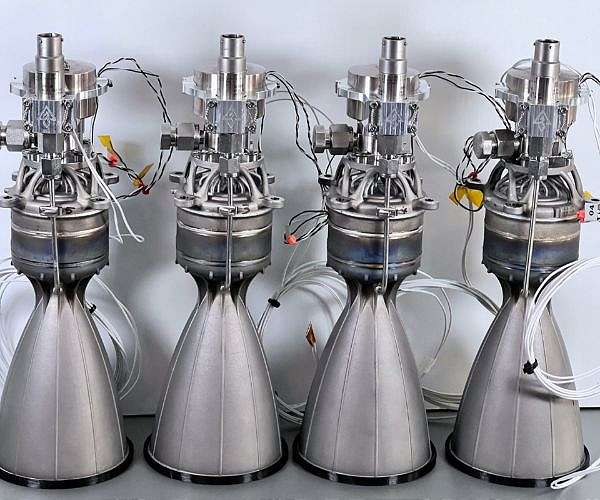
Spanish firm Arkadia Space has developed a new 250 newton monopropellant reaction control thruster, designated ARIEL, for use on reusable European launchers and other space transportation vehicles.
ARIEL, which stands for Attitude for Reusable and Innovative European Launchers, is designed as part of a reaction control system that provides reliable attitude adjustment for space transportation systems.
The thruster uses highly concentrated hydrogen peroxide as its monopropellant, offering an alternative to the hydrazine propellant widely used in existing reaction control systems.
Hydrogen peroxide is less toxic and more sustainable than hydrazine and can be handled with simpler ground infrastructure and procedures, reducing operational complexity and costs.
With a maximum thrust of 250 newtons, ARIEL could lift the equivalent of a 25 kilogram mass under Earth gravity, a performance level sufficient to reorient spacecraft or adjust the trajectory of launch vehicles.
According to ESA, ARIEL is among the first hydrogen peroxide monopropellant thrusters of this size developed in Europe, targeting future European launch and in-space transportation applications.
The European Space Agency supported the development through its Future Launchers Preparatory Programme, which backs technologies judged relevant for upcoming launch and space transportation systems.
Arkadia and ESA signed the initial development contract in June 2023, and the first hot-fire test of the ARIEL thruster took place only seven months later.
Since then ARIEL has completed an extensive test campaign at the Arkadia Space Test Center located at Castellon Airport in Spain, reaching technology readiness level six within two years of contract signature.
The project also covered the design and manufacture of tank prototypes that store the hydrogen peroxide propellant and feed it to the thruster.
These tanks can operate in blowdown mode, in which gaseous hydrogen peroxide in the tank pressurises the remaining liquid and pushes it through the feed system to the engine without the need for separate pressurant gas.
Arkadia constructed an in-house test bench to support the ARIEL qualification programme, able to withstand the 250 newton thrust level and the long-duration burns required for repeated firing cycles.
During testing ARIEL demonstrated a specific impulse exceeding 178 seconds in vacuum conditions, confirming the efficiency of the hydrogen peroxide monopropellant configuration.
The thruster sustained continuous burns of up to five minutes, validating its capability for extended attitude control maneuvers or reaction control duty cycles.
Test sequences also included short pulses down to 40 milliseconds, showing that ARIEL can deliver rapid, precise thrust impulses for fine pointing or fast attitude changes.
Across the qualification campaign each ARIEL unit completed more than 2000 individual pulses, indicating robustness of the catalyst bed, chamber, and valves under repeated thermal and mechanical cycling.
More than 100 kilograms of hydrogen peroxide were fired through each engine during the test programme, providing a substantial data set on performance and degradation behaviour.
ESA propulsion engineer Bernard Decotignie commented on the collaboration, stating: "We are very happy to see the results of this project," and noted that "Arkadia showed a quick turnaround, and the results speak for themselves, it was a great collaboration with our propulsion experts working closely together to achieve a robust, innovative product and in record time."
Arkadia Space cofounder and chief technology officer Ismael Gutierrez highlighted the role of ESA support, saying: "Thanks to the FLPP contract and ESA experts' guidance, we managed to develop a thruster that rapidly got market traction. Following the activity, ARIEL has continued to evolve, demonstrating soon its capability as a product ready to be sold," and added: "we are excited to have won the contract to supply ARIEL as the thruster for the reaction control system of MaiaSpace, and we hope soon to sign more contracts related to reaction control systems for big spacecrafts and space vehicles. The ESA FLPP contract has been instrumental for us".
Related Links
Arkadia Space
Space Tourism, Space Transport and Space Exploration News
| Subscribe Free To Our Daily Newsletters |
| Subscribe Free To Our Daily Newsletters |







