24/7 Space News
TECH SPACE
Engineered interlayers boost satellite insulation and flexible electronics
illustration only

Engineered interlayers boost satellite insulation and flexible electronics

by Robert Schreiber
Berlin, Germany (SPX) Dec 17, 2025

Researchers at Empa are refining the multilayer insulation foils that wrap many satellites and space probes, aiming to improve their mechanical robustness while maintaining thermal protection. These foils, known as multilayer insulation or superinsulation, are built from stacked layers of a strong polymer coated with thin metal, typically aluminum, and are also used on Earth in items such as survival blankets.

On spacecraft, this insulation shields sensitive electronics from large and rapid temperature swings in orbit. For satellites in low Earth orbit, the temperature difference between the sun-facing side and the side in shadow can reach about 200 degrees, and similar swings occur when a satellite passes into and out of Earth's shadow many times per day, even though the electronics operate best near room temperature.

The thin-film system usually relies on polyimide as the base polymer because it withstands high temperatures and vacuum and forms a stable bond with the aluminum coating. According to Empa researcher Barbara Putz, an extremely thin interlayer only a few nanometers thick forms at the interface between polymer and aluminum during coating and plays a key role in adhesion, prompting the team to study and control this interface more closely.

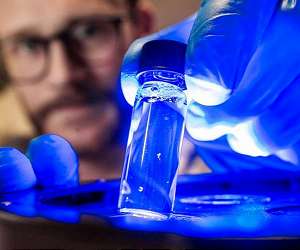
Putz's project, supported by an Ambizione Grant from the Swiss National Science Foundation, aims to use a deliberately engineered interlayer to improve superinsulation for future satellites and enable new flexible electronic systems on Earth. To investigate the effect of this layer, Putz and doctoral student Johanna Byloff chose a simple model: a 50-micrometer polyimide film topped with 150 nanometers of aluminum, separated by a five-nanometer aluminum oxide layer.

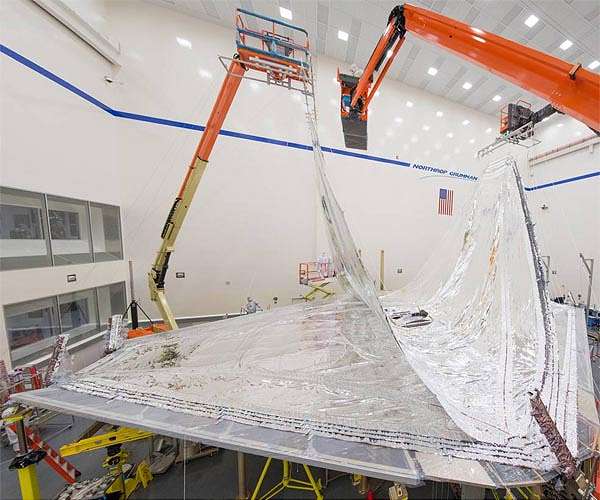
Working with a layer only a few nanometers thick requires precise vacuum processing, so the team uses a coating machine developed by Empa spin-off Swiss Cluster AG that can run multiple coating steps on the same sample without breaking vacuum. The material combination in their experiments matches that used in space hardware such as ESA's Mercury mission BepiColombo and the sunshield of NASA's James Webb Space Telescope.

Byloff notes that in existing space systems the intermediate layer arises naturally, whereas in the Empa approach it is manufactured explicitly, allowing its properties to be tuned. The James Webb sunshield, measuring roughly 21 by 14 meters, highlights the mechanical demands on the composite: the stacked layers had to survive being tightly stowed for launch, deploy at the destination without tearing or delamination, and withstand impacts from particles and space debris without cracks spreading across large areas.

The Empa team subjects the model films to tensile tests, thermal shock loading, and detailed chemical and physical characterization to evaluate performance. Results indicate that the artificial interlayer increases elasticity and improves resistance to cracking and flaking of the metal coating.

Next, the researchers plan to vary the interlayer thickness and transfer the concept to other polymer substrates. Putz points out that naturally formed interlayers appear only on a limited set of polymers and to thicknesses of about five nanometers, whereas the engineered version could enable stable multilayer systems on polymers that previously showed poor coating adhesion.

Beyond satellite insulation, Putz and Byloff see broad potential in flexible electronics, which also rely on metal-coated polymer films and often stack several thin layers of different materials. The controlled use of ultra-thin interlayers could improve mechanical behavior in foldable or rollable devices, smart textiles, and flexible medical sensors by helping multilayer stacks absorb deformation without failure.

Research Report:From Mechanics to Electronics: Influence of ALD Interlayers on the Multiaxial Electro-Mechanical Behavior of Metal - Oxide Bilayers

Related Links
Swiss Federal Laboratories for Materials Science and Technology (Empa)
Space Technology News - Applications and Research

Subscribe Free To Our Daily Newsletters
Tweet

RELATED CONTENT
The following news reports may link to other Space Media Network websites.
TECH SPACE
X-MAT introduces X-FOAM: A game-changing ceramic foam for extreme environments
Orlando, FL (SPX) Dec 01, 2025
X-MAT has announced the release of X-FOAM, a 1,300°C ceramic foam engineered for use in harsh environments demanding high thermal insulation and structural performance. This machinable ceramic foam has a thermal conductivity of only 0.034 W/m·K, on par with some aerogel products; but is stiff and hard, with a compressive strength in the hundreds to thousands of PSI. It is also very light, with a density of only 0.15g/cc, seven times less dense than water. ... read more

TECH SPACE
ISS to change commanders before Soyuz crew leaves orbit

Lodestar Space wins SECP support to advance AI satellite awareness system

Micro nano robots aim to cut carbon buildup in closed life support systems

NASA extends ISS National Lab management contract through 2030

TECH SPACE
Musk signals plan to launch IPO for SpaceX

Southern Launch to host INNOSPACE missions from South Australian spaceports

Rocket Lab completes first dedicated JAXA mission with Electron launch

Neutron Hungry Hippo fairing completes qualification ahead of first launch

TECH SPACE
GoMars model simulates Martian dust storms to improve mission safety

NASA JPL Unveils Rover Operations Center for Moon, Mars Missions

Ancient Martian brines left bromine rich fingerprints in jarosite minerals

Maven stays silent after routine pass behind Mars

TECH SPACE
Experts at Hainan symposium call for stronger global space partnership

Foreign satellites ride Kinetica 1 on new CAS Space mission

Triple Long March launches mark record day for Chinese space program

China prepares Qingzhou cargo ship for low cost resupply flights

TECH SPACE
Smart modeling framework targets 6G spectrum chaos in space air and ground networks

K2 Space raises 250m to scale Mega class high power satellites

Private capital targets mission-critical software power and platforms in new space economy

Beyond Gravity positions new modular satellite platform for European LEO missions

TECH SPACE
Galactic Slots: Space-Themed Games with Out-of-This-World Bonus Features

X-MAT introduces X-FOAM: A game-changing ceramic foam for extreme environments

Bible 1.0: How Ancient Canon Became Our First Large Language Models

Digital twin successfully launched and deployed into space

TECH SPACE
RISTRETTO spectrograph cleared for Proxima b atmospheric hunt

Clues to the migration path of hot Jupiters in their orbits

Can scientists detect life without knowing what it looks like

Ultra hot super Earth shows dense atmosphere over magma ocean

TECH SPACE
Uranus and Neptune may be rock rich worlds

SwRI links Uranus radiation belt mystery to solar storm driven waves

Looking inside icy moons

Saturn moon mission planning shifts to flower constellation theory

Subscribe Free To Our Daily Newsletters


The content herein, unless otherwise known to be public domain, are Copyright 1995-2024 - Space Media Network. All websites are published in Australia and are solely subject to Australian law and governed by Fair Use principals for news reporting and research purposes. AFP, UPI and IANS news wire stories are copyright Agence France-Presse, United Press International and Indo-Asia News Service. ESA news reports are copyright European Space Agency. All NASA sourced material is public domain. Additional copyrights may apply in whole or part to other bona fide parties. All articles labeled "by Staff Writers" include reports supplied to Space Media Network by industry news wires, PR agencies, corporate press officers and the like. Such articles are individually curated and edited by Space Media Network staff on the basis of the report's information value to our industry and professional readership. Advertising does not imply endorsement, agreement or approval of any opinions, statements or information provided by Space Media Network on any Web page published or hosted by Space Media Network. General Data Protection Regulation (GDPR) Statement Our advertisers use various cookies and the like to deliver the best ad banner available at one time. All network advertising suppliers have GDPR policies (Legitimate Interest) that conform with EU regulations for data collection. By using our websites you consent to cookie based advertising. If you do not agree with this then you must stop using the websites from May 25, 2018. Privacy Statement. Additional information can be found here at About Us.