24/7 Space News
EXO WORLDS
Webb maps carbon rich atmosphere on distorted pulsar planet
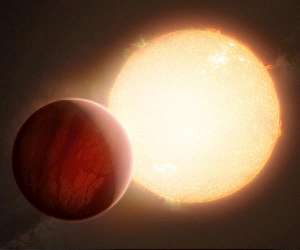
illustration only

Webb maps carbon rich atmosphere on distorted pulsar planet

by Robert Schreiber
Berlin, Germany (SPX) Dec 17, 2025

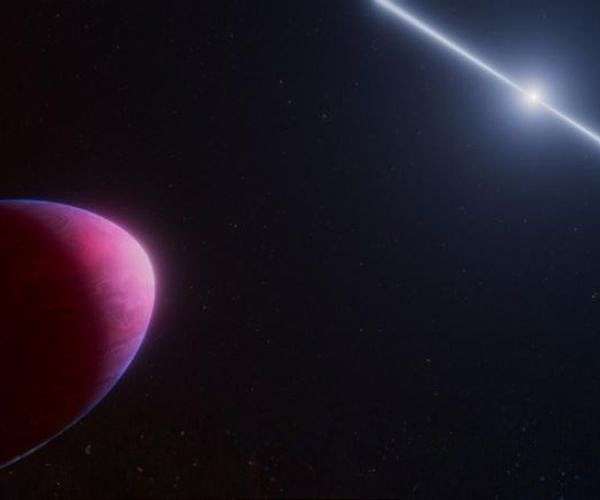
Scientists using NASA's James Webb Space Telescope have identified an exoplanet with an atmosphere unlike any seen before, orbiting a rapidly spinning neutron star known as a pulsar. The object, officially designated PSR J2322-2650b, has a mass comparable to Jupiter but is stretched into a lemon-like shape by the strong gravitational pull of its compact host star. Its atmosphere appears dominated by helium and carbon, with soot-like carbon clouds that models suggest could condense into diamonds deep inside the planet under high pressure.

Lead author Michael Zhang of the University of Chicago described the host as "a star that's completely bizarre - the mass of the Sun, but the size of a city," noting that the team is seeing "a new type of planet atmosphere that nobody has ever seen before." Team member Peter Gao of the Carnegie Earth and Planets Laboratory recalled the moment the Webb data arrived, saying, "I remember after we got the data down, our collective reaction was 'What the heck is this?'" The work has been accepted for publication in The Astrophysical Journal Letters.

PSR J2322-2650b orbits its neutron star at a distance of only about 1 million miles, far closer than Earth's roughly 100 million mile separation from the Sun. Because the pulsar emits mainly gamma rays and other high-energy particles that do not overwhelm Webb's infrared detectors, astronomers can track the planet's spectrum throughout its orbit without the usual glare from a bright star. Graduate student Maya Beleznay of Stanford University, who modeled the planet's shape and orbital geometry, said this configuration provides an unusually "pristine" spectrum, allowing the system to be examined in finer detail than typical exoplanets.

Instead of the common molecules usually detected in exoplanet atmospheres, such as water, methane and carbon dioxide, the Webb data reveal molecular carbon species C3 and C2. At the planet's core, the team suggests that extreme pressures could compress carbon into diamond. Zhang emphasized that the composition poses a major challenge for formation theories, saying, "It's very hard to imagine how you get this extremely carbon-enriched composition. It seems to rule out every known formation mechanism."

The pulsar - planet pair likely belongs to the class of "black widow" systems, where a rapidly rotating neutron star is paired with a small companion that has lost material to the pulsar over time. As mass transferred onto the neutron star, it would have spun up and generated an intense particle wind that then erodes the companion. In classic black widow binaries the companion is a low-mass star, but in this case the International Astronomical Union classifies the object as an exoplanet, underscoring its unusual nature.

Zhang argued that PSR J2322-2650b does not fit standard scenarios for either planets or stripped stellar remnants. "Did this thing form like a normal planet? No, because the composition is entirely different," he said. "Did it form by stripping the outside of a star, like 'normal' black widow systems are formed? Probably not, because nuclear physics does not make pure carbon."

Co-author Roger Romani of Stanford University and the Kavli Institute for Particle Astrophysics and Cosmology suggested a possible process inside the companion that might explain its atmosphere. "As the companion cools down, the mixture of carbon and oxygen in the interior starts to crystallize," he proposed. "Pure carbon crystals float to the top and get mixed into the helium, and that's what we see. But then something has to happen to keep the oxygen and nitrogen away. And that's where there's controversy." He added, "I'm looking forward to learning more about the weirdness of this atmosphere. It's great to have a puzzle to go after."

The discovery relied on Webb's high sensitivity in the infrared and its thermally stable environment about a million miles from Earth, where a large sunshield keeps its instruments extremely cold. Zhang noted that similar measurements are effectively impossible from Earth's surface because thermal emission from the surroundings adds interfering photons to the signal. The team also included University of Chicago scientists Jacob Bean, graduate student Brandon Park Coy, and Rafael Luque, now at the Instituto de Astrofisica de Andalucia in Spain.

Research Report:A Carbon-rich Atmosphere on a Windy Pulsar Planet

Related Links
University of Chicago
Lands Beyond Beyond - extra solar planets - news and science
Life Beyond Earth

Subscribe Free To Our Daily Newsletters
Tweet

RELATED CONTENT
The following news reports may link to other Space Media Network websites.
EXO WORLDS
Hidden circumbinary giant planet emerges from decade old Gemini data
Berlin, Germany (SPX) Dec 14, 2025
Astronomers have directly imaged a giant exoplanet orbiting a pair of stars, in a configuration reminiscent of the fictional Tatooine system but with the closest-known directly imaged planet to its twin suns in a binary system. The planet orbits a spectroscopic binary in the Scorpius-Centaurus association and was found buried in data taken nearly a decade ago with the Gemini Planet Imager (GPI) on the Gemini South telescope in Chile. The newly confirmed world, designated HD 143811 AB b, is about s ... read more

EXO WORLDS
ISS to change commanders before Soyuz crew leaves orbit

Lodestar Space wins SECP support to advance AI satellite awareness system

Micro nano robots aim to cut carbon buildup in closed life support systems

NASA extends ISS National Lab management contract through 2030

EXO WORLDS
Musk signals plan to launch IPO for SpaceX

Southern Launch to host INNOSPACE missions from South Australian spaceports

Rocket Lab completes first dedicated JAXA mission with Electron launch

Neutron Hungry Hippo fairing completes qualification ahead of first launch

EXO WORLDS
GoMars model simulates Martian dust storms to improve mission safety

NASA JPL Unveils Rover Operations Center for Moon, Mars Missions

Ancient Martian brines left bromine rich fingerprints in jarosite minerals

Maven stays silent after routine pass behind Mars

EXO WORLDS
Experts at Hainan symposium call for stronger global space partnership

Foreign satellites ride Kinetica 1 on new CAS Space mission

Triple Long March launches mark record day for Chinese space program

China prepares Qingzhou cargo ship for low cost resupply flights

EXO WORLDS
Smart modeling framework targets 6G spectrum chaos in space air and ground networks

K2 Space raises 250m to scale Mega class high power satellites

Private capital targets mission-critical software power and platforms in new space economy

Beyond Gravity positions new modular satellite platform for European LEO missions

EXO WORLDS
Galactic Slots: Space-Themed Games with Out-of-This-World Bonus Features

X-MAT introduces X-FOAM: A game-changing ceramic foam for extreme environments

Bible 1.0: How Ancient Canon Became Our First Large Language Models

Digital twin successfully launched and deployed into space

EXO WORLDS
RISTRETTO spectrograph cleared for Proxima b atmospheric hunt

Clues to the migration path of hot Jupiters in their orbits

Can scientists detect life without knowing what it looks like

Ultra hot super Earth shows dense atmosphere over magma ocean

EXO WORLDS
Uranus and Neptune may be rock rich worlds

SwRI links Uranus radiation belt mystery to solar storm driven waves

Looking inside icy moons

Saturn moon mission planning shifts to flower constellation theory

Subscribe Free To Our Daily Newsletters


The content herein, unless otherwise known to be public domain, are Copyright 1995-2024 - Space Media Network. All websites are published in Australia and are solely subject to Australian law and governed by Fair Use principals for news reporting and research purposes. AFP, UPI and IANS news wire stories are copyright Agence France-Presse, United Press International and Indo-Asia News Service. ESA news reports are copyright European Space Agency. All NASA sourced material is public domain. Additional copyrights may apply in whole or part to other bona fide parties. All articles labeled "by Staff Writers" include reports supplied to Space Media Network by industry news wires, PR agencies, corporate press officers and the like. Such articles are individually curated and edited by Space Media Network staff on the basis of the report's information value to our industry and professional readership. Advertising does not imply endorsement, agreement or approval of any opinions, statements or information provided by Space Media Network on any Web page published or hosted by Space Media Network. General Data Protection Regulation (GDPR) Statement Our advertisers use various cookies and the like to deliver the best ad banner available at one time. All network advertising suppliers have GDPR policies (Legitimate Interest) that conform with EU regulations for data collection. By using our websites you consent to cookie based advertising. If you do not agree with this then you must stop using the websites from May 25, 2018. Privacy Statement. Additional information can be found here at About Us.