24/7 Space News
EXO WORLDS
Clues to the migration path of hot Jupiters in their orbits
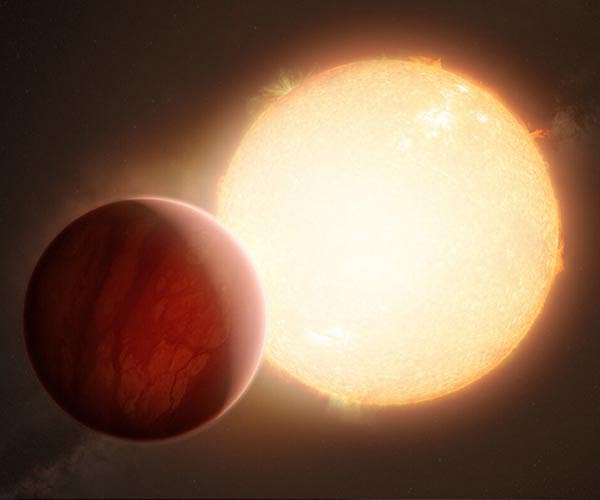
illustration only

Clues to the migration path of hot Jupiters in their orbits

by Riko Seibo
Tokyo, Japan (SPX) Dec 16, 2025

The first exoplanet discovered in 1995 was a hot Jupiter, a Jupiter mass planet orbiting its star every few days. Today, models indicate that hot Jupiters form far from their stars, similar to Jupiter in the Solar System, and later move inward. Two main migration channels are considered: high-eccentricity migration, in which gravitational perturbations excite the orbit before tidal forces circularize it close to the star, and disk migration, in which the planet drifts inward through the protoplanetary disk.

Observationally, separating these mechanisms has been difficult. In the high-eccentricity case, gravitational interactions can tilt the planet's orbit relative to the star's rotation axis, producing a measurable spin - orbit misalignment. Tidal forces, however, can realign the orbit and stellar spin over time, so aligned systems are not automatically evidence of disk migration. This degeneracy has limited attempts to identify planets that reached close-in orbits through disk-driven migration.

A team led by PhD student Yugo Kawai and Assistant Professor Akihiko Fukui at the Graduate School of Arts and Sciences, the University of Tokyo, proposed a new way to distinguish migration histories by exploiting the timescale of high-eccentricity migration itself. In the high-eccentricity scenario, a planet first occupies a highly elongated orbit before repeated close passages near the star allow tides to remove orbital energy and angular momentum, gradually circularizing the orbit. The circularization timescale depends on factors such as planetary mass, orbital period, stellar properties, and the efficiency of tidal dissipation.

If a hot Jupiter formed through high-eccentricity migration, its eccentricity must damp within a time shorter than the age of the planetary system. The researchers calculated tidal circularization timescales for more than 500 known hot Jupiters and compared these values with estimated system ages. They then searched for planets whose observed circular orbits could not be reconciled with the time available for tidal circularization under the high-eccentricity scenario.

This analysis identified about 30 hot Jupiters whose orbits are already circular even though their computed circularization times exceed the inferred ages of their host systems. For these planets, high-eccentricity migration would not have had enough time to erase orbital eccentricity, making that pathway unlikely. Their present-day architectures instead point to an origin via disk migration, in which the eccentricity remains low as the planet migrates inward through the gas disk.

The same subset of planets exhibits additional properties expected for disk migration. None of these hot Jupiters shows a significant spin - orbit misalignment, consistent with migration in a disk that remains roughly aligned with the stellar equator and does not strongly disturb the orbital plane. In several systems, the hot Jupiter orbits alongside nearby planetary companions, a configuration that high-eccentricity migration would tend to disrupt by scattering or ejecting other planets.

The team concludes that these hot Jupiters preserve a clearer dynamical record of their migration paths. By isolating planets whose orbits still reflect their original migration processes, astronomers can better connect current orbital architectures to earlier phases of planetary system formation and evolution. Future work that measures atmospheric composition and elemental abundance ratios in these planets may reveal where in the protoplanetary disk they formed, placing tighter constraints on the origin and migration mechanisms of hot Jupiters.

Research Report:Identifying Close-in Jupiters that Arrived via Disk Migration: Evidence of Primordial Alignment, Preference of Nearby Companions and Hint of Runaway Migration

Related Links
Graduate School of Arts and Sciences, College of Arts and Sciences, The University of Tokyo
Lands Beyond Beyond - extra solar planets - news and science
Life Beyond Earth

Subscribe Free To Our Daily Newsletters
Tweet

RELATED CONTENT
The following news reports may link to other Space Media Network websites.
EXO WORLDS
Hidden circumbinary giant planet emerges from decade old Gemini data
Berlin, Germany (SPX) Dec 14, 2025
Astronomers have directly imaged a giant exoplanet orbiting a pair of stars, in a configuration reminiscent of the fictional Tatooine system but with the closest-known directly imaged planet to its twin suns in a binary system. The planet orbits a spectroscopic binary in the Scorpius-Centaurus association and was found buried in data taken nearly a decade ago with the Gemini Planet Imager (GPI) on the Gemini South telescope in Chile. The newly confirmed world, designated HD 143811 AB b, is about s ... read more

EXO WORLDS
ISS to change commanders before Soyuz crew leaves orbit

Lodestar Space wins SECP support to advance AI satellite awareness system

Micro nano robots aim to cut carbon buildup in closed life support systems

NASA extends ISS National Lab management contract through 2030

EXO WORLDS
Musk signals plan to launch IPO for SpaceX

China launches carrier rocket to deploy experimental cargo ship and satellite

LandSpace reviews booster loss after Zhuque-3 reusable rocket test

UK plasma thruster test positions Pulsar Fusion for larger satellite propulsion

EXO WORLDS
Martian sound study models acoustic signals in Jezero crater

NASA JPL Unveils Rover Operations Center for Moon, Mars Missions

Ancient Martian brines left bromine rich fingerprints in jarosite minerals

Maven stays silent after routine pass behind Mars

EXO WORLDS
Experts at Hainan symposium call for stronger global space partnership

Foreign satellites ride Kinetica 1 on new CAS Space mission

Triple Long March launches mark record day for Chinese space program

China prepares Qingzhou cargo ship for low cost resupply flights

EXO WORLDS
Beyond Gravity positions new modular satellite platform for European LEO missions

K2 Space raises 250m to scale Mega class high power satellites

Private capital targets mission-critical software power and platforms in new space economy

Applied Aerospace and PCX create US flight and space hardware group

EXO WORLDS
Bible 1.0: How Ancient Canon Became Our First Large Language Models

Galactic Slots: Space-Themed Games with Out-of-This-World Bonus Features

ONE Bow River backs Odyssey Space Research growth in flight software and mission engineering

D-Orbit launches dual orbital transportation missions, passes 200-payload milestone

EXO WORLDS
RISTRETTO spectrograph cleared for Proxima b atmospheric hunt

Ultra hot super Earth shows dense atmosphere over magma ocean

Hidden circumbinary giant planet emerges from decade old Gemini data

NASA backs WHOI effort to read organic signals from ocean worlds

EXO WORLDS
Uranus and Neptune may be rock rich worlds

SwRI links Uranus radiation belt mystery to solar storm driven waves

Looking inside icy moons

Saturn moon mission planning shifts to flower constellation theory

Subscribe Free To Our Daily Newsletters


The content herein, unless otherwise known to be public domain, are Copyright 1995-2024 - Space Media Network. All websites are published in Australia and are solely subject to Australian law and governed by Fair Use principals for news reporting and research purposes. AFP, UPI and IANS news wire stories are copyright Agence France-Presse, United Press International and Indo-Asia News Service. ESA news reports are copyright European Space Agency. All NASA sourced material is public domain. Additional copyrights may apply in whole or part to other bona fide parties. All articles labeled "by Staff Writers" include reports supplied to Space Media Network by industry news wires, PR agencies, corporate press officers and the like. Such articles are individually curated and edited by Space Media Network staff on the basis of the report's information value to our industry and professional readership. Advertising does not imply endorsement, agreement or approval of any opinions, statements or information provided by Space Media Network on any Web page published or hosted by Space Media Network. General Data Protection Regulation (GDPR) Statement Our advertisers use various cookies and the like to deliver the best ad banner available at one time. All network advertising suppliers have GDPR policies (Legitimate Interest) that conform with EU regulations for data collection. By using our websites you consent to cookie based advertising. If you do not agree with this then you must stop using the websites from May 25, 2018. Privacy Statement. Additional information can be found here at About Us.