24/7 Space News
VENUSIAN HEAT
Venus radar study reveals vast underground lava cave
illustration only

Venus radar study reveals vast underground lava cave

by Robert Schreiber
Berlin, Germany (SPX) Feb 10, 2026

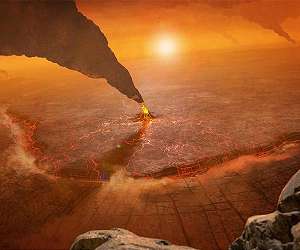
Volcanic activity is a key force shaping the surfaces of rocky planets, and new work from Italy indicates that Venus hosts a giant empty lava tube beneath its surface. Using radar images from NASA's Magellan mission, a team at the University of Trento has identified a skylight feature in the Nyx Mons region that reveals a large underground cavity interpreted as a lava conduit.

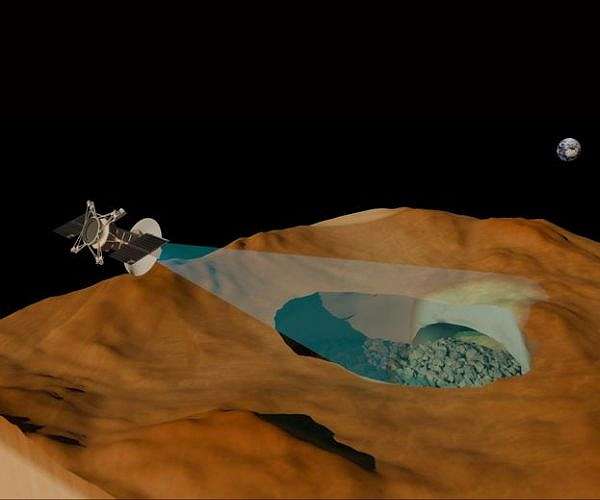
The study, published in Nature Communications, relies on Synthetic Aperture Radar data collected between 1990 and 1992 by the Magellan spacecraft. Because Venus is shrouded in thick clouds that block optical views, radar imaging is essential for investigating its geology and any processes occurring below the surface. The research focuses on localized surface collapses that may indicate the presence of subsurface voids.

Lava tubes generally form when flowing lava develops a solid insulating crust while molten rock continues to move inside the channel. Once the lava drains away, an empty tunnel can remain, with occasional roof collapses opening skylights that are visible at the surface. Similar features have already been found or proposed on the Moon and Mars, but demonstrating their existence on Venus has been more difficult.

Lead author Lorenzo Bruzzone, a full professor of Telecommunications and head of the Remote Sensing Laboratory at the University of Trento, coordinated the analysis. The team developed and applied an imaging technique designed to detect and characterize underground conduits near skylights in radar data. By examining Magellan images of Nyx Mons, they found clear signatures of a large subsurface cavity associated with a surface pit.

According to the study, the inferred conduit has an estimated diameter of roughly one kilometer, a roof at least 150 meters thick and an empty void extending to depths of no less than 375 meters. These dimensions place the Venus lava tube at the upper end of what scientists have suggested or observed for similar structures on the Moon and above typical sizes expected on Earth or Mars. The researchers note that this is consistent with Venus also having lava channels that are larger and longer than those on other planets.

Bruzzone points out that the identification of a volcanic cavity on Venus is important because it validates long-standing theories that such features should exist under the planet's surface. He explains that our understanding of Venus remains limited and that until now there has been no direct observational evidence of subsurface lava tubes on Earth's so-called twin. The discovery, he argues, deepens knowledge of how volcanic and internal processes have influenced Venusian evolution.

The physical and atmospheric conditions on Venus appear to favor the formation of extensive lava tubes. Compared with Earth, Venus has lower surface gravity and a much denser atmosphere, factors that can enable rapid development of a thick insulating crust as lava flows away from a vent. This environment may promote the creation of large and stable underground channels capable of spanning great distances.

The available Magellan data allow the team to confirm and measure only the section of the cavity near the identified skylight. However, by analyzing the morphology and elevation of the surrounding terrain, and by noting the presence of other pits similar to the main feature, the researchers suggest that the subsurface conduits in the Nyx Mons region could extend for at least 45 kilometers. If true, the system would rank among the most extensive known lava tube networks in the Solar System.

To verify this hypothesis and search for additional lava tubes on Venus, scientists will need new observations at higher spatial resolution and with improved subsurface sensing capabilities. The study highlights how upcoming missions such as the European Space Agency's Envision and NASA's Veritas will be crucial. Both spacecraft are planned to carry advanced radar instruments that can capture sharper images of the surface and detect small pits that might mark further skylights.

Envision will also host an orbital ground-penetrating radar, the Subsurface Radar Sounder, designed to probe several hundred meters below the Venusian surface. This instrument could reveal underground conduits even where no skylight or collapse pit is visible from above. The University of Trento team argues that their newly reported lava tube is likely only the beginning of a broader effort to map and understand Venus's hidden volcanic architecture.

Research Report:Radar-Based Observation of a Lava Tube on Venus

Related Links
Universita di Trento
Venus Express News and Venusian Science

Subscribe Free To Our Daily Newsletters
Tweet

RELATED CONTENT
The following news reports may link to other Space Media Network websites.
VENUSIAN HEAT
Venus' Cloud Aerosols Contain Reservoirs of Water and Iron
Pomona CA (SPX) Sep 30, 2025
A new analysis of the aerosols in Venus' clouds, from data originally collected in 1978 during the Pioneer Venus mission, has found evidence for substantial water and iron. The study, Re-analysis of Pioneer Venus data: Water, iron sulfate, and sulfuric acid are major components in Venus' aerosols, was led by Rakesh Mogul, a professor in the Chemistry and Biochemistry Department at California State Polytechnic University, Pomona and published online this week in the Journal of Geophysical Research: Plane ... read more

VENUSIAN HEAT
The coming end of ISS, symbol of an era of global cooperation

NASA confirms first flight to ISS since medical evacuation

Crew 12 set for Dragon launch to Station in February

Bezos's Blue Origin to 'pause' space tourism to focus on Moon efforts

VENUSIAN HEAT
Isar Aerospace expands engine and stage testing at Esrange

NASA Moon mission launch srubbed to March after test

NASA books fifth Axiom private astronaut flight to space station

Musk merges xAI into SpaceX in bid to build space data centers

VENUSIAN HEAT
Martian toxin found to toughen microbe built bricks

Curiosity Blog, Sols 4788-4797: Welcome Back from Conjunction

NASA Study: Non-biologic Processes Don't Fully Explain Mars Organics

Perseverance rover completes landmark AI guided trek across Jezero rim

VENUSIAN HEAT
Dragon spacecraft gears up for crew 12 arrival and station science work

China prepares offshore test base for reusable liquid rocket launches

Retired EVA workhorse to guide China's next-gen spacesuit and lunar gear

Tiangong science program delivers data surge

VENUSIAN HEAT
BlackSky expands Gen 3 Assured deals with new defense customer

ESA member states back SWISSto12 HummingSat with fresh funding round

Muon Space ramps up multi-mission satellite constellations

Aerospacelab expands Pulsar navigation constellation work with new Xona satellite order

VENUSIAN HEAT
Launching the idea of data centers in space

Gilat books multimillion order for Sidewinder inflight ESA terminals

NTU Singapore boosts agile space access with trio of new projects

Musk merges xAI into SpaceX in bid to build space data centers

VENUSIAN HEAT
Survey of 80 near Earth asteroids sharpens view of their origins and risks

Lab made cosmic dust experiment reveals paths to life chemistry

Einstein effect clears planets from tight double star systems

Engineered microbes use light to build new molecules

VENUSIAN HEAT
Jupiter size refined by new radio mapping

Polar weather on Jupiter and Saturn hints at the planets' interior details

Europa ice delamination may deliver nutrients to hidden ocean

Birth conditions fixed water contrast on Jupiters moons

Subscribe Free To Our Daily Newsletters


The content herein, unless otherwise known to be public domain, are Copyright 1995-2024 - Space Media Network. All websites are published in Australia and are solely subject to Australian law and governed by Fair Use principals for news reporting and research purposes. AFP, UPI and IANS news wire stories are copyright Agence France-Presse, United Press International and Indo-Asia News Service. ESA news reports are copyright European Space Agency. All NASA sourced material is public domain. Additional copyrights may apply in whole or part to other bona fide parties. All articles labeled "by Staff Writers" include reports supplied to Space Media Network by industry news wires, PR agencies, corporate press officers and the like. Such articles are individually curated and edited by Space Media Network staff on the basis of the report's information value to our industry and professional readership. Advertising does not imply endorsement, agreement or approval of any opinions, statements or information provided by Space Media Network on any Web page published or hosted by Space Media Network. General Data Protection Regulation (GDPR) Statement Our advertisers use various cookies and the like to deliver the best ad banner available at one time. All network advertising suppliers have GDPR policies (Legitimate Interest) that conform with EU regulations for data collection. By using our websites you consent to cookie based advertising. If you do not agree with this then you must stop using the websites from May 25, 2018. Privacy Statement. Additional information can be found here at About Us.