





For two years, NASA has framed Artemis as a "sustainable return" to the Moon, not a flag-planting sprint. Chinese officials describe their 2030 crewed landing goal as methodical national development, not a reaction to anyone else's timetable. Both descriptions are technically accurate, but both carefully avoid the obvious: space programs are not judged in spreadsheet columns; they are judged in headlines, live television and the stories nations tell about themselves.
On those terms, the race is on, and the finish line is no longer just about who plants the next set of bootprints in the lunar regolith. It is about who defines the narrative of the first permanent phase of cislunar space.
Artemis II is, on paper, a conservative mission. It will follow a free-return trajectory, taking commander Reid Wiseman, pilot Victor Glover, mission specialist Christina Koch and Canadian astronaut Jeremy Hansen on a ten-day flight around the far side of the Moon before bringing them home in Orion's small capsule. There is no descent stage, no surface operations and no new flag to be raised.
Yet that modest profile understates its political and psychological weight. When it flies, currently targeting no earlier than March 6, 2026, it will be the first crewed deep-space mission since Apollo 17 in 1972. An entire generation that has only known human spaceflight as an exercise in low Earth orbit will see astronauts once again disappear behind the Moon.
In this perception war, that alone is transformative. Artemis II will demonstrate that the United States can still operate human spacecraft at lunar distances, orchestrate communications, navigation and life-support systems for cislunar operations and sustain the spectacle of a high-stakes crewed mission watched in real time around the world. For most publics and politicians, the simple takeaway will be that America is back at the Moon.
China, by contrast, will still be in the prototype phase. Its Long March 10 heavy lifter has yet to fly, the Mengzhou crew vehicle and Lanyue lunar lander remain in ground testing and the infrastructure for a two-launch rendezvous in lunar orbit is still under construction. Beijing's target of a crewed landing "by 2030" reflects real confidence, but offers little room to accelerate even under political pressure.
If Artemis II succeeds in 2026 and Artemis III manages a landing in 2028 or 2029, China will be forced to tell a different story: not about being first, but about being more methodical, more independent or more "of the 21st century." In perception terms, that is defensive positioning and concedes much of the emotional terrain.
This approach avoids the need for in-space cryogenic propellant transfer, large orbital depots or the parallel development of multiple novel systems. It spreads the engineering challenge across stages where China already has experience: medium-to-heavy launchers, rendezvous and docking, and robotic landers honed through Chang'e missions. It also locks the program into a sequence where almost nothing can be rushed without compounding risk.
The result is a lunar program that looks robust on the drawing board but vulnerable in the narrative arena. While Artemis II loops around the Moon and returns live video to a global audience, China will have to point to construction sites, test stands and robotic successes as evidence that its turn is coming. Historically, however, the first visible human mission often defines the emotional shape of a race long before the most technically ambitious mission flies, and Artemis II is poised to play that role again.
Into this evolving landscape steps Elon Musk with a pivot that would have been unthinkable a decade ago. In early February, the SpaceX founder declared that the company has "already shifted focus to building a self-growing city on the Moon," arguing that such a settlement is achievable in less than ten years, while a comparable outpost on Mars would take twenty or more.
The logic Musk presents is blunt and operational. Launch windows to Mars open only when planetary alignments cooperate, roughly every 26 months, constraining how quickly hardware can be tested, iterated and deployed. Launches to the Moon, by contrast, are possible roughly "every 10 days," allowing Starship and any future lunar infrastructure to evolve at a pace far closer to a terrestrial tech sector cadence.
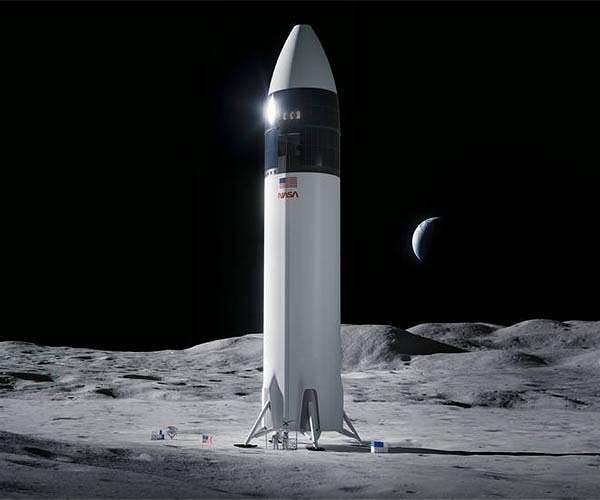
This rhetorical pivot also tightens SpaceX's alignment with Washington's political priorities. In late 2025, President Donald Trump signed an executive order on ensuring American space superiority that formally affirms the goal to land Americans on the Moon by 2028 under NASA's Artemis umbrella and to begin establishing a permanent outpost by 2030. SpaceX is already on contract to provide the human landing system that will ferry Artemis astronauts from lunar orbit to the surface.
By recentering his public narrative on the Moon, Musk does more than follow the flow of federal dollars. He reframes SpaceX's grand storyline from a starkly independent Mars crusade into a public-private partnership: a commercially minded company building the logistics backbone of a U.S.-led cislunar economy. That is precisely the kind of story equity markets understand and can price.
An eventual SpaceX initial public offering has been rumored for years, often with the Starlink broadband constellation floated as the first spin-off candidate. Folding a "self-growing" Moon city into the long-term roadmap serves a dual purpose. It positions Starship and its derivatives as indispensable to a U.S. national project and gives future investors a vision of open-ended demand anchored not just in consumer broadband or ISS crew rotations, but in national-security-driven lunar infrastructure.
In a political environment where Artemis budgets are increasingly sold on Capitol Hill as defense spending by another name as a way to match or overmatch China's presence in cislunar space that linkage between national security and commercial growth could be worth tens of billions of dollars in implied valuation. Musk's eye is firmly on the Moon, but he also has one eye on the balance sheet that will underpin any future SpaceX IPO.
As a thought experiment, space data centers fit the moment. Compute demand is soaring, terrestrial data centers are running up against power and cooling bottlenecks and space hardware is getting cheaper and more capable. It is easy to imagine investors and architects drawing straight lines from reusable heavy lifters to orbital data farms fed by megawatts of beamed solar power.
But the economics look very different from those driving Artemis or China's national lunar programs. Lunar exploration and development, at least for the next two decades, are not expected to make commercial sense in narrow terms. They proceed because they are underwritten by governments willing to pay for national prestige, alliance-building, industrial policy and security benefits that never appear directly on corporate balance sheets.
Space data centers, by contrast, would live or die on private capital and market pricing. They would require enormous upfront investments in heavy-lift launches, on-orbit assembly and high-reliability server hardware. They would also demand parallel investment in solar power satellites and power-beaming infrastructure if they are to rely on dedicated space solar power rather than nuclear or other high-risk alternatives.
Crucially, any revenue model for space data centers would be constrained by competition with Earth-based facilities. Terrestrial data centers benefit from plummeting renewable energy prices, aggressive efficiency gains and far lower technical and regulatory risks. Even if launch costs fall dramatically, space-based facilities would need to charge a premium to cover capital and risk, only to find that many of their most logical customers are under relentless pressure to reduce, not raise, the cost per unit of compute.
In the context of this new Moon race, space data centers are best treated as an intriguing forward concept rather than a near-term driver. They illustrate how far the imagination is already leaping ahead of the balance sheet and underscore why lunar exploration today is being pulled primarily by governments rather than by profit-seeking markets. The heavy funding will flow first into missions with explicit national-security and prestige rationales; speculative commercial megaprojects must wait for costs to fall and regulatory regimes to catch up.
For Beijing, the Moon sits inside a broader strategy that includes the Tiangong space station, a growing launch industry and a deliberate push to offer space partnerships to states outside the traditional U.S. alliance system. A Chinese crewed landing by 2030 would symbolize not just technical maturity but the emergence of a rival center of gravity in space governance and cislunar operations.
Either way, the money will flow not because helium-3 or lunar ice suddenly become profitable exports, but because both capitals see the Moon and cislunar space as the next strategic high ground. Artemis II's countdown may hinge on weather and valve tests, but its budgets hinge on committee hearings where the word "China" is never far from the microphone and where lunar infrastructure is increasingly justified in the language of national security.
In that environment, companies like SpaceX sit at a unique junction. As NASA contractors, they deliver exploration milestones. As national-security assets in all but name, they build the lift, logistics and on-orbit infrastructure that can be repurposed in a crisis. As future public companies, they offer investors leveraged exposure to a state-funded race that neither side can easily back away from, especially once early human missions succeed and public attention locks in.
Project the current timelines forward and the sequence is messy rather than neat. Artemis II flies a crewed lunar flyby around 2026. Artemis III attempts a landing later in the decade, likely closer to 2028 or 2029 than the most optimistic early targets. China aims for a first crewed landing around 2030 with its two-launch architecture and domestic industrial base.
In that world, the question of who "won" becomes almost meaningless. The United States will claim victory for returning humans to the lunar vicinity first and for building an international coalition around Artemis. China will claim victory for fielding an independent landing capability and for demonstrating that it can match U.S. feats within a few years. Investors will care less about symbolic precedence than about which companies end up with the recurring contracts to haul people, fuel and hardware into cislunar space and beyond.
Yet perception still matters. The first images from Artemis II, the first dust clouds kicked up by a new American footprint, the first Chinese flag unfurled on the surface each will shape how publics and politicians understand the race, which in turn will shape budgets and policies for decades. That is why the stakes feel so high as Artemis II inches toward the pad and as Musk publicly retunes SpaceX from a Mars-first crusade to a Moon-focused builder.
A race is underway, whether the main actors admit it or not. It is being run simultaneously in launch manifests, in committee rooms, on social media and, eventually, on the dusty plains of the lunar south pole. There may never be a single decisive moment when one side "wins" and the other yields. Instead, there will be a series of inflection points Artemis II among them that tilt the narrative one way or another. In that kind of race, perception, funding and strategy are intertwined, and the players who understand that NASA's planners, China's program managers and Elon Musk with one eye on cislunar space and the other on a future SpaceX IPO are already running hard.
Related Links
Artemis at NASA
SpaceX
Mars News and Information at MarsDaily.com
Lunar Dreams and more
| Subscribe Free To Our Daily Newsletters |
| Subscribe Free To Our Daily Newsletters |








