





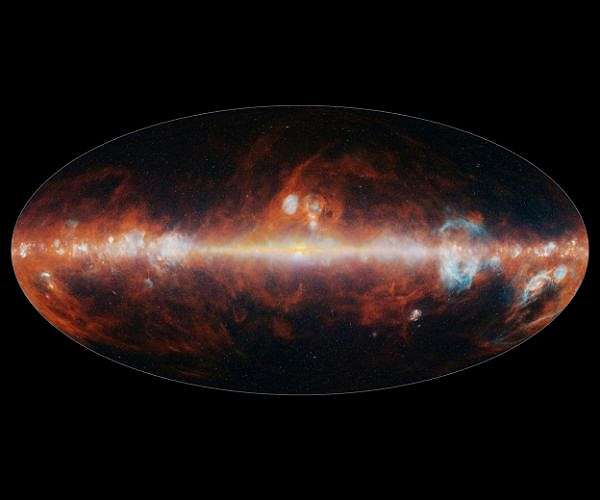
SPHEREx, which stands for Spectro-Photometer for the History of the Universe, Epoch of Reionization, and Ices Explorer, surveys the sky from Earth orbit about 14.5 times per day, taking approximately 3,600 images daily along a circular strip as it flies from pole to pole. As Earth moves around the Sun, the telescope's field of view gradually shifts, and over six months SPHEREx observes every direction in space to assemble a full-sky mosaic spanning 360 degrees.
The mission, managed by NASA's Jet Propulsion Laboratory in Southern California, began mapping the sky in May and completed its first all-sky map in December. Over its two-year primary mission, SPHEREx will produce three additional full-sky surveys, and combining these maps will increase the sensitivity of its measurements for faint sources. The full dataset is being made available to the research community and the public through NASA and the IPAC data center at Caltech.
Each of the 102 colors in SPHEREx's maps corresponds to a specific infrared wavelength, providing detailed information about galaxies, stars, dense dust clouds, and planet-forming regions. Some star- and planet-forming regions in the Milky Way emit strongly at particular infrared wavelengths but are dark at others, so spectroscopy across many bands allows astronomers to separate overlapping components such as stellar light, hot hydrogen gas, and interstellar dust. A panoramic view from the first map shows how the sky appears to SPHEREx, transitioning between emissions from hot hydrogen gas and cosmic dust and those dominated by starlight.
NASA officials emphasize the scientific value of the dataset, especially when combined with other missions. "It's incredible how much information SPHEREx has collected in just six months - information that will be especially valuable when used alongside our other missions' data to better understand our universe," said Shawn Domagal-Goldman, director of the Astrophysics Division at NASA Headquarters in Washington. "We essentially have 102 new maps of the entire sky, each one in a different wavelength and containing unique information about the objects it sees. I think every astronomer is going to find something of value here, as NASA's missions enable the world to answer fundamental questions about how the universe got its start, and how it changed to eventually create a home for us in it."
The mission team describes SPHEREx as a mid-sized observatory designed to address fundamental astrophysical questions. "SPHEREx is a mid-sized astrophysics mission delivering big science," said JPL Director Dave Gallagher. "It's a phenomenal example of how we turn bold ideas into reality, and in doing so, unlock enormous potential for discovery."
SPHEREx's core capability is its combination of many-color spectroscopy with an all-sky field of view. Earlier missions such as NASA's Wide-field Infrared Survey Explorer also mapped the full sky in infrared, but not in nearly as many wavelengths, while the James Webb Space Telescope can observe at many more wavelengths with a much smaller field of view. This contrast makes SPHEREx well suited to provide broad statistical surveys that complement Webb's targeted, high-resolution studies.
Beth Fabinsky, SPHEREx project manager at JPL, compared the observatory's spectral coverage and survey strategy to an extended color vision system. "The superpower of SPHEREx is that it captures the whole sky in 102 colors about every six months. That's an amazing amount of information to gather in a short amount of time," she said. "I think this makes us the mantis shrimp of telescopes, because we have an amazing multicolor visual detection system and we can also see a very wide swath of our surroundings."
To achieve this coverage, SPHEREx uses six detectors, each matched with a specially engineered filter containing a gradient of 17 colors, so every exposure records data in 102 wavelengths at once. Each all-sky product from the mission can therefore be treated as 102 separate maps, each isolating different physical components such as stars, gas, or dust depending on the wavelength.
One of SPHEREx's principal goals is to measure distances to hundreds of millions of galaxies, turning existing two-dimensional maps of galaxy positions into a three-dimensional view of large-scale structure. By quantifying subtle variations in the clustering and distribution of galaxies, scientists aim to test theories about the early universe, including an event known as inflation.
Inflation refers to an episode in the first billionth of a trillionth of a trillionth of a second after the big bang, when the universe is thought to have expanded by a factor of about a trillion-trillion. No similar process has occurred since, and the way galaxies cluster in three dimensions preserves information about this initial expansion. SPHEREx's large sample of galaxies and its multiwavelength coverage are designed to provide new constraints on how inflation unfolded and how it seeded the structures seen today.
Within the Milky Way, SPHEREx data will help map the distribution of ices and other key ingredients relevant to planet formation and the potential for life. The mission's infrared sensitivity to cold dust and gas will allow astronomers to trace where water and other compounds reside in dense clouds that eventually form stars and planetary systems.
SPHEREx is managed by JPL for NASA's Astrophysics Division within the Science Mission Directorate in Washington, with the telescope and spacecraft bus built by BAE Systems. A science team drawn from 10 institutions across the United States, South Korea, and Taiwan is analyzing the data, while IPAC at Caltech in Pasadena processes and archives the observations. The mission's principal investigator is based at Caltech with a joint appointment at JPL, and the resulting datasets are publicly accessible for community use.
Related Links
SPHEREx at NASA
Understanding Time and Space
| Subscribe Free To Our Daily Newsletters |

| Subscribe Free To Our Daily Newsletters |








