





The expansion rate of the universe, known as the Hubble constant, describes how quickly galaxies recede as a function of distance, with local measurements indicating that objects about one megaparsec, or 3.3 million light years, away move away at roughly 73 kilometers per second. Traditional approaches rely on distance ladders built from Type Ia supernovae and Cepheid variable stars, whose properties are used to infer distances in other galaxies, but residual doubts about systematic errors have motivated independent methods that do not depend on these calibrators.
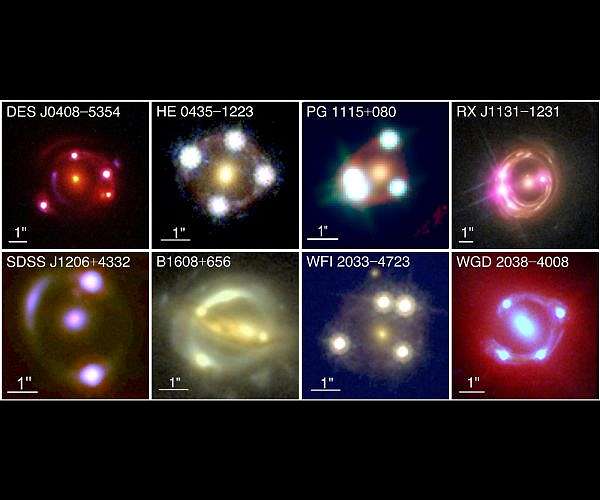
In a new study, a team including Project Assistant Professor Kenneth Wong and postdoctoral researcher Eric Paic at the University of Tokyo's Research Center for the Early Universe report results from time-delay cosmography applied to eight strong gravitational lens systems, each featuring a massive foreground galaxy bending light from a background quasar. "To measure the Hubble constant using time-delay cosmography, you need a really massive galaxy that can act as a lens," said Wong.
"The gravity of this 'lens' deflects light from objects hiding behind it around itself, so we see a distorted version of them. This is called gravitational lensing. If the circumstances are right, we'll actually see multiple distorted images, and each will have taken a slightly different pathway to get to us, taking different amounts of time. By looking for identical changes in these images that are slightly out of step, we can measure the difference in time they took to reach us.
Coupling this data with estimates on the distribution of the mass of the galactic lens that's distorting them is what allows us to calculate the acceleration of distant objects more accurately. The Hubble constant we measure is well within the ranges supported by other modes of estimation."
Each of the eight systems contains a central lens galaxy surrounded by multiple lensed images of a background quasar, which appears as bright points arranged in rings or arcs around the lens. Because the light forming each image travels along a different path through the warped spacetime near the lens galaxy, brightness variations in the quasar arrive at slightly different times, and those time delays, combined with models of the lens mass distribution, provide an independent route to the Hubble constant.
The new measurement is consistent with other late-universe estimates based on nearby objects and differs from early-universe values inferred from the cosmic microwave background, which give a Hubble constant of about 67 kilometers per second per megaparsec. "Our measurement of the Hubble constant is more consistent with other current-day observations and less consistent with early-universe measurements. This is evidence that the Hubble tension may indeed arise from real physics and not just some unknown source of error in the various methods," said Wong. "Our measurement is completely independent of other methods, both early- and late-universe, so if there are any systematic uncertainties in those methods, we should not be affected by them."
The work addresses the so-called Hubble tension, the mismatch between expansion rates derived from local distance ladders and those inferred from the cosmic microwave background, the relic radiation from the big bang. If the disagreement persists as measurements improve, it could indicate that the standard cosmological model is incomplete or that new physical effects shaped the universe's expansion history.
"The main focus of this work was to improve our methodology, and now we need to increase the sample size to improve the precision and decisively settle the Hubble tension," said Paic. "Right now, our precision is about 4.5%, and in order to really nail down the Hubble constant to a level that would definitively confirm the Hubble tension, we need to get to a precision of around 1-2%."
The team's current analysis uses eight time-delay lens systems with background quasars and draws on new observations from both ground-based telescopes and space-based facilities including the James Webb Space Telescope. Researchers plan to enlarge the sample of lenses, refine their modeling of how mass is distributed within lens galaxies, and check for remaining systematic errors that could influence the inferred expansion rate.
"One of the largest sources of uncertainty is the fact that we don't know exactly how the mass in the lens galaxies is distributed. It is usually assumed that the mass follows some simple profile that is consistent with observations, but it is hard to be sure, and this uncertainty can directly influence the values we calculate," said Wong. "The Hubble tension matters, as it may point to a new era in cosmology revealing new physics. Our project is the result of a decades-long collaboration between multiple independent observatories and researchers, highlighting the importance of international collaboration in science."
Research Report:TDCOSMO 2025: Cosmological constraints from strong lensing time delays
Related Links
The University of Tokyo
Understanding Time and Space
| Subscribe Free To Our Daily Newsletters |
| Subscribe Free To Our Daily Newsletters |








