24/7 Space News
WATER WORLD
Rock microbes reveal hidden groundwater carbon engine
illustration only

Rock microbes reveal hidden groundwater carbon engine

by Robert Schreiber
Berlin, Germany (SPX) Feb 03, 2026

Deep underground, microbial communities living on rock surfaces are emerging as powerful but largely overlooked drivers of groundwater chemistry and carbon storage. A team from the Cluster of Excellence Balance of the Microverse at Friedrich Schiller University Jena has now shown that these attached microbes follow fundamentally different strategies from free-floating cells in groundwater, with major implications for environmental science and water management.

Previous work on groundwater microbiology has focused mainly on cells suspended in the water column because they are easier to sample and analyze. Early indications, however, suggested that this approach captured only a fraction of the subsurface biosphere. The new study confirms that most microorganisms in the subsurface actually live as biofilms tightly attached to rock, where they can be up to a thousand times more abundant than free-living cells.

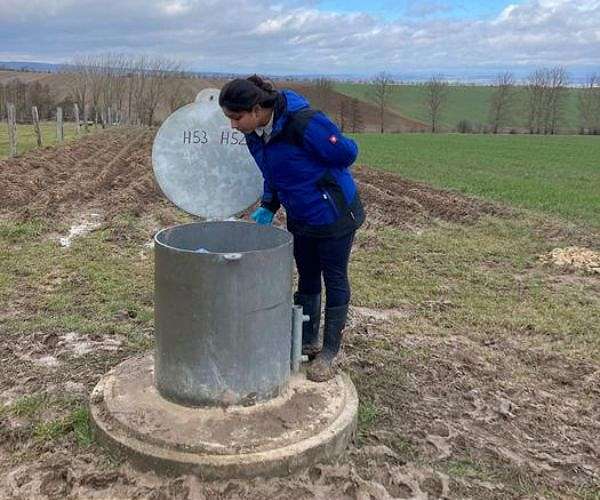
To probe this hidden lifestyle, the researchers deployed passive samplers in a natural carbonate aquifer in Germany's Thuringian Hainich region. Over time, microbial communities colonized rock material in the samplers, allowing direct comparison between rock-attached communities and those freely suspended in the same groundwater system. Using modern genome-based techniques, the team analyzed community composition and metabolic potential in both habitats.

The results reveal two sharply contrasting microbial ecosystems coexisting in close physical proximity. Rock-attached communities and free-living communities host very different sets of species and functions. According to first author and doctoral researcher Alisha Sharma, the way microbes live, whether fixed to rock or drifting in water, exerts a stronger influence on community structure than environmental factors such as oxygen availability.

On rock surfaces, microbes form highly specialized communities capable of tapping inorganic energy sources such as iron and sulfur. By oxidizing these compounds, they can fix carbon dioxide and build biomass, effectively turning the subsurface into an active carbon sink. These metabolic capabilities allow rock-bound microbes to play a central role in transforming chemicals and sequestering carbon in the underground.

In contrast, the free-living microorganisms in groundwater appear functionally more constrained. They lack the same breadth of metabolic tools seen in rock-attached communities and contribute less to key processes such as carbon fixation. The researchers argue that focusing solely on planktonic cells leads to a distorted view of how groundwater ecosystems function and evolve over time.

"If we ignore the community attached to rock, we overlook an important functional actor in the groundwater system," explains research group leader Martin Taubert from the Cluster of Excellence. He notes that these attached microorganisms are deeply involved in central chemical processes, particularly the carbon cycle, that shape groundwater quality and geochemistry. Recognizing their role is essential for realistic models of subsurface environments.

The findings carry direct relevance for environmental protection, drinking water safety and climate assessments. Groundwater is one of the world's most important sources of drinking water, and an improved understanding of subsurface microbial processes can refine estimates of natural self-purification and contaminant breakdown. The work also suggests that carbonate rock aquifers may lock away significantly more carbon dioxide than previously assumed, a factor that could influence how natural carbon sinks are represented in climate models.

Beyond their immediate environmental implications, the results contribute to the broader goals of the Balance of the Microverse Cluster of Excellence. The initiative seeks to understand how microbial communities shape their surroundings and how environmental conditions in turn regulate microbial balance. Aquatic geomicrobiologist and cluster speaker Kirsten Kuesel emphasizes that microorganisms act as quiet stabilizers of many natural systems, often without human awareness.

By revealing the distinct strategies of rock-attached and free-living microbes in the subsurface, the study underscores that microbial life underground is not merely a passive backdrop. Instead, it is an active architect of groundwater composition, carbon cycling and ecosystem stability. Unlocking these hidden habitats helps researchers gauge how robust or fragile subsurface systems may be in the face of environmental change.

Research Report:Two worlds beneath: Distinct microbial strategies of the rock-attached and planktonic subsurface biosphere

Related Links
Friedrich Schiller University Jena
Water News - Science, Technology and Politics

Subscribe Free To Our Daily Newsletters
Tweet

RELATED CONTENT
The following news reports may link to other Space Media Network websites.
WATER WORLD
UN report warns world is entering era of global water bankruptcy
Los Angeles CA (SPX) Jan 21, 2026
A flagship report from the United Nations University Institute for Water Environment and Health warns that the world has entered an era of global water bankruptcy in which many human water systems can no longer return to past conditions. The report argues that familiar terms such as water stress and water crisis understate the scale and permanence of damage in basins where long term withdrawals, pollution and degradation have pushed water resources beyond recovery. Titled Global Water Bankruptcy ... read more

WATER WORLD
NASA astronaut stuck in space for nine months retires

Tourists hit record in Japan, despite plunge from China

What happens when fire ignites in space? 'A ball of flame'

ISS astronauts splash down on Earth after first-ever medical evacuation

WATER WORLD
NASA and GE run hybrid jet engine test toward commercial flight

Starfighters completes key wind tunnel campaign for STARLAUNCH 1 air launch vehicle

Major equity deal backs Gilmour Space expansion of sovereign launch capability

Stratolaunch secures major funding to scale hypersonic flight services

WATER WORLD
Ancient deltas reveal vast Martian ocean across northern hemisphere

Tiny Mars' big impact on Earth's climate

The electrifying science behind Martian dust

Sandblasting winds sculpt Mars landscape

WATER WORLD
Retired EVA workhorse to guide China's next-gen spacesuit and lunar gear

Tiangong science program delivers data surge

China tallies record launch year as lunar and asteroid plans advance

China harnesses nationwide system to drive spaceflight and satellite navigation advances

WATER WORLD
Aerospacelab expands Pulsar navigation constellation work with new Xona satellite order

ThinkOrbital raises seed funding to advance orbital defense and construction systems

China outlines mega constellations in ITU satellite filings

Multiple satellite filings demonstrate transparency, responsibility and ambition: China Daily editorial

WATER WORLD
German software giant SAP's shares plunge on AI worries

Autonomous AI network boosts materials discovery efficiency

Desert sand mix points to new path for greener concrete

EU to show Google how to open up to rival AI services; Microsoft shares slide as AI spending surges

WATER WORLD
Icy cycles may have driven early protocell evolution

Cosmic dust chemistry forges peptide building blocks in deep space

Hidden magma oceans could shield rocky exoplanets from harmful radiation

ALMA survey maps turbulent youth of distant planetary systems

WATER WORLD
Polar weather on Jupiter and Saturn hints at the planets' interior details

Europa ice delamination may deliver nutrients to hidden ocean

Birth conditions fixed water contrast on Jupiters moons

Study links Europa's quiet seafloor to hidden potential for life

Subscribe Free To Our Daily Newsletters


The content herein, unless otherwise known to be public domain, are Copyright 1995-2024 - Space Media Network. All websites are published in Australia and are solely subject to Australian law and governed by Fair Use principals for news reporting and research purposes. AFP, UPI and IANS news wire stories are copyright Agence France-Presse, United Press International and Indo-Asia News Service. ESA news reports are copyright European Space Agency. All NASA sourced material is public domain. Additional copyrights may apply in whole or part to other bona fide parties. All articles labeled "by Staff Writers" include reports supplied to Space Media Network by industry news wires, PR agencies, corporate press officers and the like. Such articles are individually curated and edited by Space Media Network staff on the basis of the report's information value to our industry and professional readership. Advertising does not imply endorsement, agreement or approval of any opinions, statements or information provided by Space Media Network on any Web page published or hosted by Space Media Network. General Data Protection Regulation (GDPR) Statement Our advertisers use various cookies and the like to deliver the best ad banner available at one time. All network advertising suppliers have GDPR policies (Legitimate Interest) that conform with EU regulations for data collection. By using our websites you consent to cookie based advertising. If you do not agree with this then you must stop using the websites from May 25, 2018. Privacy Statement. Additional information can be found here at About Us.