24/7 Space News
TIME AND SPACE
Quantum interferometer boosts sensitivity to tiny laser beam shifts
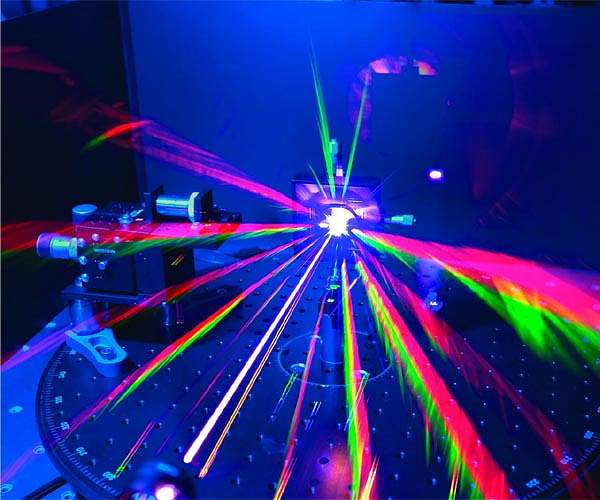
illustration only

Quantum interferometer boosts sensitivity to tiny laser beam shifts

by Robert Schreiber
Berlin, Germany (SPX) Jan 09, 2026

Researchers at Ludwig-Maximilians-Universitat Munchen have demonstrated a quantum interferometric method that can register extremely small tilts and displacements of a laser beam. The approach is based on weak value amplification, a concept from quantum mechanics that enhances the response of an interferometer when internal beam parameters change only slightly.

In many experiments and technologies, such as atomic force microscopy, detecting these minute positional changes is essential. Weak value amplification has shown that, under specific conditions, even very small modifications in the paths inside an interferometer can translate into a large change at the output, because the device compares overlapping light waves.

LMU physicist Carlotta Versmold and colleagues in the MCQST Cluster of Excellence, working with a team at Tel Aviv University, have now extended this scheme so that it also amplifies changes affecting the incoming beam itself. This extension enables measurements with higher precision than before and opens possibilities for sensing tasks that were previously difficult to achieve.

The researchers illustrate that a laser beam reflected from a distant window can in principle pick up vibrations in the glass produced by speech inside a room. In such a case, the amplified signal at the interferometer output could carry information about the conversations, highlighting the method's potential for remote vibration and sound detection.

In a standard interferometer, any fluctuation in the incoming light usually appears identically in both arms and cancels out in the combined output. In the weak value approach used for internal beam shifts, the light is split into two slightly different paths that are later recombined and then directed to two outputs.

Versmold's team inserted a Dove prism into one arm of the interferometer. The additional reflection introduced by this prism reverses the direction of the shift in that arm relative to the other, so that the two paths experience equal but opposite displacements. When recombined, these opposite shifts translate into an amplified effective displacement at the output.

Using this setup, Versmold measured both tilt and lateral displacement of the incoming beam with a precision on the order of tenths of a microradian and tenths of a micrometer, respectively, which is much smaller than the beam diameter of roughly 2 millimeters. This level of sensitivity shows how subtle geometric changes in the beam path can be resolved.

As a test, she encoded music into the vibrations of a mirror and reflected the laser off that vibrating surface before it entered the interferometer. When the signal was converted back into sound after passing through the interferometer, the audio quality was clearly better than for signals converted from light without using an interferometer.

"This shows the potential of the method for particularly sensitive measurements," says LMU physicist Harald Weinfurter, the study's senior author. The work indicates how quantum-inspired interferometric techniques can enhance classical sensing applications without altering the basic properties of the light source.

Research Report:Interferometric Amplification and Suppression of External Beam Shifts

Related Links
Ludwig-Maximilians-Universitat Munchen
Understanding Time and Space

Subscribe Free To Our Daily Newsletters
Tweet

RELATED CONTENT
The following news reports may link to other Space Media Network websites.
TIME AND SPACE
Hybrid detector array sharpens measurements of neutron rich nuclei lifetimes
Tokyo, Japan (SPX) Jan 06, 2026
Researchers from the Institute of Modern Physics and collaborating institutions have developed a hybrid detection system called HALIMA to measure the lifetimes of excited states in neutron rich nuclei produced by fission. Their study in Nuclear Science and Techniques describes how the array enables sub nanosecond lifetime measurements using a four fold FF/beta Ge LaBr3(Ce) LaBr3(Ce) coincidence technique. HALIMA integrates high resolution gamma spectroscopy with fast timing in one setup. Eight HPG ... read more

TIME AND SPACE
Startups go public in litmus test for Chinese AI

Sprawling CES gadgetfest a world stage for AI and its hype

Billionaire Trump nominee confirmed to lead NASA amid Moon race

ISS to change commanders before Soyuz crew leaves orbit

TIME AND SPACE
AI systems proposed to boost launch cadence reliability and traffic management

China debuts Long March 12A reusable rocket in Jiuquan test flight

Japan's flagship H3 rocket fails to launch satellite

Hydrogen from ethanol reforming mapped as aviation fuel-cell pathway

TIME AND SPACE
Wind-Sculpted Landscapes: Investigating the Martian Megaripple 'Hazyview'

HiRISE camera aboard Mars Reconnaissance Orbiter passes 100000 image milestone

Search for life should be top science priority for first human landing on Mars report says

Curiosity Blog, Sols 4750-4762: See You on the Other Side of the Sun

TIME AND SPACE
China harnesses nationwide system to drive spaceflight and satellite navigation advances

Shenzhou 21 crew complete eight hour spacewalk outside Tiangong station

Foreign satellites ride Kinetica 1 on new CAS Space mission

Experts at Hainan symposium call for stronger global space partnership

TIME AND SPACE
Time-expanded network model cuts complexity in mega constellation launch planning

Southern Launch to Host Lux Aeterna Re-Entries South Australia

Smart modeling framework targets 6G spectrum chaos in space air and ground networks

K2 Space raises 250m to scale Mega class high power satellites

TIME AND SPACE
From music to mind reading: AI startups bet on earbuds

New tool narrows the search for ideal material structures

Nostalgia and new fans as Tamagotchi turns 30

Chlorine and hydrogen from waste brines without external power

TIME AND SPACE
Clues to the migration path of hot Jupiters in their orbits

Hubble pinpoints asteroid smash ups in nearby Fomalhaut system

Evolution study finds history and environment shifts can steer species in very different directions

Webb maps carbon rich atmosphere on distorted pulsar planet

TIME AND SPACE
Uranus and Neptune may be rock rich worlds

SwRI links Uranus radiation belt mystery to solar storm driven waves

Looking inside icy moons

Saturn moon mission planning shifts to flower constellation theory

Subscribe Free To Our Daily Newsletters


The content herein, unless otherwise known to be public domain, are Copyright 1995-2024 - Space Media Network. All websites are published in Australia and are solely subject to Australian law and governed by Fair Use principals for news reporting and research purposes. AFP, UPI and IANS news wire stories are copyright Agence France-Presse, United Press International and Indo-Asia News Service. ESA news reports are copyright European Space Agency. All NASA sourced material is public domain. Additional copyrights may apply in whole or part to other bona fide parties. All articles labeled "by Staff Writers" include reports supplied to Space Media Network by industry news wires, PR agencies, corporate press officers and the like. Such articles are individually curated and edited by Space Media Network staff on the basis of the report's information value to our industry and professional readership. Advertising does not imply endorsement, agreement or approval of any opinions, statements or information provided by Space Media Network on any Web page published or hosted by Space Media Network. General Data Protection Regulation (GDPR) Statement Our advertisers use various cookies and the like to deliver the best ad banner available at one time. All network advertising suppliers have GDPR policies (Legitimate Interest) that conform with EU regulations for data collection. By using our websites you consent to cookie based advertising. If you do not agree with this then you must stop using the websites from May 25, 2018. Privacy Statement. Additional information can be found here at About Us.