24/7 Space News
TIME AND SPACE
Surrey Japan team to probe short lived atomic nuclei in cosmic element quest
illustration only

Surrey Japan team to probe short lived atomic nuclei in cosmic element quest

by Robert Schreiber
Berlin, Germany (SPX) Jan 09, 2026

Plans to obtain the first precision measurements of some of the rarest and most unstable atomic nuclei are set to advance understanding of nuclear structure and the way chemical elements form during extreme cosmic events such as supernovae, neutron star mergers and X-ray bursts.

The University of Surrey is partnering with researchers in Japan to develop instruments that can measure previously inaccessible isotopes, which are forms of matter that exist only briefly at the limits of nuclear stability.

The project has been awarded 215,100 pounds from the Royal Society's International Science Partnership Fund and brings together Surrey, Kyushu University and the Radioactive Isotope Beam Factory (RIBF) at the RIKEN laboratory, a facility where intense beams of exotic nuclei are produced for experiments.

Researchers will investigate fundamental properties of unstable atomic nuclei, concentrating on both neutron rich and neutron deficient isotopes that do not occur naturally on Earth and can only be created momentarily in advanced laboratories.

By measuring their mass and their half life, the team aims to refine theoretical models of nuclear structure and improve understanding of how chemical elements originate in nuclear astrophysical environments.

Dr Ragandeep Singh Sidhu, Future Fellow at the University of Surrey's School of Mathematics and Physics and project co-lead, said: "These extremely rare isotopes are among the most difficult atomic nuclei to study, but they hold crucial clues about how nuclear matter behaves at its limits. Measuring their mass and half-lives for the first time will allow us to significantly improve the models used to understand both atomic nuclei and the cosmic processes that create the heaviest elements in the universe. This work would not be possible without close collaboration with our partners in Japan and access to world-leading facilities at RIBF, RIKEN."

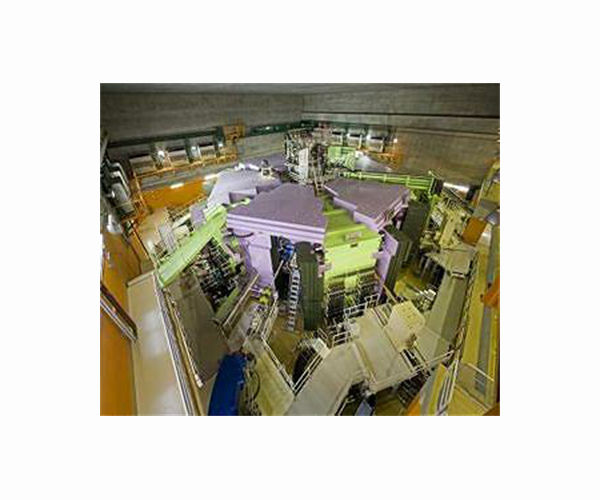
Experiments will take place at the Rare-Radioactive Isotope Ring (R3) at RIBF, RIKEN, a facility that can store and repeatedly observe short lived nuclei.

Using advanced detection methods, the collaboration will probe regions of the nuclear chart that have not previously been reached by experiment.

The Surrey group will lead development and testing of detector and data acquisition systems in the UK ahead of the experimental campaign in Japan, giving the team a central role in preparing the measurements.

Over three years, the project will also deepen collaboration between the UK and Japan, support new experimental tools and help maintain the UK's role in nuclear physics research.

Dr Masaomi Tanaka, Assistant Professor at Kyushu University and project co-lead, said: "One of the most exciting aspects of this project is the opportunity to study how nuclear shells behave in some of the heaviest and most neutron-rich nuclei ever measured. For some of these isotopes, we currently have almost no experimental data, so these measurements will directly challenge and improve our understanding. Through this collaboration, we aim to map the nuclear landscape in new and previously inaccessible detail."

Related Links
University of Surrey
Understanding Time and Space

Subscribe Free To Our Daily Newsletters
Tweet

RELATED CONTENT
The following news reports may link to other Space Media Network websites.
TIME AND SPACE
Electrons lag behind the nucleus
Zurich, Switzerland (SPX) Jan 07, 2026
One of the great successes of 20th-century physics was the quantum mechanical description of solids. This allowed scientists to understand for the first time how and why certain materials conduct electric current and how these properties could be purposefully modified. For instance, semiconductors such as silicon could be used to produce transistors, which revolutionized electronics and made modern computers possible. To be able to mathematically capture the complex interplay between electrons and ... read more

TIME AND SPACE
NASA Back for Seconds with New Food System Design Challenge

New orbital mapping system targets Earth Moon libration traffic

International Space Station crew to return early after astronaut medical issue

Startups go public in litmus test for Chinese AI

TIME AND SPACE
PH-1 test flight advances Chinese reusable suborbital spacecraft plans

Starfighters completes supersonic tests for GE Aerospace ramjet program

Fueling research in nuclear thermal propulsion

Indian rocket hits snag during launch

TIME AND SPACE
Ancient deltas reveal vast Martian ocean across northern hemisphere

Tiny Mars' big impact on Earth's climate

The electrifying science behind Martian dust

Sandblasting winds sculpt Mars landscape

TIME AND SPACE
Tiangong science program delivers data surge

China tallies record launch year as lunar and asteroid plans advance

China harnesses nationwide system to drive spaceflight and satellite navigation advances

Shenzhou 21 crew complete eight hour spacewalk outside Tiangong station

TIME AND SPACE
Aerospacelab expands Pulsar navigation constellation work with new Xona satellite order

China outlines mega constellations in ITU satellite filings

Multiple satellite filings demonstrate transparency, responsibility and ambition: China Daily editorial

ThinkOrbital raises seed funding to advance orbital defense and construction systems

TIME AND SPACE
Momentus to flight test 3D printed fuel tank on Vigoride 7

How IVRT Testing Ensures Consistent Product Quality

Quantum camera startup plans satellite and telescope constellations

This exotic form of ice just got weirder

TIME AND SPACE
Creating hallucination-free, psychedelic-like molecules by shining light on life's basic building blocks

Pandora exoplanet mission checks in after launch

Mixed crystal phase of superionic water mapped inside giant planets

Berkeley Scientists set to home in on 100 signals from Seti at Home

TIME AND SPACE
Jupiter's moon Europa has a seafloor that may be quiet and lifeless

Uranus and Neptune may be rock rich worlds

SwRI links Uranus radiation belt mystery to solar storm driven waves

Looking inside icy moons

Subscribe Free To Our Daily Newsletters


The content herein, unless otherwise known to be public domain, are Copyright 1995-2024 - Space Media Network. All websites are published in Australia and are solely subject to Australian law and governed by Fair Use principals for news reporting and research purposes. AFP, UPI and IANS news wire stories are copyright Agence France-Presse, United Press International and Indo-Asia News Service. ESA news reports are copyright European Space Agency. All NASA sourced material is public domain. Additional copyrights may apply in whole or part to other bona fide parties. All articles labeled "by Staff Writers" include reports supplied to Space Media Network by industry news wires, PR agencies, corporate press officers and the like. Such articles are individually curated and edited by Space Media Network staff on the basis of the report's information value to our industry and professional readership. Advertising does not imply endorsement, agreement or approval of any opinions, statements or information provided by Space Media Network on any Web page published or hosted by Space Media Network. General Data Protection Regulation (GDPR) Statement Our advertisers use various cookies and the like to deliver the best ad banner available at one time. All network advertising suppliers have GDPR policies (Legitimate Interest) that conform with EU regulations for data collection. By using our websites you consent to cookie based advertising. If you do not agree with this then you must stop using the websites from May 25, 2018. Privacy Statement. Additional information can be found here at About Us.