24/7 Space News
EXO WORLDS
Creating hallucination-free, psychedelic-like molecules by shining light on life's basic building blocks
illustration only

Creating hallucination-free, psychedelic-like molecules by shining light on life's basic building blocks

by Greg Watry
Davis CA (SPX) Jan 08, 2026

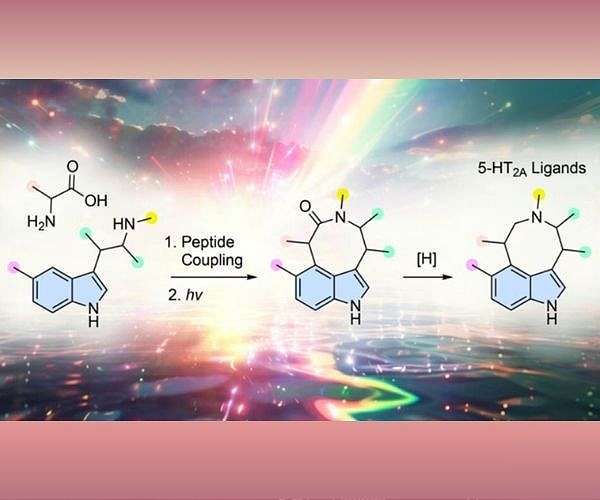
UC Davis researchers have developed a new method that uses light to transform amino acids - the building blocks of proteins - into molecules that are similar in structure to psychedelics and mimic their interaction with the brain. Like psychedelics, these molecules activate the brain's serotonin 5-HT2A receptors, which promote cortical neuron growth, and could be candidates to treat a host of brain disorders, such as depression, substance-use disorder and PTSD. However, they don't trigger hallmark hallucinogenic behavior in animal models.

The research was recently published in the Journal of the American Chemical Society.

"The question that we were trying to answer was, 'Is there whole new class of drugs in this field that hasn't been discovered?" said study author Joseph Beckett, a Ph.D. student working with Professor Mark Mascal, UC Davis Department of Chemistry, and an affiliate of the UC Davis Institute for Psychedelics and Neurotherapeutics (IPN). "The answer in the end was, 'Yes.'"

The research opens the door to a streamlined and environmentally friendly drug discovery platform for new serotonin-effecting drugs that confer the benefits of psychedelics without significantly distorting perception.

"In medicinal chemistry, it's very typical to take an existing scaffold and make modifications that just tweak the pharmacology a little bit one way or another," said study author Trey Brasher, also a Ph.D. student in the Mascal Lab and an affiliate of IPN. "But especially in the psychedelic field, completely new scaffolds are incredibly rare. And this is the discovery of a brand-new therapeutic scaffold."

The researchers created a library of potentially therapeutic molecules by coupling various amino acids with tryptamine, a metabolite of the essential amino acid tryptophan. They then irradiated these molecules with ultraviolet light to transform them into new compounds of medicinal value.

Computer simulations were used to test the binding affinity of 100 of these compounds at the 5-HT2A receptor.

Five candidates were selected for further lab testing to determine efficacy and potency. Efficacies of the selected compounds ranged from 61% to 93%, with the latter representing a full agonist - a compound capable of producing the maximum biological response from the 5-HT2A system.

The team labeled the full agonist in the group as D5. They expected that administering the compound to mouse models would induce head twitch responses, a hallmark of hallucinogenic-like behaviors.

However, that wasn't the case. Despite fully activating the same receptor as psychedelics, D5 didn't induce head twitch responses.

"Laboratory and computational studies showed that these molecules can partially or fully activate serotonin signaling pathways linked to both brain plasticity and hallucinations, while experiments in mice demonstrated suppression of psychedelic-like responses rather than their induction," Beckett and Brasher said.

The team plans to conduct follow-up studies to better understand if other serotonin receptors in the brain modulate or suppress the hallucinogenic-like effects of D5.

"We determined that the scaffold itself possesses a range of activity," Brasher said. "But now it's about elucidating that activity and understanding why D5 and similar molecules are non-hallucinogenic when they're full agonists."

Additional authors on the paper include Mark Mascal and Lena E. H. Svanholm, of UC Davis; Marc Bazin, Ryan Buzdygon and Steve Nguyen, of HepatoChem Inc.; John D. McCorvy, Allison A. Clark and Serena S. Schalk, of the Medical College of Wisconsin; and Adam L. Halberstadt and Bruna Cuccurazza, of UC San Diego.

The research reported on here was funded by grants from the National Institutes of Health and Source Research Foundation.

Research Report:Transforming Amino Acids into Serotonin 5-HT2A Receptor Ligands Using Photochemistry

Related Links
UC Davis Institute for Psychedelics and Neurotherapeutics
Lands Beyond Beyond - extra solar planets - news and science
Life Beyond Earth

Subscribe Free To Our Daily Newsletters
Tweet

RELATED CONTENT
The following news reports may link to other Space Media Network websites.
EXO WORLDS
Giant amoeba virus ushikuvirus sheds light on how complex cells evolved
Tokyo, Japan (SPX) Jan 08, 2026
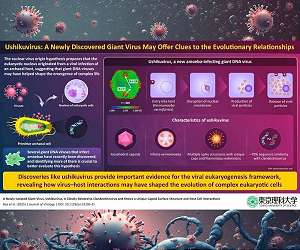
Giant DNA viruses that infect amoebae are providing new evidence that viruses may have helped drive the evolution of complex life, according to researchers at Tokyo University of Science and the National Institute of Natural Sciences in Japan. In work published online on November 24, 2025, in the Journal of Virology, the team reports the discovery of ushikuvirus, a newly isolated giant virus named after Lake Ushiku in Ibaraki Prefecture, where it was found. Ushikuvirus infects vermamoeba and belon ... read more

EXO WORLDS
Startups go public in litmus test for Chinese AI

Sprawling CES gadgetfest a world stage for AI and its hype

Billionaire Trump nominee confirmed to lead NASA amid Moon race

ISS to change commanders before Soyuz crew leaves orbit

EXO WORLDS
AI systems proposed to boost launch cadence reliability and traffic management

China debuts Long March 12A reusable rocket in Jiuquan test flight

Japan's flagship H3 rocket fails to launch satellite

Hydrogen from ethanol reforming mapped as aviation fuel-cell pathway

EXO WORLDS
Wind-Sculpted Landscapes: Investigating the Martian Megaripple 'Hazyview'

HiRISE camera aboard Mars Reconnaissance Orbiter passes 100000 image milestone

Search for life should be top science priority for first human landing on Mars report says

Curiosity Blog, Sols 4750-4762: See You on the Other Side of the Sun

EXO WORLDS
China harnesses nationwide system to drive spaceflight and satellite navigation advances

Shenzhou 21 crew complete eight hour spacewalk outside Tiangong station

Foreign satellites ride Kinetica 1 on new CAS Space mission

Experts at Hainan symposium call for stronger global space partnership

EXO WORLDS
Time-expanded network model cuts complexity in mega constellation launch planning

Southern Launch to Host Lux Aeterna Re-Entries South Australia

Smart modeling framework targets 6G spectrum chaos in space air and ground networks

K2 Space raises 250m to scale Mega class high power satellites

EXO WORLDS
From music to mind reading: AI startups bet on earbuds

New tool narrows the search for ideal material structures

Nostalgia and new fans as Tamagotchi turns 30

Chlorine and hydrogen from waste brines without external power

EXO WORLDS
Creating hallucination-free, psychedelic-like molecules by shining light on life's basic building blocks

Giant amoeba virus ushikuvirus sheds light on how complex cells evolved

Clues to the migration path of hot Jupiters in their orbits

Hubble pinpoints asteroid smash ups in nearby Fomalhaut system

EXO WORLDS
Uranus and Neptune may be rock rich worlds

SwRI links Uranus radiation belt mystery to solar storm driven waves

Looking inside icy moons

Saturn moon mission planning shifts to flower constellation theory

Subscribe Free To Our Daily Newsletters


The content herein, unless otherwise known to be public domain, are Copyright 1995-2024 - Space Media Network. All websites are published in Australia and are solely subject to Australian law and governed by Fair Use principals for news reporting and research purposes. AFP, UPI and IANS news wire stories are copyright Agence France-Presse, United Press International and Indo-Asia News Service. ESA news reports are copyright European Space Agency. All NASA sourced material is public domain. Additional copyrights may apply in whole or part to other bona fide parties. All articles labeled "by Staff Writers" include reports supplied to Space Media Network by industry news wires, PR agencies, corporate press officers and the like. Such articles are individually curated and edited by Space Media Network staff on the basis of the report's information value to our industry and professional readership. Advertising does not imply endorsement, agreement or approval of any opinions, statements or information provided by Space Media Network on any Web page published or hosted by Space Media Network. General Data Protection Regulation (GDPR) Statement Our advertisers use various cookies and the like to deliver the best ad banner available at one time. All network advertising suppliers have GDPR policies (Legitimate Interest) that conform with EU regulations for data collection. By using our websites you consent to cookie based advertising. If you do not agree with this then you must stop using the websites from May 25, 2018. Privacy Statement. Additional information can be found here at About Us.