24/7 Space News
EXO WORLDS
Puffy young exoplanets reveal origin of super Earths
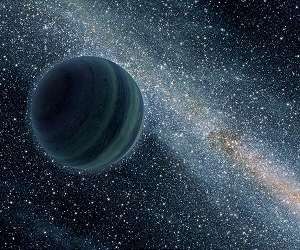
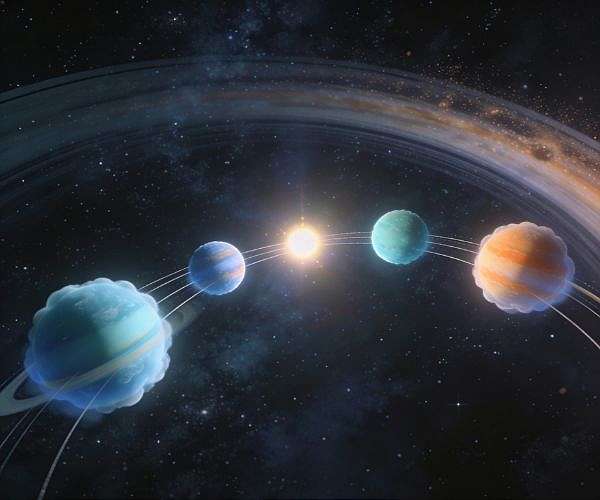
illustration only

Puffy young exoplanets reveal origin of super Earths

by Riko Seibo
Tokyo, Japan (SPX) Jan 08, 2026

Astronomers have identified a young planetary system that links newborn giant worlds to the compact super Earths and sub Neptunes that dominate the Milky Way. V1298 Tau, a star about 20 million years old, hosts four planets between the sizes of Neptune and Jupiter in close-in orbits, offering a snapshot of planets during a brief and dynamic stage of evolution.

Over ten years, researchers combined observations from ground and space telescopes to track when each planet crossed the face of V1298 Tau. By measuring small deviations in the timing of these transits, known as Transit Timing Variations, they determined that the planets gravitationally perturb one another, which allowed precise mass estimates.

The team found that although each planet has a radius 5 to 10 times that of Earth, their masses range from only 5 to 15 Earth masses. This combination implies very low densities and extended atmospheres, resembling large, diffuse envelopes rather than compact rocky bodies.

Lead author John Livingston of the Astrobiology Center in Tokyo said, "What's so exciting is that we're seeing a preview of what will become a very normal planetary system. The four planets we studied will likely contract into 'super-Earths' and 'sub-Neptunes'-the most common types of planets in our galaxy, but we've never had such a clear picture of them in their formative years."

Because simple cooling cannot keep such planets inflated, the results indicate that V1298 Tau's planets have already lost a significant fraction of their primordial atmospheres. The analysis suggests that once the gas-rich protoplanetary disk dispersed, intense radiation and changing conditions around the young star drove rapid atmospheric escape and accelerated cooling.

Co-author Erik Petigura of UCLA noted that the usual Doppler radial-velocity technique is not practical for such an active young star. "For astronomers, our go-to 'Doppler' method for weighing planets involves making careful measurements of the star's velocity as it's tugged by its retinue of planets. But young stars are so extremely spotty, active, and temperamental, that the Doppler method is a non-starter. By using TTVs, we essentially used the planets' own gravity against each other. Precisely timing how they tug on their neighbors allowed us to calculate their masses, and sidestep the issues with this young star."

The mass and radius measurements confirm that the planets are extremely low density, consistent with earlier suggestions that young close-in worlds begin as large, tenuous objects. These values provide a benchmark for models that track how planetary atmospheres cool and contract after formation.

Trevor David of the Flatiron Institute, who led the initial discovery of the system, emphasized that the new measurements confirm long-standing theoretical expectations about young planets. "The unusually large radii of young planets led to the hypothesis that they have very low densities, but this had never been measured. By weighing these planets for the first time, we have provided the first observational proof. They are indeed exceptionally 'puffy,' which gives us a crucial, long-awaited benchmark for theories of planet evolution."

Theoretical modeling led by James Owen at Imperial College London shows that the V1298 Tau planets will keep evolving over billions of years. "These planets have already undergone a dramatic transformation, rapidly losing much of their original atmospheres and cooling faster than what we'd expect from standard models," he explained. "But they're still evolving. Over the next few billion years, they will continue to lose their atmosphere and shrink significantly, transforming into the compact worlds we see throughout the galaxy."

Erik Petigura compared the system's role in planetary science to a key fossil in human evolution. "I'm reminded of the famous 'Lucy' fossil, one of our hominid ancestors that lived 3 million years ago and was one of the key 'missing links' between apes and humans," he added. "V1298Tau is a critical link between the star/planet forming nebulae we see all over the sky, and the mature planetary systems that we have now discovered by the thousands."

The V1298 Tau system now acts as a benchmark laboratory for studying how abundant close-in planets form and evolve. Its properties may also illuminate why the Solar System lacks super Earths and sub Neptunes, even though these planets are common around other stars.

Livingston stressed the broader implications for exoplanet demographics. "This discovery fundamentally changes how we think about planetary systems," he said. "V1298 Tau shows us that today's super-Earths and sub-Neptunes start out as giant, puffy worlds that contract over time. We're essentially watching the universe's most successful planetary architecture in the making."

Research Report:A young progenitor for the most common planetary systems in the Galaxy

Related Links
National Institutes of Natural Sciences
Lands Beyond Beyond - extra solar planets - news and science
Life Beyond Earth

Subscribe Free To Our Daily Newsletters
Tweet

RELATED CONTENT
The following news reports may link to other Space Media Network websites.
EXO WORLDS
Rogue planet mass pinned down for the first time
Tokyo, Japan (SPX) Jan 06, 2026
Peking University, January 2, 2026: A coordinated observation campaign using space- and ground-based telescopes has yielded the first precise mass measurement of a rogue planet, confirming that one long-standing candidate is indeed a planet. Unlike planets in the Solar System, rogue planets travel through space without orbiting a host star. Over the last decade, astronomers have identified about a dozen rogue planet candidates through brief microlensing events, when a compact object passes in fron ... read more

EXO WORLDS
Second ESCAPADE spacecraft completes key trajectory fix on path to Mars

China launches twin Shijian-29 satellites to test space-target detection tech

ESA reaches new benchmark in autonomous formation flying

Overseas scholars drawn to China's scientific clout, funding

EXO WORLDS
North Korea tests hypersonic missiles, says nuclear forces ready for war

Starfighters completes supersonic tests for GE Aerospace ramjet program

Galileo satellites ride Ariane 6 to boost Europe navigation resilience

AI systems proposed to boost launch cadence reliability and traffic management

EXO WORLDS
Sandblasting winds sculpt Mars landscape

Thin ice may have protected lake water on frozen Mars

Curiosity's Nevado Sajama postcard captures Mars on the eve of conjunction

Wind-Sculpted Landscapes: Investigating the Martian Megaripple 'Hazyview'

EXO WORLDS
China harnesses nationwide system to drive spaceflight and satellite navigation advances

Shenzhou 21 crew complete eight hour spacewalk outside Tiangong station

Foreign satellites ride Kinetica 1 on new CAS Space mission

Experts at Hainan symposium call for stronger global space partnership

EXO WORLDS
Time-expanded network model cuts complexity in mega constellation launch planning

Southern Launch to Host Lux Aeterna Re-Entries South Australia

Smart modeling framework targets 6G spectrum chaos in space air and ground networks

K2 Space raises 250m to scale Mega class high power satellites

EXO WORLDS
Essential Strategies for Enhancing Data Integrity and Compliance in Today's Business Environment

Momentus to flight test 3D printed fuel tank on Vigoride 7

Satellites lined up for shared space computing power networks

Planet delivers first light image from Pelican 6 satellite capturing Lhasa Gonggar Airport

EXO WORLDS
Deep Arctic gas hydrate mounds host ultra deep cold seep ecosystem

Joint ground- and space-based observations reveal Saturn-mass rogue planet

ALMA views giant dusty disk in Gomezs Hamburger with signs of early giant planet formation

We finally know how the most common types of planets are created

EXO WORLDS
Jupiter's moon Europa has a seafloor that may be quiet and lifeless

Uranus and Neptune may be rock rich worlds

SwRI links Uranus radiation belt mystery to solar storm driven waves

Looking inside icy moons

Subscribe Free To Our Daily Newsletters


The content herein, unless otherwise known to be public domain, are Copyright 1995-2024 - Space Media Network. All websites are published in Australia and are solely subject to Australian law and governed by Fair Use principals for news reporting and research purposes. AFP, UPI and IANS news wire stories are copyright Agence France-Presse, United Press International and Indo-Asia News Service. ESA news reports are copyright European Space Agency. All NASA sourced material is public domain. Additional copyrights may apply in whole or part to other bona fide parties. All articles labeled "by Staff Writers" include reports supplied to Space Media Network by industry news wires, PR agencies, corporate press officers and the like. Such articles are individually curated and edited by Space Media Network staff on the basis of the report's information value to our industry and professional readership. Advertising does not imply endorsement, agreement or approval of any opinions, statements or information provided by Space Media Network on any Web page published or hosted by Space Media Network. General Data Protection Regulation (GDPR) Statement Our advertisers use various cookies and the like to deliver the best ad banner available at one time. All network advertising suppliers have GDPR policies (Legitimate Interest) that conform with EU regulations for data collection. By using our websites you consent to cookie based advertising. If you do not agree with this then you must stop using the websites from May 25, 2018. Privacy Statement. Additional information can be found here at About Us.