





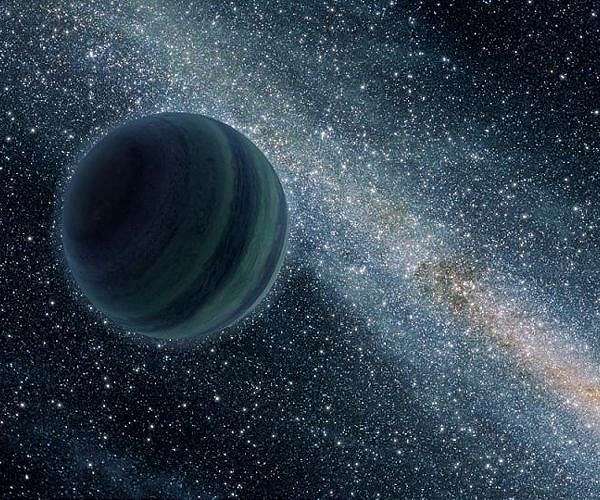
Over the last decade, astronomers have identified about a dozen rogue planet candidates through brief microlensing events, when a compact object passes in front of a background star and its gravity magnifies the star's light. These short brightenings reveal that a lensing object is present, but typically offer only limited information about its mass and distance.
In a new study in Science, an international team led by Dong Subo of Peking University reports that one such candidate has a mass of about one fifth that of Jupiter, comparable to Saturn, resolving doubts about whether it is planetary in nature. Previous microlensing detections had suggested a wide range of possible masses for free-floating objects, from Earth-sized bodies to Jupiter-like giants, but estimates were rough and indirect.
"For the first time, we have a direct measurement of a rogue planet candidate's mass and not just a rough statistical estimate," said Dong, a professor of astronomy. "We know for sure it's a planet."
The result supports long-running microlensing surveys and theoretical work indicating that the Milky Way may host billions or even trillions of planets that drift through interstellar space without stars. "Our discovery offers further evidence that the Galaxy may be teeming with rogue planets that were likely ejected from their original homes," said Dong.
The newly confirmed world was detected during a two-day microlensing event on May 3, 2024, cataloged as KMT-2024-BLG-0792/OGLE-2024-BLG-0516. Two large ground-based surveys, the Korea Microlensing Telescope Network (KMTNet), led by Chung-Uk Lee at the Korea Astronomy and Space Science Institute and using three 1.6-meter telescopes in Chile, South Africa, and Australia, and the Optical Gravitational Lensing Experiment (OGLE), led by Andrzej Udalski at the Astronomical Observatory of the University of Warsaw with a 1.3-meter telescope in Chile, both recorded the event.
By chance, the European Space Agency's Gaia spacecraft also observed the same lensing episode while conducting its long-term campaign to map nearly two billion stars from 2014 to early 2025. The simultaneous coverage from Gaia, KMTNet, and OGLE marks the only instance in Gaia's mission in which all three instruments captured a rogue planet candidate.
This unique data set enabled the team to measure the microlens parallax effect, which separates the influence of the lens's mass and its distance on the observed light bending. Astronomers had previously measured the deflection angles caused by about a dozen rogue planet candidates, but without parallax information, mass and distance could not be disentangled.
Humans perceive depth because each eye sees a scene from a slightly different angle, and the brain combines the views to infer distance. "We are able to use the same principle to extract the distance information of this rogue planet candidate, finding the mass and distance separately," said Dong.
The parallax made the microlensing event appear about two hours later from Gaia's vantage point than from Earth. "The difference is that the spacing between the eyes of we humans is a few centimeters, whereas Gaia is about 1.5 million kilometers away from Earth." said Dong.
From these measurements, Dong and colleagues concluded that a Saturn-mass object caused the observed brightening. "You need to have this fundamental measurement of mass to really know it's a planet," said Dong. "Getting this kind of data opens up lots of doors to understanding more about a planet's possible origins and history."
The team notes that the parallax method demonstrated in this work will be important for upcoming space-based microlensing surveys that will observe above Earth's atmosphere. Later this year, NASA plans to launch the Nancy Grace Roman Space Telescope, which will conduct an infrared microlensing program expected to uncover hundreds of rogue planets.
China is also preparing the Chinese Space Station Survey Telescope (CSST) and developing the Earth 2.0 mission, both of which list microlensing as one of their key science goals. With many future detections and mass measurements, researchers will be able to examine how different types of planets become unbound from their systems.
Dynamical interactions in young planetary systems, where forming planets scatter off one another, are thought to be a major route for ejecting planets into interstellar space. Close encounters with passing stars may also destabilize planetary systems and send planets out of orbit, while some rogue planets may form directly from collapsing gas and dust clouds without ever orbiting a star. Whether these different pathways produce distinct populations, for example favoring the ejection of lower-mass planets over giant planets, remains an open question.
"The new space-based facilities such as Roman, CSST, and Earth 2.0 are going to revolutionize the field of microlensing and the study of free-floating planets," said Dong. "So far, we only have a glimpse into this emerging population of rogue worlds and what light they can shed on the formation of the bodies in the planetary systems of the universe."
The collaboration includes co-author Wu Zexuan, a graduate student at Peking University, along with scientists from China, Korea, Poland, Israel, the United Kingdom, Switzerland, Sweden, Germany, the United States, and New Zealand.
Research Report: Astronomers confirm rogue planet candidate as a planet for the first time
Related Links
Peking University
Lands Beyond Beyond - extra solar planets - news and science
Life Beyond Earth
| Subscribe Free To Our Daily Newsletters |
| Subscribe Free To Our Daily Newsletters |







