24/7 Space News
TECH SPACE
Satellites lined up for shared space computing power networks
illustration only

Satellites lined up for shared space computing power networks

by Riko Seibo
Tokyo, Japan (SPX) Dec 31, 2025

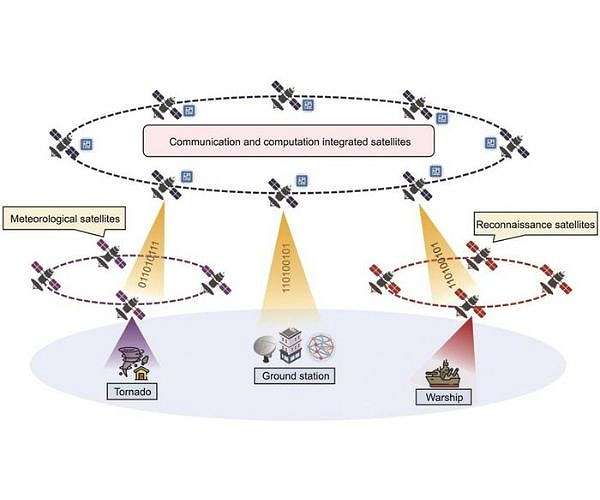
Researchers are outlining a space computing power network that would link communication and computation across satellite constellations to handle growing data processing demands in orbit. Over recent decades, satellites have expanded global connectivity and remote sensing, but many systems still move raw data to the ground for processing under tight contact windows.

Traditional satellite-ground links must operate within short visibility periods, share limited high-frequency spectrum, and address data privacy concerns when downlinking sensitive information. To reduce these constraints, the proposed space computing power networks, or Space-CPN, use edge computing techniques and onboard computing payloads so satellites can process and filter information in space instead of sending all data to Earth.

The Space-CPN framework extends terrestrial computing power networks into space by integrating the communication and computation capabilities of low Earth orbit, medium Earth orbit, and geostationary Earth orbit satellites. Within this architecture, operators can schedule computing tasks flexibly across different satellite nodes to support secure, low-latency, and accurate onboard intelligent data processing. In emergencies, GEO, MEO, and LEO satellites could function as space-based computing centers, while ground stations would take on high-demand or less time-sensitive computing tasks.

A central challenge for Space-CPN is the design of communication principles that support specific computation tasks instead of simply maximizing raw data throughput. The work highlights a robust information bottleneck principle that seeks to maximize mutual information between the computed result and the true label of a data sample to maintain accuracy, while minimizing mutual information between the extracted feature and the input sample to improve compression. This balance is intended to strengthen communication robustness without adding overhead to the system.

Onboard computing architectures in satellites must also operate under constrained energy and hardware resources, which drives interest in low-power approaches. The study points to neuromorphic computing, which mirrors how the brain combines memory and processing, as one candidate solution for spacecraft. It examines the use of spiking neural networks in orbit and proposes satellite federated and decentralized neuromorphic learning network architectures to support onboard training across distributed satellite nodes.

Resource allocation across a Space-CPN is another core issue because satellite networks are dynamic and uncertain, with changing connectivity, workloads, and link conditions. The article proposes robust optimization tools to match computation tasks to available links and processing units, including robust reinforcement learning for deploying satellite microservices and distributionally robust optimization for satellite task scheduling. These methods aim to quantify the relationship between task requirements and network resources so operators can maintain efficient utilization as conditions change.

Together, these elements position space computing power networks as a next step in merging communication and computing throughout space infrastructure. By rethinking task-oriented communications, adopting energy-efficient onboard computing paradigms, and applying robust resource allocation strategies, such networks could change how satellites process and transmit information and support more capable and autonomous satellite systems.

Research Report:Space Computing Power Networks: Fundamentals and Techniques

Related Links
Tsinghua University
Space Technology News - Applications and Research

Subscribe Free To Our Daily Newsletters
Tweet

RELATED CONTENT
The following news reports may link to other Space Media Network websites.
TECH SPACE
Bible 1.0: How Ancient Canon Became Our First Large Language Models
Sydney, Australia (SPX) Dec 14, 2025
Modern large language models are treated as something radically new: vast statistical machines trained on almost everything humans have written, and able to regenerate knowledge on demand. Yet in structural terms, humanity has worked with something similar for millennia. ... read more

TECH SPACE
ESA reaches new benchmark in autonomous formation flying

Hydrogen peroxide thruster qualifies for ESA launcher attitude control

Billionaire Trump nominee confirmed to lead NASA amid Moon race

ISS to change commanders before Soyuz crew leaves orbit

TECH SPACE
AI systems proposed to boost launch cadence reliability and traffic management

China debuts Long March 12A reusable rocket in Jiuquan test flight

Japan's flagship H3 rocket fails to launch satellite

Hydrogen from ethanol reforming mapped as aviation fuel-cell pathway

TECH SPACE
Curiosity Blog, Sols 4750-4762: See You on the Other Side of the Sun

Wind-Sculpted Landscapes: Investigating the Martian Megaripple 'Hazyview'

NASA team presses MAVEN recovery before Mars solar conjunction

Perseverance rover cleared for long distance Mars exploration

TECH SPACE
China harnesses nationwide system to drive spaceflight and satellite navigation advances

Shenzhou 21 crew complete eight hour spacewalk outside Tiangong station

Foreign satellites ride Kinetica 1 on new CAS Space mission

Experts at Hainan symposium call for stronger global space partnership

TECH SPACE
Time-expanded network model cuts complexity in mega constellation launch planning

How an Earnings Calendar Improves Your Investment Decisions

Southern Launch to Host Lux Aeterna Re-Entries South Australia

Smart modeling framework targets 6G spectrum chaos in space air and ground networks

TECH SPACE
AST BlueBird 6 enters orbit as record low Earth orbit cellular array

SSC ground stations to support NASA PExT wideband Ka band test

Space ground fluid AI framework targets satellite powered 6G edge intelligence

Space Themed Casino Games Slots, Rockets, and Astronaut Adventures

TECH SPACE
Hubble pinpoints asteroid smash ups in nearby Fomalhaut system

Philosopher argues AI consciousness may remain unknowable

Evolution study finds history and environment shifts can steer species in very different directions

Webb maps carbon rich atmosphere on distorted pulsar planet

TECH SPACE
Uranus and Neptune may be rock rich worlds

SwRI links Uranus radiation belt mystery to solar storm driven waves

Looking inside icy moons

Saturn moon mission planning shifts to flower constellation theory

Subscribe Free To Our Daily Newsletters


The content herein, unless otherwise known to be public domain, are Copyright 1995-2024 - Space Media Network. All websites are published in Australia and are solely subject to Australian law and governed by Fair Use principals for news reporting and research purposes. AFP, UPI and IANS news wire stories are copyright Agence France-Presse, United Press International and Indo-Asia News Service. ESA news reports are copyright European Space Agency. All NASA sourced material is public domain. Additional copyrights may apply in whole or part to other bona fide parties. All articles labeled "by Staff Writers" include reports supplied to Space Media Network by industry news wires, PR agencies, corporate press officers and the like. Such articles are individually curated and edited by Space Media Network staff on the basis of the report's information value to our industry and professional readership. Advertising does not imply endorsement, agreement or approval of any opinions, statements or information provided by Space Media Network on any Web page published or hosted by Space Media Network. General Data Protection Regulation (GDPR) Statement Our advertisers use various cookies and the like to deliver the best ad banner available at one time. All network advertising suppliers have GDPR policies (Legitimate Interest) that conform with EU regulations for data collection. By using our websites you consent to cookie based advertising. If you do not agree with this then you must stop using the websites from May 25, 2018. Privacy Statement. Additional information can be found here at About Us.