





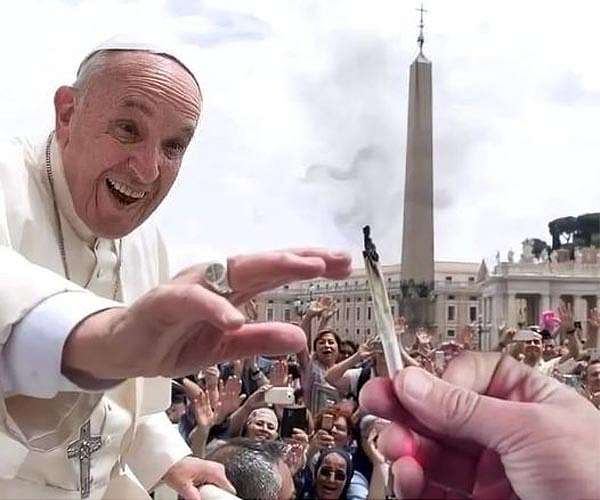
In a message marking the World Day of Social Communications, the pope said AI systems reflect the worldview of their creators and can shape patterns of thought by reproducing biases embedded in the data they process.
"The challenge... is a matter of protecting human identity and authentic relationships," the pontiff said.
Leo XIV's warning comes as generative AI makes leaps and bounds towards replicating, altering and manufacturing images, music and text to levels sometimes indistinguishable from human-made works.
In 2023, Leo's predecessor, pope Francis, was the subject of a viral fake AI image of him wearing a white puffer jacket.
Since then, generative AI has been a go-to tool by some high-profile figures, including US President Donald Trump, who has posted or reposted computer-generated images to his online accounts.
Pope Leo XIV warned that just a small number of companies hold significant power over AI development, and that AI tools increase "the difficulty of distinguishing between reality and simulation".
Since his election pope last May as the first pope from the United States, Leo XIV has consistently warned about the growing influence of AI technologies.
He also criticised systems that present statistical probability as reliable knowledge, arguing that such tools ultimately offer only approximations.
He said the challenge ahead is to establish effective governance and called for young people to be educated about how algorithms influence perceptions of reality.
Last month, he condemned the accelerating use of AI in military applications, warning against delegating life?and?death decisions to machines.
Musk makes Davos debut with promise of robots for all
Davos, Switzerland (AFP) Jan 22, 2026 -
Elon Musk sees his humanoid robots hitting the market next year, one of several "optimistic" forecasts by the US tech mogul at his first-ever Davos appearance on Thursday.
In front of a packed conference hall, Musk had a chance to tear into a World Economic Forum he has long derided as a "boring" confab of out-of-touch elites.
But in a remarkably subdued "conversation" with WEF interim chair Larry Fink -- also the CEO of investment behemoth BlackRock -- Musk stuck to his script of optimistic enthusiasm for AI, robotics and space travel.
He was not pressed for example on the scandal caused by sexualised deepfakes of his Grok AI tool, or claims of persistent fake news spread by his X social network.
"Who wouldn't want a robot to watch over your kids, take care of your pet... If you had a robot that could take care and protect an elderly parent, that'd be great," he told the audience.
His Optimus robots will be doing more complex tasks later this year, he said, and "by the end of next year I think we'll be selling humanoid robots to the public".
Musk also predicted the artificial intelligence boom will have models that are "smarter than any human by the end of this year, and I would say no later than next year".
"And then probably by 2030 or 2031, so five years from now, AI will be smarter than all of humanity collectively."
But he ended his talk with a caveat: "Generally, I think that for quality of life, it is actually better to err on the side of being an optimist and wrong, rather than being a pessimist and right."
Related Links
All about the robots on Earth and beyond!
| Subscribe Free To Our Daily Newsletters |

| Subscribe Free To Our Daily Newsletters |








