





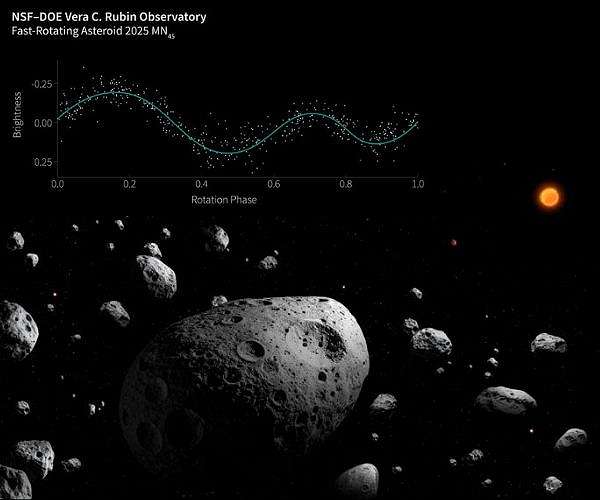
The study was led by Sarah Greenstreet, NSF NOIRLab assistant astronomer and lead of Rubin Observatory's Solar System Science Collaboration's Near-Earth Objects and Interstellar Objects working group. The team presents their results in a paper appearing in The Astrophysical Journal Letters, as well as at a press conference at the 247th meeting of the American Astronomical Society (AAS) in Phoenix, Arizona.
Rubin Observatory is a joint program of NSF NOIRLab and DOE's SLAC National Accelerator Laboratory, who cooperatively operate Rubin. NOIRLab is managed by the Association of Universities for Research in Astronomy (AURA).
"NSF-DOE Rubin Observatory will find things that no one even knew to look for," says Luca Rizzi, an NSF program director for research infrastructure. "When Rubin's Legacy Survey of Space and Time begins, this huge spinning asteroid will be joined by an avalanche of new information about our Universe, captured nightly."
The Legacy Survey of Space and Time (LSST) is Rubin's mission to repeatedly scan the Southern Hemisphere night sky for ten years to create an ultra-wide, ultra-high-definition time-lapse record of the Universe. LSST is expected to start in the coming months.
The study discussed here uses data collected over the course of about ten hours across seven nights in April/May 2025, during Rubin Observatory's early commissioning phase. This is the first published peer-reviewed scientific paper that uses data from the LSST Camera - the largest digital camera in the world.
"The Department of Energy's investment in Rubin Observatory's cutting-edge technology, particularly the LSST Camera, is proving invaluable," said Regina Rameika, the DOE Associate Director for High Energy Physics. "Discoveries like this exceptionally fast-rotating asteroid are a direct result of the observatory's unique capability to provide high-resolution, time-domain astronomical data, pushing the boundaries of what was previously observable."
"We have known for years that Rubin would act as a discovery machine for the Universe, and we are already seeing the unique power of combining the LSST Camera with Rubin's incredible speed. Together, Rubin can take an image every 40 seconds," said Aaron Roodman, Deputy Head of LSST and professor of Particle Physics and Astrophysics at SLAC. "The ability to find thousands of new asteroids in such a short period of time, and learn so much about them, is a window into what will be uncovered during the 10-year survey."
As asteroids orbit the Sun, they also rotate at a wide range of speeds. These spin rates not only offer clues about the conditions of their formation billions of years ago, but also tell us about their internal composition and evolution over their lifetimes. In particular, an asteroid spinning quickly may have been sped up by a past collision with another asteroid, suggesting that it could be a fragment of an originally larger object.
Fast rotation also requires an asteroid to have enough internal strength to not fly apart into many smaller pieces, called fragmentation. Most asteroids are 'rubble piles', which means they are made of many smaller pieces of rock held together by gravity, and thus have limits based on their densities as to how fast they can spin without breaking apart. For objects in the main asteroid belt, the fast-rotation limit to avoid being fragmented is 2.2 hours; asteroids spinning faster than this must be structurally strong to remain intact. The faster an asteroid spins above this limit, and the larger its size, the stronger the material it must be made from.
The study presents 76 asteroids with reliable rotation periods. This includes 16 super-fast rotators with rotation periods between roughly 13 minutes and 2.2 hours, and three ultra-fast rotators that complete a full spin in less than five minutes.
All 19 newly identified fast-rotators are longer than the length of an American football field (100 yards or about 90 meters). The fastest-spinning main-belt asteroid identified, named 2025 MN45, is 710 meters (0.4 miles) in diameter and it completes a full rotation every 1.88 minutes. This combination makes it the fastest-spinning asteroid with a diameter over 500 meters that astronomers have found.
"Clearly, this asteroid must be made of material that has very high strength in order to keep it in one piece as it spins so rapidly," says Greenstreet. "We calculate that it would need a cohesive strength similar to that of solid rock. This is somewhat surprising since most asteroids are believed to be what we call 'rubble pile' asteroids, which means they are made of many, many small pieces of rock and debris that coalesced under gravity during Solar System formation or subsequent collisions."
Most fast-rotators discovered so far orbit the Sun just beyond Earth, known as near-Earth objects (NEOs). Scientists find fewer fast-rotating main-belt asteroids (MBAs), which orbit the Sun between Mars and Jupiter. This is mainly because of the main-belt asteroids' greater distance from Earth, which makes their light fainter and more difficult to see.
All but one of the newly identified fast-rotators live in the main asteroid belt, some even just beyond its outer edge, with the lone exception being an NEO. This shows that scientists are now finding these extremely rapidly rotating asteroids at farther distances than ever before, an achievement made possible by Rubin's enormous light-collecting power and precise measurement capabilities.
In addition to 2025 MN45, other notable asteroid discoveries made by the team include 2025 MJ71 (1.9-minute rotation period), 2025 MK41 (3.8-minute rotation period), 2025 MV71 (13-minute rotation period), and 2025 MG56 (16-minute rotation period). These five super- to ultra-fast rotators are all several hundred meters in diameter and join a couple of NEOs as the fastest spinning sub-kilometer asteroids known.
"As this study demonstrates, even in early commissioning, Rubin is successfully allowing us to study a population of relatively small, very-rapidly-rotating main-belt asteroids that hadn't been reachable before," says Greenstreet.
Scientists expect to find more fast rotators once Rubin begins its 10-year Legacy Survey of Space and Time (LSST). Unlike the dense, rapid First Look observations that enabled this quick burst of discoveries, LSST's regular, sparser observations will instead uncover fast rotators gradually as the survey accumulates data, providing pivotal information about the strengths, compositions, and collisional histories of these primitive bodies.
Research Report: Lightcurves, rotation periods, and colors for Vera C. Rubin Observatory's first asteroid discoveries
Related Links
NSF-DOE Vera C. Rubin Observatory
Asteroid and Comet Mission News, Science and Technology
| Subscribe Free To Our Daily Newsletters |
| Subscribe Free To Our Daily Newsletters |








