

24/7 Space News
IRON AND ICE
ICE-CSIC leads a pioneering study on the feasibility of asteroid mining
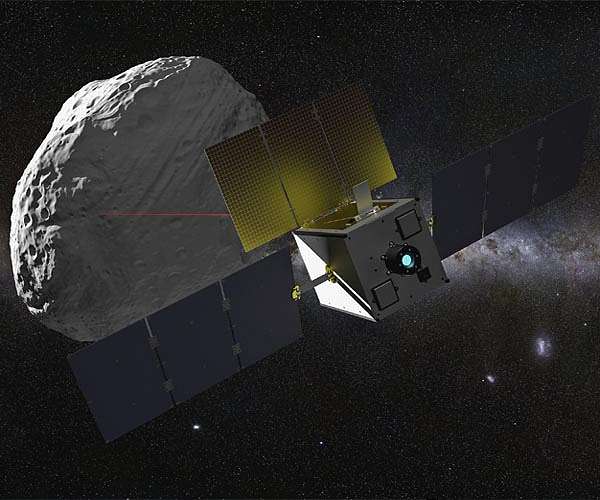
illustration only

ICE-CSIC leads a pioneering study on the feasibility of asteroid mining

by Staff Writs for CSIC News
Madrid, Spain (SPX) Dec 11, 2025
Much remains to be known about the chemical composition of small asteroids. Their potential to harbour valuable metals, materials from the early solar system, and the possibility of obtaining a geochemical record of their parent bodies makes them promising candidates for future use of space resources. A team led by the Institute of Space Sciences (ICE-CSIC) has analyzed samples of C-type asteroids, carbon-rich minor bodies of the Solar System, progenitors of the carbonaceous chondrites. Their findings, published in the Monthly Notices of the Royal Astronomical Society, support the idea that these asteroids can serve as crucial material sources and identify their parent bodies, as well as for planning future missions and developing new technologies for resource exploitation.

In a natural way, carbonaceous chondrites fall from the sky, although with a proportion of 5% regarding the rest of meteorite falls. However, many of them are so fragile that they fragment and are never recovered. Therefore, they are usually rare and are mainly located in desert regions, such as the Sahara or Antarctica. "The scientific interest in each of these meteorites is that they sample small, undifferentiated asteroids, and provide valuable information on the chemical composition and evolutionary history of the bodies from which they originate," says Josep M. Trigo-Rodriguez, first author of the study and astrophysicist at ICE-CSIC, affiliated to the Institute of Space Studies of Catalonia (IEEC).

The physical and chemical composition of asteroids

The scientific team from ICE-CSIC selected, characterized, and provided the asteroid samples, which were analyzed using mass spectrometry at the University of Castilla-La Mancha by Professor Jacinto Alonso-Azcarate. This allowed them to determine the precise chemical abundances of the six most common classes of carbonaceous chondrites, fostering the discussion among the scientific community of whether their future extraction would be feasible.

The Asteroids, Comets, and Meteorites research group at ICE-CSIC investigates the physicochemical properties of the materials that make up the surfaces of asteroids and comets and has made numerous contributions in this field over the last decade. "At ICE-CSIC and IEEC, we specialize in developing experiments to better understand the properties of these asteroids and how the physical processes that occur in space affect their nature and mineralogy," says Trigo-Rodriguez, who leads this group.

Furthermore, for over a decade he has been involved in selecting and requesting from NASA the several carbonaceous chondrites analyzed in this study, as well as devising several experiments with them, since the ICE-CSIC is the international repository for NASA's Antarctic meteorite collection. "The work now being published is the culmination of that team effort," he adds.

"Studying and selecting these types of meteorites in our clean room using other analytical techniques is fascinating, particularly because of the diversity of minerals and chemical elements they contain. However, most asteroids have relatively small abundances of precious elements, and therefore the objective of our study has been to understand to what extent their extraction would be viable," says Pau Grebol Tomas, ICE-CSIC predoctoral researcher.

"Although most small asteroids have surfaces covered in fragmented material called regolith - and it would facilitate the return of small amounts of samples - developing large-scale collection systems to achieve clear benefits is a very different matter. In any case, it deserves to be explored because the search for resources in space could be susceptible to minimizing the impact of mining activities on terrestrial ecosystems," points out Jordi Ibanez-Insa, Geosciences Barcelona (GEO3BCN-CSIC) researcher and co-author of the study.

The future of exploration and resource extraction on small asteroids

Given the diversity present in the main asteroid belt, it is crucial to define what types of resources could be found there. According to Trigo-Rodriguez: "They are small and quite heterogeneous objects, heavily influenced by their evolutionary history, particularly collisions and close approaches to the Sun. If we are looking for water, there are certain asteroids from which hydrated carbonaceous chondrites originate, which, conversely, will have fewer metals in their native state. Let's not forget that, after 4.56 billion years since their formation, each asteroid has a different composition, as revealed by the study of chondritic meteorites."

One of the study's conclusions is that mining undifferentiated asteroids - the primordial remnants of the solar system's formation considered the progenitor bodies of chondritic meteorites - is still far from viable. On the other hand, the study points to a type of pristine asteroid with olivine and spinel bands as a potential target for mining. A comprehensive chemical analysis of carbonaceous chondrites is essential to identify promising targets for space mining. However, the team states that this effort must be accompanied by new sample-return missions to verify the identity of the progenitor bodies.

"Alongside the progress represented by sample return missions, companies capable of taking decisive steps in the technological development necessary to extract and collect these materials under low-gravity conditions are truly needed. The processing of these materials and the waste generated would also have a significant impact that should be quantified and properly mitigated," adds Trigo-Rodriguez.

The team is confident of very short-term progress, given that the use of in-situ resources will be a key factor for future long-term missions to the Moon and Mars, reducing dependence on resupply from Earth. In this regard, the authors point out that if water extraction were the goal, water-altered asteroids with a high concentration of water-bearing minerals should be selected.

Exploiting these resources under low-gravity conditions requires the development of new extraction and processing techniques. "It sounds like science fiction, but it also seemed like science fiction when the first sample return missions were being planned thirty years ago," says Pau Grebol Tomas.

In an international context, several proposals have been put forward, such as capturing small asteroids that pass close to Earth and placing them in a circumlunar orbit for exploitation. "For certain water-rich carbonaceous asteroids, extracting water for reuse seems more viable, either as fuel or as a primary resource for exploring other worlds. This could also provide science with greater knowledge about certain bodies that could one day threaten our very existence. In the long term, we could even mine and shrink potentially hazardous asteroids so that they cease to be dangerous," Trigo-Rodriguez explains.

Research Report:Assessing the metal and rare earth element mining potential of undifferentiated asteroids through the study of carbonaceous chondrites

Related Links
Spanish National Research Council (CSIC)
Asteroid and Comet Mission News, Science and Technology

Subscribe Free To Our Daily Newsletters
Tweet

RELATED CONTENT
IRON AND ICE
OSIRIS-APEX spacecraft completes Earth flyby on its journey to explore Apophis
Los Angeles CA (SPX) Nov 26, 2025
NASA's OSIRIS-APEX spacecraft has completed a precisely targeted Earth flyby, using the planet's gravity to bend its trajectory toward a close encounter with the near-Earth asteroid Apophis in 2029. During the Sept. 23 flyby, the spacecraft passed about 3,438km above Earth while collecting a rich set of images and measurements to calibrate its science instruments ahead of the asteroid campaign ... read more

IRON AND ICE
Lodestar Space wins SECP support to advance AI satellite awareness system

ISS to change commanders before Soyuz crew leaves orbit

Micro nano robots aim to cut carbon buildup in closed life support systems

NASA extends ISS National Lab management contract through 2030

IRON AND ICE
Space shuttle design study maps path to breakthrough inventions

Neutron Hungry Hippo fairing completes qualification ahead of first launch

LandSpace reviews booster loss after Zhuque-3 reusable rocket test

UK plasma thruster test positions Pulsar Fusion for larger satellite propulsion

IRON AND ICE
Martian sound study models acoustic signals in Jezero crater

Martian butterfly crater reveals low angle impact and buried lava history

Bacterial partnership offers pathway to produce Mars regolith bricks for future habitats

Chinese team runs long term Martian dust cycle simulation with GoMars model

IRON AND ICE
Wenchang spaceport hits record cadence with double-digit launches in 2025

China consolidates new commercial space regulator and industry roadmap

Beijing space lab targets orbital data centers for AI era

China supports private space firms to expand global reach

IRON AND ICE
Private capital targets mission-critical software power and platforms in new space economy

MDA Space plans C250 million senior unsecured note issue maturing 2030

SLI and AscendArc agree on 200 million GEO satellite leasing framework

Beyond Gravity positions new modular satellite platform for European LEO missions

IRON AND ICE
Leading the Odds: Five Bookmakers Transforming Ireland's Modern Betting Landscape

Space operators urged to share costs of clearing orbital debris

X-MAT introduces X-FOAM: A game-changing ceramic foam for extreme environments

How Real-Time Follower Tracking Transforms Modern Social Media Analytics

IRON AND ICE
Subaru OASIS survey uncovers massive planet and brown dwarf

The bacteria that wont wake up found in spacecraft cleanrooms

Supernova mixing traced as source of key life elements

RISTRETTO spectrograph cleared for Proxima b atmospheric hunt

IRON AND ICE
SwRI links Uranus radiation belt mystery to solar storm driven waves

Looking inside icy moons

Saturn moon mission planning shifts to flower constellation theory

Could these wacky warm Jupiters help astronomers solve the planet formation puzzle?


The content herein, unless otherwise known to be public domain, are Copyright 1995-2026 - SpaceDaily.com. All websites are published in Australia and are solely subject to Australian law and governed by Fair Use principals for news reporting and research purposes. AFP, UPI and IANS news wire stories are copyright Agence France-Presse, United Press International and Indo-Asia News Service. ESA news reports are copyright European Space Agency. All NASA sourced material is public domain. Additional copyrights may apply in whole or part to other bona fide parties. All articles labeled "by Staff Writers" include reports supplied to Space Media Network by industry news wires, PR agencies, corporate press officers and the like. Such articles are individually curated and edited by Space Media Network staff on the basis of the report's information value to our industry and professional readership. Advertising does not imply endorsement, agreement or approval of any opinions, statements or information provided by Space Media Network on any Web page published or hosted by Space Media Network. General Data Protection Regulation (GDPR) Statement Our advertisers use various cookies and the like to deliver the best ad banner available at one time. All network advertising suppliers have GDPR policies (Legitimate Interest) that conform with EU regulations for data collection. By using our websites you consent to cookie based advertising. If you do not agree with this then you must stop using the websites from May 25, 2018. Privacy Statement. Additional information can be found here at About Us.
Subscribe Free To Our Daily Newsletters







