24/7 Space News
SOLAR SCIENCE
NJIT researchers discover long-hidden source of gamma rays unleashed by solar flares
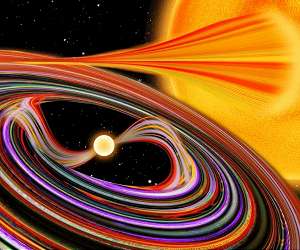
illustration only

NJIT researchers discover long-hidden source of gamma rays unleashed by solar flares

by Jesse Jenkins for NJIT News
Newark NJ (SPX) Jan 08, 2026

Solar physicists say they have found a key source of intense gamma rays unleashed when Earth's nearest star produces its most violent eruptions.

In findings published in Nature Astronomy, scientists at NJIT's Center for Solar-Terrestrial Research (NJIT-CSTR) have pinpointed a previously unknown class of high-energy particles in the Sun's upper atmosphere responsible for generating the long-puzzling radiation signals observed during major solar flare events for decades.

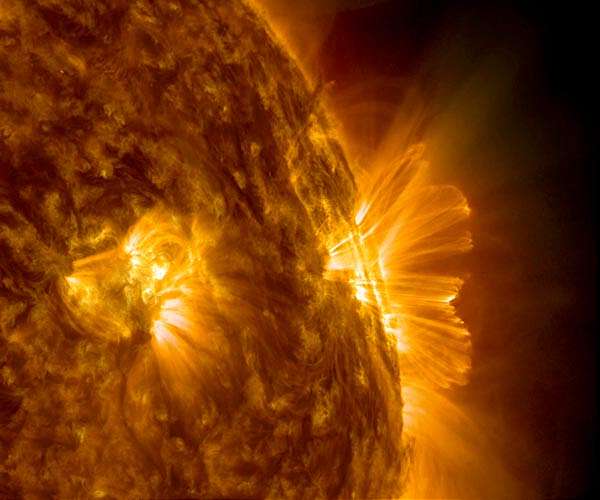
The signals were traced back to a localized region in the solar corona during a powerful X8.2-class flare that erupted on September 10, 2017, where trillions upon trillions of particles were measured at energies of several million electron volts (MeV) - hundreds to thousands of times more energetic than typical flare particles and moving near the speed of light.

Researchers believe these particles generate gamma rays through a process known as bremsstrahlung - a mechanism in which lightweight charged particles, such as electrons, emit high-energy light when they collide with material in the Sun's atmosphere.

The team says the discovery fills critical gaps in our understanding of solar flare physics and could improve models of solar activity that ultimately enhance space weather forecasting.

"We knew solar flares produced a unique gamma-ray signal, but that data alone couldn't reveal its source or how it was generated," said Gregory Fleishman, NJIT-CSTR research professor of physics and lead author of the study. "Without that crucial information, we couldn't fully understand the particles responsible or evaluate any potential impact on our space weather environment. By combining gamma-ray and microwave observations from a solar flare, we were finally able to solve this puzzle."

To find the source, the NJIT team combined observations of the 2017 flare from NASA's Fermi Gamma-ray Space Telescope and NJIT's Expanded Owens Valley Solar Array (EOVSA), a state-of-the-art radio telescope array in California.

Fermi provided crucial measurements of high-energy gamma-ray emissions during the flare, while EOVSA delivered spatially resolved microwave imaging that captured the signatures of accelerated particles in the solar corona.

By analyzing these datasets together, the team identified a distinct region in the solar atmosphere - called Region of Interest 3 (ROI 3) - in addition to two previously studied areas, ROI 1 and ROI 2, where microwave and gamma-ray signals converged.

This convergence pointed to a unique population of particles energized to MeV levels.

"Unlike the typical electrons accelerated in solar flares, which usually decrease in number as their energy increases, this newly discovered population is unusual because most of these particles have very high energies, on the order of millions of electron volts, with relatively few lower-energy electrons present," explained Fleishman.

Using advanced modeling, the team linked the energy distribution of these particles directly to the observed gamma-ray spectrum, pointing to bremsstrahlung emission - high-energy light usually produced when electrons collide with solar plasma - as the elusive source of the gamma-ray signals.

Fleishman also says their observations within ROI 3 - located near regions of significant magnetic field decay and intense particle acceleration - support long-standing theories about how solar flares accelerate particles to extreme energies and sustain them.

"We see clear evidence that solar flares can efficiently accelerate charged particles to very high energies by releasing stored magnetic energy. These accelerated particles then evolve into the MeV-peaked population we discovered," said Fleishman.

For now, Fleishman says key questions remain about these extreme particle populations.

Future observational insights could soon come from NJIT's Expanded Owens Valley Solar Array (EOVSA), currently being upgraded to EOVSA-15. This project, led by NJIT-CSTR professor of physics and EOVSA director Bin Chen - a co-author on the study - is funded by the National Science Foundation and will enhance the array with 15 new antennas and advanced ultra-wideband feeds.

"One big unknown is whether these particles are electrons or positrons," Fleishman said. "Measuring the polarization of microwave emissions from similar events could provide a definitive way to tell them apart. We expect to gain this capability soon with the EOVSA-15 upgrade."

The team's study, "Solar Flare Hosts MeV-peaked Electrons in a Coronal Source," was supported by funding from the National Science Foundation and NASA.

Research Report:Megaelectronvolt-peaked electrons in a coronal source of a solar flare

Related Links
Expanded Owens Valley Solar Array (EOVSA)
Solar Science News at SpaceDaily

Subscribe Free To Our Daily Newsletters
Tweet

RELATED CONTENT
The following news reports may link to other Space Media Network websites.
SOLAR SCIENCE
NASA's IXPE Measures White Dwarf Star for First Time
Huntsville AL (SPX) Jan 05, 2026
For the first time, scientists have used NASA's IXPE (Imaging X-ray Polarization Explorer) to study a white dwarf star. Using IXPE's unique X-ray polarization capability, astronomers examined a star called the intermediate polar EX Hydrae, unlocking the geometry of energetic binary systems. In 2024, IXPE spent nearly one week focused on EX Hydrae, a white dwarf star system located in the constellation Hydra, approximately 200 light-years from Earth. A paper about the results published in the Astro ... read more

SOLAR SCIENCE
Second ESCAPADE spacecraft completes key trajectory fix on path to Mars

China launches twin Shijian-29 satellites to test space-target detection tech

ESA reaches new benchmark in autonomous formation flying

Overseas scholars drawn to China's scientific clout, funding

SOLAR SCIENCE
North Korea tests hypersonic missiles, says nuclear forces ready for war

Starfighters completes supersonic tests for GE Aerospace ramjet program

Galileo satellites ride Ariane 6 to boost Europe navigation resilience

AI systems proposed to boost launch cadence reliability and traffic management

SOLAR SCIENCE
Sandblasting winds sculpt Mars landscape

Thin ice may have protected lake water on frozen Mars

Curiosity's Nevado Sajama postcard captures Mars on the eve of conjunction

Wind-Sculpted Landscapes: Investigating the Martian Megaripple 'Hazyview'

SOLAR SCIENCE
China harnesses nationwide system to drive spaceflight and satellite navigation advances

Shenzhou 21 crew complete eight hour spacewalk outside Tiangong station

Foreign satellites ride Kinetica 1 on new CAS Space mission

Experts at Hainan symposium call for stronger global space partnership

SOLAR SCIENCE
Time-expanded network model cuts complexity in mega constellation launch planning

Southern Launch to Host Lux Aeterna Re-Entries South Australia

Smart modeling framework targets 6G spectrum chaos in space air and ground networks

K2 Space raises 250m to scale Mega class high power satellites

SOLAR SCIENCE
Essential Strategies for Enhancing Data Integrity and Compliance in Today's Business Environment

Momentus to flight test 3D printed fuel tank on Vigoride 7

Satellites lined up for shared space computing power networks

Planet delivers first light image from Pelican 6 satellite capturing Lhasa Gonggar Airport

SOLAR SCIENCE
Deep Arctic gas hydrate mounds host ultra deep cold seep ecosystem

Joint ground- and space-based observations reveal Saturn-mass rogue planet

ALMA views giant dusty disk in Gomezs Hamburger with signs of early giant planet formation

We finally know how the most common types of planets are created

SOLAR SCIENCE
Jupiter's moon Europa has a seafloor that may be quiet and lifeless

Uranus and Neptune may be rock rich worlds

SwRI links Uranus radiation belt mystery to solar storm driven waves

Looking inside icy moons

Subscribe Free To Our Daily Newsletters


The content herein, unless otherwise known to be public domain, are Copyright 1995-2024 - Space Media Network. All websites are published in Australia and are solely subject to Australian law and governed by Fair Use principals for news reporting and research purposes. AFP, UPI and IANS news wire stories are copyright Agence France-Presse, United Press International and Indo-Asia News Service. ESA news reports are copyright European Space Agency. All NASA sourced material is public domain. Additional copyrights may apply in whole or part to other bona fide parties. All articles labeled "by Staff Writers" include reports supplied to Space Media Network by industry news wires, PR agencies, corporate press officers and the like. Such articles are individually curated and edited by Space Media Network staff on the basis of the report's information value to our industry and professional readership. Advertising does not imply endorsement, agreement or approval of any opinions, statements or information provided by Space Media Network on any Web page published or hosted by Space Media Network. General Data Protection Regulation (GDPR) Statement Our advertisers use various cookies and the like to deliver the best ad banner available at one time. All network advertising suppliers have GDPR policies (Legitimate Interest) that conform with EU regulations for data collection. By using our websites you consent to cookie based advertising. If you do not agree with this then you must stop using the websites from May 25, 2018. Privacy Statement. Additional information can be found here at About Us.