24/7 Space News
SOLAR SCIENCE
NASA's IXPE Measures White Dwarf Star for First Time
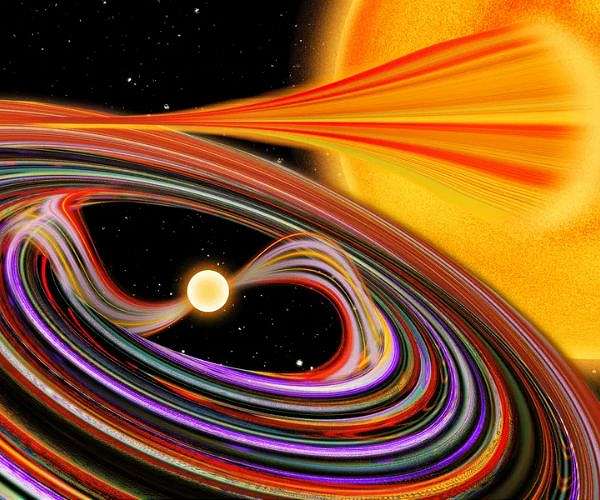
illustration only

NASA's IXPE Measures White Dwarf Star for First Time

by Michael Allen
Huntsville AL (SPX) Jan 05, 2026

For the first time, scientists have used NASA's IXPE (Imaging X-ray Polarization Explorer) to study a white dwarf star. Using IXPE's unique X-ray polarization capability, astronomers examined a star called the intermediate polar EX Hydrae, unlocking the geometry of energetic binary systems.

In 2024, IXPE spent nearly one week focused on EX Hydrae, a white dwarf star system located in the constellation Hydra, approximately 200 light-years from Earth. A paper about the results published in the Astrophysical Journal. Astrophysics research scientists based at the Massachusetts Institute of Technology in Cambridge led the study, along with co-authors at the University of Iowa, East Tennessee State University, University of Liege, and Embry Riddle Aeronautical University.

A white dwarf star occurs after a star runs out of hydrogen fuel to fuse in its core but is not massive enough to explode as core-collapse supernovae. What remains is very dense, roughly the same diameter as Earth with as much mass as our Sun.

EX Hydrae is in a binary system with a main sequence companion star, from which gas is continuously falling onto the white dwarf. How exactly the white dwarf is accumulating, or accreting, this matter and where it arrives on the white dwarf depends on the strength of the white dwarf star's magnetic field.

In the case of EX Hydrae, its magnetic field is not strong enough to focus matter completely at the star's poles. But, it is still rapidly adding mass to the accretion disk, earning the classification "intermediate polars.

In an intermediate polar system, material forms an accretion disk while also being pulled towards its magnetic poles. During this phenomenon, matter reaches tens of millions of degrees Fahrenheit, bouncing off other material bound to the white dwarf star, creating large columns of gas that emit high-energy X-rays - a cosmic situation perfect for IXPE to study.

"NASA IXPE's one-of-a-kind polarimetry capability allowed us to measure the height of the accreting column from the white dwarf star to be almost 2,000 miles high - without as many assumptions required as past calculations," said Sean Gunderson, MIT scientist and lead author on the paper. "The X-rays we observed likely scattered off the white dwarf's surface itself. These features are far smaller than we could hope to image directly and clearly show the power of polarimetry to 'see' these sources in detail never before possible."

Information from IXPE's polarization data of EX Hydrae will help scientists understand other highly energetic binary systems.

Related Links
Imaging X-ray Polarization Explorer (IXPE), NASA
Solar Science News at SpaceDaily

Subscribe Free To Our Daily Newsletters
Tweet

RELATED CONTENT
The following news reports may link to other Space Media Network websites.
SOLAR SCIENCE
Solar probes follow hyperactive sunspot region through three full rotations
Zurich, Switzerland (SPX) Jan 06, 2026
The sun rotates about once every 28 days, so active regions on its surface are usually visible from Earth for only around two weeks before they move out of view behind the limb. Ioannis Kontogiannis, a solar physicist at ETH Zurich and the Istituto ricerche solari Aldo e Cele Dacco (IRSOL) in Locarno, notes that ESA's Solar Orbiter mission, launched in 2020, has extended this viewing window by observing parts of the far side of the sun. Solar Orbiter circles the sun roughly every six months and ca ... read more

SOLAR SCIENCE
Second ESCAPADE spacecraft completes key trajectory fix on path to Mars

China launches twin Shijian-29 satellites to test space-target detection tech

ESA reaches new benchmark in autonomous formation flying

Overseas scholars drawn to China's scientific clout, funding

SOLAR SCIENCE
North Korea tests hypersonic missiles, says nuclear forces ready for war

Starfighters completes supersonic tests for GE Aerospace ramjet program

Galileo satellites ride Ariane 6 to boost Europe navigation resilience

AI systems proposed to boost launch cadence reliability and traffic management

SOLAR SCIENCE
Sandblasting winds sculpt Mars landscape

Thin ice may have protected lake water on frozen Mars

Curiosity's Nevado Sajama postcard captures Mars on the eve of conjunction

Wind-Sculpted Landscapes: Investigating the Martian Megaripple 'Hazyview'

SOLAR SCIENCE
China harnesses nationwide system to drive spaceflight and satellite navigation advances

Shenzhou 21 crew complete eight hour spacewalk outside Tiangong station

Foreign satellites ride Kinetica 1 on new CAS Space mission

Experts at Hainan symposium call for stronger global space partnership

SOLAR SCIENCE
Time-expanded network model cuts complexity in mega constellation launch planning

Southern Launch to Host Lux Aeterna Re-Entries South Australia

Smart modeling framework targets 6G spectrum chaos in space air and ground networks

K2 Space raises 250m to scale Mega class high power satellites

SOLAR SCIENCE
Essential Strategies for Enhancing Data Integrity and Compliance in Today's Business Environment

Momentus to flight test 3D printed fuel tank on Vigoride 7

Satellites lined up for shared space computing power networks

Planet delivers first light image from Pelican 6 satellite capturing Lhasa Gonggar Airport

SOLAR SCIENCE
Deep Arctic gas hydrate mounds host ultra deep cold seep ecosystem

Joint ground- and space-based observations reveal Saturn-mass rogue planet

ALMA views giant dusty disk in Gomezs Hamburger with signs of early giant planet formation

We finally know how the most common types of planets are created

SOLAR SCIENCE
Jupiter's moon Europa has a seafloor that may be quiet and lifeless

Uranus and Neptune may be rock rich worlds

SwRI links Uranus radiation belt mystery to solar storm driven waves

Looking inside icy moons

Subscribe Free To Our Daily Newsletters


The content herein, unless otherwise known to be public domain, are Copyright 1995-2024 - Space Media Network. All websites are published in Australia and are solely subject to Australian law and governed by Fair Use principals for news reporting and research purposes. AFP, UPI and IANS news wire stories are copyright Agence France-Presse, United Press International and Indo-Asia News Service. ESA news reports are copyright European Space Agency. All NASA sourced material is public domain. Additional copyrights may apply in whole or part to other bona fide parties. All articles labeled "by Staff Writers" include reports supplied to Space Media Network by industry news wires, PR agencies, corporate press officers and the like. Such articles are individually curated and edited by Space Media Network staff on the basis of the report's information value to our industry and professional readership. Advertising does not imply endorsement, agreement or approval of any opinions, statements or information provided by Space Media Network on any Web page published or hosted by Space Media Network. General Data Protection Regulation (GDPR) Statement Our advertisers use various cookies and the like to deliver the best ad banner available at one time. All network advertising suppliers have GDPR policies (Legitimate Interest) that conform with EU regulations for data collection. By using our websites you consent to cookie based advertising. If you do not agree with this then you must stop using the websites from May 25, 2018. Privacy Statement. Additional information can be found here at About Us.