24/7 Space News
SOLAR SCIENCE
Solar probes follow hyperactive sunspot region through three full rotations
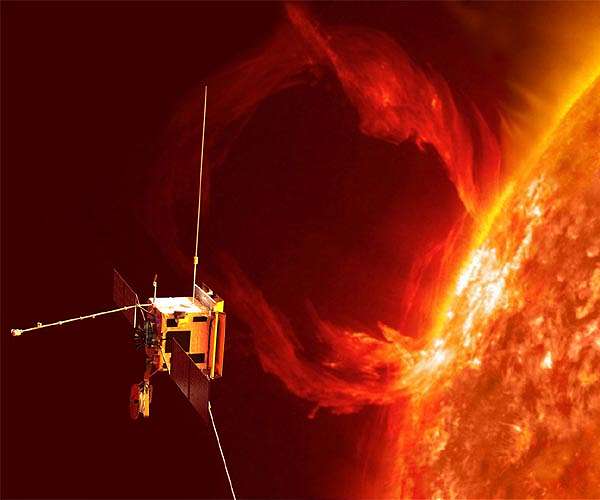
illustration only

Solar probes follow hyperactive sunspot region through three full rotations

by Robert Schreiber
Zurich, Switzerland (SPX) Jan 06, 2026

The sun rotates about once every 28 days, so active regions on its surface are usually visible from Earth for only around two weeks before they move out of view behind the limb. Ioannis Kontogiannis, a solar physicist at ETH Zurich and the Istituto ricerche solari Aldo e Cele Dacco (IRSOL) in Locarno, notes that ESA's Solar Orbiter mission, launched in 2020, has extended this viewing window by observing parts of the far side of the sun.

Solar Orbiter circles the sun roughly every six months and can image the far side that ground- and Earth-orbiting instruments cannot see. Between April and July 2024, the spacecraft monitored one of the most active solar regions of the past twenty years, designated NOAA 13664, as it evolved over three rotations.

When NOAA 13664 rotated onto the Earth-facing side in May 2024, it produced the strongest geomagnetic storms recorded since 2003. "This region caused the spectacular aurora borealis that was visible as far south as Switzerland," says Louise Harra, professor at ETH Zurich and director of the Davos Physical Meteorological Observatory.

To investigate how such superactive regions form, evolve and affect space weather, Harra and Kontogiannis assembled an international research team. The group combined Solar Orbiter observations of NOAA 13664 on the far side with data from NASA's Solar Dynamics Observatory, which sits near the Earth - sun line and monitors the near side.

This coordinated campaign allowed the scientists to track NOAA 13664 almost continuously for 94 days. "This is the longest continuous series of images ever created for a single active region: it's a milestone in solar physics," says Kontogiannis, adding that the team followed the region from its emergence on 16 April 2024 on the far side through its decay after 18 July 2024.

Active regions on the sun host strong and complex magnetic fields that arise when highly magnetised plasma rises to the surface. These fields can drive powerful solar storms that emit intense electromagnetic radiation in the form of flares, eject plasma from the solar atmosphere, and launch high-energy particles into space.

Beyond creating auroras, major solar storms can damage or disrupt modern technological systems on and around Earth. They can trigger power outages, interfere with communication links, increase radiation exposure for aircraft crews and force satellites to reenter, as occurred in February 2022 when 38 of 49 newly launched Starlink satellites were lost within two days.

"Even signals on railway lines can be affected and switch from red to green or vice versa," says Harra. NOAA 13664 also generated problems in May 2024, when "modern digital agriculture was particularly affected," she explains, as signals from satellites, drones and sensors were disturbed, causing lost working days for farmers and crop failures with significant economic impact.

"It's a good reminder that the sun is the only star that influences our activities," adds Kontogiannis. "We live with this star, so it's really important we observe it and try to understand how it works and how it affects our environment."

Using data from multiple space probes, the researchers followed three full solar rotations and documented how the magnetic field in the superactive region developed over several stages, becoming more intricate with time. The analysis shows that an intertwined magnetic structure formed before the most powerful flare of the past twenty years erupted from the far side of the sun on 20 May 2024.

The team expects these results to sharpen understanding of how solar storms arise and what impacts they may have on Earth. Their goal is to improve space-weather forecasting so that vulnerable infrastructure and technologies can be better protected.

"When we see a region on the sun with an extremely complex magnetic field, we can assume that there is a large amount of energy there that will have to be released as solar storms," explains Harra. At present, however, models cannot yet predict how large any given eruption will be, whether a region will unleash one major event or a sequence of smaller ones, or precisely when such eruptions will occur.

"We're not there yet. But we're currently developing a new space probe at ESA called Vigil which will be dedicated exclusively to improving our understanding of space weather," says Harra. The Vigil mission is scheduled for launch in 2031 and will focus on monitoring solar activity relevant to space-weather hazards.

Research Report: Near-continuous tracking of solar active region NOAA 13664 over three solar rotations

Related Links
ETH Zurich
Solar Science News at SpaceDaily

Subscribe Free To Our Daily Newsletters
Tweet

RELATED CONTENT
The following news reports may link to other Space Media Network websites.
SOLAR SCIENCE
Proba-3 mission closes gap in inner solar corona monitoring
Berlin, Germany (SPX) Dec 19, 2025
Proba-3 has spent its first year in orbit generating more than 50 artificial solar eclipses, giving scientists sustained access to the inner solar corona that previously could only be studied intermittently during brief total eclipses on Earth. The two-satellite ESA mission is designed to supply the missing observations between the solar disc and the well-studied outer corona, and recent data confirm that it is now routinely filling this longstanding observational gap. Launched in December 2024, t ... read more

SOLAR SCIENCE
ESA reaches new benchmark in autonomous formation flying

Hydrogen peroxide thruster qualifies for ESA launcher attitude control

China launches twin Shijian-29 satellites to test space-target detection tech

Billionaire Trump nominee confirmed to lead NASA amid Moon race

SOLAR SCIENCE
AI systems proposed to boost launch cadence reliability and traffic management

China debuts Long March 12A reusable rocket in Jiuquan test flight

Japan's flagship H3 rocket fails to launch satellite

North Korea tests hypersonic missiles, says nuclear forces ready for war

SOLAR SCIENCE
Curiosity Blog, Sols 4750-4762: See You on the Other Side of the Sun

Wind-Sculpted Landscapes: Investigating the Martian Megaripple 'Hazyview'

NASA team presses MAVEN recovery before Mars solar conjunction

Perseverance rover cleared for long distance Mars exploration

SOLAR SCIENCE
China harnesses nationwide system to drive spaceflight and satellite navigation advances

Shenzhou 21 crew complete eight hour spacewalk outside Tiangong station

Foreign satellites ride Kinetica 1 on new CAS Space mission

Experts at Hainan symposium call for stronger global space partnership

SOLAR SCIENCE
Southern Launch to Host Lux Aeterna Re-Entries South Australia

Smart modeling framework targets 6G spectrum chaos in space air and ground networks

Time-expanded network model cuts complexity in mega constellation launch planning

K2 Space raises 250m to scale Mega class high power satellites

SOLAR SCIENCE
India space agency launches its heaviest satellite

Space ground fluid AI framework targets satellite powered 6G edge intelligence

Engineered interlayers boost satellite insulation and flexible electronics

Planet delivers first light image from Pelican 6 satellite capturing Lhasa Gonggar Airport

SOLAR SCIENCE
Deep Arctic gas hydrate mounds host ultra deep cold seep ecosystem

Joint ground- and space-based observations reveal Saturn-mass rogue planet

Hubble pinpoints asteroid smash ups in nearby Fomalhaut system

Evolution study finds history and environment shifts can steer species in very different directions

SOLAR SCIENCE
Uranus and Neptune may be rock rich worlds

SwRI links Uranus radiation belt mystery to solar storm driven waves

Looking inside icy moons

Saturn moon mission planning shifts to flower constellation theory

Subscribe Free To Our Daily Newsletters


The content herein, unless otherwise known to be public domain, are Copyright 1995-2024 - Space Media Network. All websites are published in Australia and are solely subject to Australian law and governed by Fair Use principals for news reporting and research purposes. AFP, UPI and IANS news wire stories are copyright Agence France-Presse, United Press International and Indo-Asia News Service. ESA news reports are copyright European Space Agency. All NASA sourced material is public domain. Additional copyrights may apply in whole or part to other bona fide parties. All articles labeled "by Staff Writers" include reports supplied to Space Media Network by industry news wires, PR agencies, corporate press officers and the like. Such articles are individually curated and edited by Space Media Network staff on the basis of the report's information value to our industry and professional readership. Advertising does not imply endorsement, agreement or approval of any opinions, statements or information provided by Space Media Network on any Web page published or hosted by Space Media Network. General Data Protection Regulation (GDPR) Statement Our advertisers use various cookies and the like to deliver the best ad banner available at one time. All network advertising suppliers have GDPR policies (Legitimate Interest) that conform with EU regulations for data collection. By using our websites you consent to cookie based advertising. If you do not agree with this then you must stop using the websites from May 25, 2018. Privacy Statement. Additional information can be found here at About Us.