





In late 2025, scientists reported that NASA's Earth Surface Mineral Dust Source Investigation, or EMIT, instrument aboard the International Space Station could identify concentrations of plastic waste on land. EMIT was launched in 2022 to map mineral dust sources in arid regions and determine how those particles warm or cool the atmosphere, but its capabilities extend far beyond its original mission.
From its perch on the space station, EMIT uses imaging spectroscopy to read the unique spectral signatures that hundreds of compounds imprint on reflected sunlight. This technology, pioneered at JPL and used on missions throughout the solar system, has already contributed to major discoveries, including the detection of water molecules on the Moon in 2009, and will support future Artemis exploration by helping locate scientifically valuable lunar samples.
Researchers have now shown that EMIT can find plastic compounds in landfills and in extensive manmade structures such as greenhouses. However, detecting plastic after it enters the ocean is far more difficult because seawater absorbs much of the infrared light that carries plastic's most prominent spectral features, effectively masking many of the signals scientists rely on.
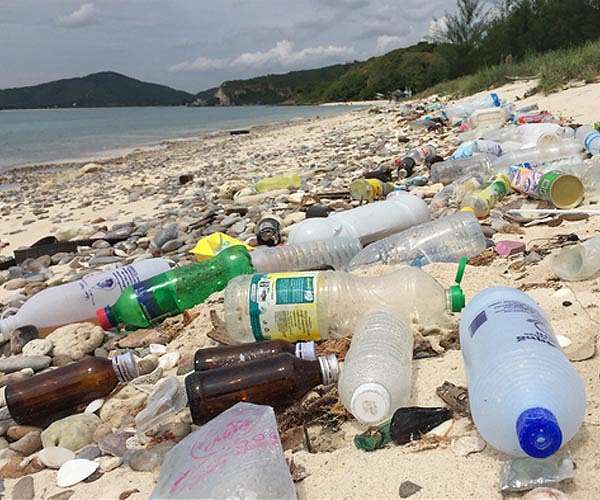
To prepare for future generations of space based sensors that could overcome these challenges, NASA intern and marine scientist Ashley Ohall led the creation of a comprehensive open source spectral reference library of marine debris. The new library compiles nearly 25,000 molecular fingerprints from a wide range of floating and washed up materials, including rope, tires, metal, bubble wrap, buoys, and bottle caps, and it catalogs 19 different types of plastic polymers that dominate marine litter.
The team drew on years of work by many researchers who studied debris samples with handheld instruments in laboratories. By standardizing their measurements into one searchable dataset, the library captures how different kinds of debris vary spectrally with material type, color, and condition. Weathered water bottles, for example, can look very different from storm driven hurricane debris in the spectral domain, so robust detection algorithms must account for that diversity.
Once patterns in this unified library are well characterized, engineers can design and test algorithms to search for similar signatures in airborne and satellite data. Ocean currents can carry debris thousands of miles from its source, so a clearer picture of where litter is concentrated and how it moves could help protect public health, inform cleanup priorities, and support coastal tourism economies.
Most of the estimated millions of tons of plastic entering the ocean each year flows from land, making mapping near shore pollution hot spots a key step in cutting the supply at its origin. EMIT's recent demonstration that it can spot plastic accumulations near coastlines suggests that imaging spectroscopy may become an important tool for tracking how waste travels from land to sea and where interventions could be most effective.
Ohall, a Florida native who recently graduated from the University of Georgia, hopes that the new spectral resource will change how the marine science community views remote sensing. "My biggest hope is that people see remote sensing as an important and useful tool for marine debris monitoring," she said. "Just because it hasn't been done yet doesn't mean it can't be done."
Conventional methods for quantifying plastic in the ocean, such as dragging nets through major garbage patches, cannot keep up with the millions of tons that flow through the global ocean. With NASA support, scientists are assessing what existing satellite sensors can already see, what capabilities are still missing to consistently detect marine debris, and how artificial intelligence tools can help sift through large archives of imagery for subtle signals.
Teams are now training AI systems to recognize features associated with floating litter in satellite images, using insights from the spectral library and field measurements. These efforts aim to bridge the gap between localized sampling and a truly global view, turning scattered observations into a more complete and dynamic picture of marine debris pathways.
NASA officials describe the challenge as a planet scale problem that will require technology in air and space working together with in water measurements. The groundwork being laid by Ohall and her collaborators moves the agency closer to using advanced imaging spectroscopy and data analysis to monitor marine debris as it moves across the world's oceans.
"Humans have a visceral connection to the ocean and its health," said Kelsey Bisson, a program manager at NASA Headquarters in Washington. "Detecting marine debris is the kind of incredible challenge that NASA can help solve."
For more information on the EMIT mission and its expanding range of applications, NASA points to its dedicated project site, which details how the instrument's mineral mapping data is already advancing research in fields such as agriculture and water science. As the marine debris spectral library and related tools mature, future spaceborne instruments inspired by EMIT could give scientists and policymakers a powerful new way to track and eventually reduce the tide of plastic pollution at a global scale.
Related Links
NASA Jet Propulsion Laboratory
Earth Observation News - Suppiliers, Technology and Application
| Subscribe Free To Our Daily Newsletters |

| Subscribe Free To Our Daily Newsletters |








