





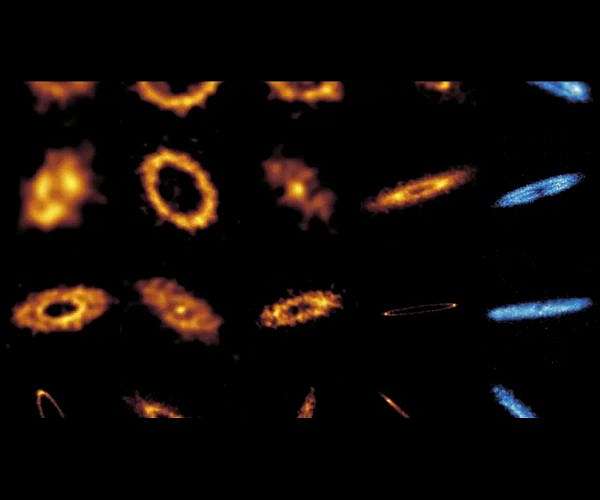
Debris discs mark a collision-dominated era when leftover planetesimals and minor bodies grind themselves down into dust through repeated impacts. In our own Solar System, this phase is represented today by the Kuiper Belt beyond Neptune, which preserves clues to giant impacts and orbital rearrangements that took place billions of years ago. By targeting debris belts around other stars, ARKS provides rare insight into what the Solar System experienced when the Moon was forming and the planets were still settling into their final orbits.
These teenage planetary systems are extremely difficult to observe because their discs are faint, often hundreds or thousands of times dimmer than the bright, gas-rich discs where planets are born. The ARKS team used ALMA's array of radio antennas to overcome this challenge, synthesizing high resolution images from the millimeter and submillimeter emission of dust grains and molecules. Instead of simple photographs, each image is reconstructed from radio signals collected by dozens of dishes working together as an interferometer.
The resulting images reveal an unexpected richness in disc structure. The survey shows belts with multiple rings and gaps, broad smooth halos of dust, sharply defined edges, and pronounced arcs and clumps that break the symmetry of the discs. This diversity suggests that many systems retain fossil structures from earlier stages of planet formation, while others have evolved into more diffuse configurations resembling expectations for the long term evolution of the Solar System's Kuiper Belt.
According to the ARKS team, roughly one third of the observed discs display clear substructures such as distinct rings or gaps. These features may be relics of planet building epochs or signatures of planets that continue to sculpt the dust over tens or hundreds of millions of years. In many systems, regions of enhanced vertical thickness point to zones of dynamical stirring, analogous to the contrast in our own Kuiper Belt between relatively undisturbed classical objects and bodies scattered onto more excited orbits by Neptune's migration.
The survey also uncovers several debris discs that contain more gas than theory would normally predict for this stage. In these systems, gas may be produced continuously by evaporating comets or collisions between icy bodies. The lingering gas can influence the chemistry in the disc and may help drive dust into extended halos, changing the appearance and evolution of the system in ways that ARKS is now beginning to map.
Lopsided discs are another striking outcome of the observations. Many systems show bright arcs, eccentric shapes, or concentrated clumps that imply gravitational perturbations from unseen planets or remnants of violent events such as giant impacts. These asymmetries may also arise from interactions between dust and gas, or from the combined effects of multiple planets migrating through the disc at different times in their histories.
The ARKS results highlight this teenage phase as a time of transition and upheaval for planetary systems. The discs appear to record a period when planetary orbits are reorganized, when large collisions can reshape surfaces and generate vast quantities of dust, and when families of planets and minor bodies settle into more stable configurations. By comparing discs around stars of different ages and types, the survey begins to distinguish which features are inherited from earlier epochs and which are sculpted later by planetary dynamics or external influences.
For researchers studying the Solar System, ARKS offers a new context for interpreting familiar structures. The team notes that the survey provides a fresh framework for understanding the craters on the Moon, the orbital architecture of Kuiper Belt objects, and the growth and migration histories of planets both large and small. In effect, ARKS fills in missing pages of the Solar System's family album by showing what similar systems look like during their restless teenage years.
The project involves an international collaboration of about 60 scientists led by institutions in the United Kingdom, Ireland, and the United States. The team has released all ARKS observations and processed data to the community, creating a benchmark dataset comparable to previous large ALMA programs that focused on younger, gas-rich discs. Astronomers worldwide can now mine these observations to search for additional patterns in debris disc structures and to link them more directly to known planets.
ALMA itself is an international facility on the high Chajnantor Plateau in northern Chile, operated as a partnership among the European Southern Observatory, the U.S. National Science Foundation, and Japan's National Institutes of Natural Sciences, in cooperation with the Republic of Chile. Funding for ALMA comes from agencies in Europe, North America, East Asia, and partner institutions in Taiwan and Korea, while the Joint ALMA Observatory coordinates construction, commissioning, and operations on site. The ARKS study, adapted in part from material provided by the National Radio Astronomy Observatory, adds a new chapter to ALMA's role in tracing the life cycles of planetary systems from birth to adulthood.
Research Report:The ALMA survey to Resolve exoKuiper belt Substructures (ARKS) - I: Motivation, sample, data reduction, and results overview
Related Links
Max Planck Institute for Astronomy
Lands Beyond Beyond - extra solar planets - news and science
Life Beyond Earth
| Subscribe Free To Our Daily Newsletters |
| Subscribe Free To Our Daily Newsletters |







