24/7 Space News
SOLAR SCIENCE
Multiple spacecraft track evolving solar storm to improve space weather forecasts
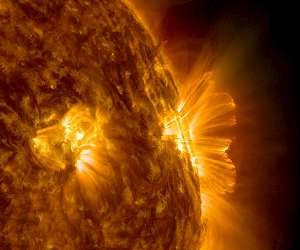
illustration only

Multiple spacecraft track evolving solar storm to improve space weather forecasts

by Riko Seibo
Tokyo, Japan (SPX) Jan 14, 2026
At times the sun ejects massive clouds of energetic material into space, and these events can disturb satellites, threaten astronauts and even affect power grids on the ground. Researchers are working to understand how these eruptions travel through the solar system so they can develop reliable space weather forecasts that protect critical technology and infrastructure.

A team including scientists from the University of Tokyo has now produced the first high-quality, multipoint measurements of how a cloud of solar ejecta evolves as it moves away from the sun. They used an ad hoc network of spacecraft instruments that were never originally designed to study solar eruptions, turning routine engineering monitors into scientific sensors that can track these events.

The eruptions, known as coronal mass ejections, or CMEs, are large blobs of magnetized plasma that erupt from the solar atmosphere and race outward through interplanetary space. When a CME passes near Earth, operators sometimes switch satellites into safe mode until the disturbance subsides, but better forecasting is needed because unexpected events can still cause serious damage.

The new method relies on a phenomenon called a Forbush decrease, where the intensity of background cosmic rays temporarily drops when a CME passes by. The CME's strong magnetic field deflects many of the high-energy charged particles that constantly bombard the solar system, making the CME appear partially opaque to cosmic rays. By measuring how the cosmic ray flux changes in time and space, the team can infer the structure of the CME and how it evolves during its journey.

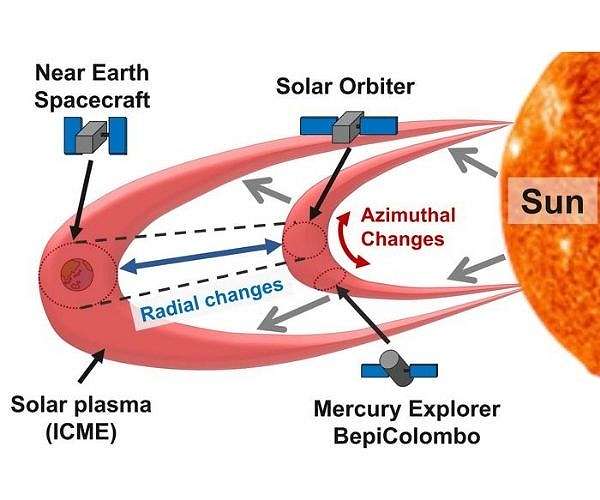
In March 2022, three spacecraft were fortuitously aligned to observe the same solar eruption from different vantage points: ESA's Solar Orbiter, ESA and JAXA's BepiColombo mission, and a NASA near-Earth spacecraft. This rare configuration allowed researchers to compare the event simultaneously along different directions and distances from the sun, building a more complete three-dimensional picture of the CME.

By combining the cosmic ray data with in situ measurements of the solar wind and magnetic field, the scientists linked variations in particle intensity directly to the physical structure of the eruption. This showed how the CME's shape and strength changed as it propagated outward, revealing details that are essential for improving models of solar storms and their potential impact on Earth.

A key result of the study is the demonstration that simple housekeeping instruments can be repurposed for frontline space weather science. On BepiColombo, the team carefully calibrated a system-monitoring detector, originally intended only to check spacecraft health, and transformed it into a sensor capable of registering Forbush decreases associated with CMEs. Long-ignored engineering data thus became a valuable scientific resource.

Unlike specialized instruments that may operate only intermittently, these general-purpose monitors tend to run continuously, providing an almost unbroken stream of measurements. When data from several such instruments on multiple spacecraft are combined, researchers can monitor CMEs from several locations at once and reconstruct their evolution in both space and time.

Because these instruments were not designed with this science in mind, the team first had to characterize their behavior from the ground up. They developed new calibration procedures and analysis techniques to extract reliable cosmic ray signals from the engineering telemetry, ensuring that the reconstructed particle variations truly reflected the passage of the CME.

With a growing fleet of spacecraft scattered between the sun and Earth and more missions planned, opportunities for routine multipoint observations are increasing. By integrating measurements from all available platforms, including repurposed engineering sensors, scientists expect to build much more accurate models of how solar ejections propagate and how they might affect planetary environments.

The work is reported in The Astrophysical Journal in a paper titled "Spatiotemporal Evolution of the 2022 March Interplanetary Coronal Mass Ejection Revealed by Multipoint Observations of Forbush Decreases". The authors describe how their approach links the observed cosmic ray decreases to the detailed structure of the CME and outline how similar methods could underpin future operational space weather forecasting systems.

Research Report:Spatiotemporal Evolution of the 2022 March Interplanetary Coronal Mass Ejection Revealed by Multipoint Observations of Forbush Decreases

Related Links
The University of Tokyo
Solar Science News at SpaceDaily

Subscribe Free To Our Daily Newsletters
Tweet

RELATED CONTENT
SOLAR SCIENCE
NJIT researchers discover long-hidden source of gamma rays unleashed by solar flares
Newark NJ (SPX) Jan 08, 2026
Solar physicists say they have found a key source of intense gamma rays unleashed when Earth's nearest star produces its most violent eruptions. In findings published in Nature Astronomy, scientists at NJIT's Center for Solar-Terrestrial Research (NJIT-CSTR) have pinpointed a previously unknown class of high-energy particles in the Sun's upper atmosphere responsible for generating the long-puzzling radiation signals observed during major solar flare events for decades. The signals were trace ... read more

SOLAR SCIENCE
NASA Back for Seconds with New Food System Design Challenge

New orbital mapping system targets Earth Moon libration traffic

International Space Station crew to return early after astronaut medical issue

Startups go public in litmus test for Chinese AI

SOLAR SCIENCE
PH-1 test flight advances Chinese reusable suborbital spacecraft plans

Starfighters completes supersonic tests for GE Aerospace ramjet program

Fueling research in nuclear thermal propulsion

Indian rocket hits snag during launch

SOLAR SCIENCE
Ancient deltas reveal vast Martian ocean across northern hemisphere

Tiny Mars' big impact on Earth's climate

The electrifying science behind Martian dust

Sandblasting winds sculpt Mars landscape

SOLAR SCIENCE
Tiangong science program delivers data surge

China tallies record launch year as lunar and asteroid plans advance

China harnesses nationwide system to drive spaceflight and satellite navigation advances

Shenzhou 21 crew complete eight hour spacewalk outside Tiangong station

SOLAR SCIENCE
Aerospacelab expands Pulsar navigation constellation work with new Xona satellite order

China outlines mega constellations in ITU satellite filings

Multiple satellite filings demonstrate transparency, responsibility and ambition: China Daily editorial

ThinkOrbital raises seed funding to advance orbital defense and construction systems

SOLAR SCIENCE
Momentus to flight test 3D printed fuel tank on Vigoride 7

How IVRT Testing Ensures Consistent Product Quality

Quantum camera startup plans satellite and telescope constellations

This exotic form of ice just got weirder

SOLAR SCIENCE
Creating hallucination-free, psychedelic-like molecules by shining light on life's basic building blocks

Pandora exoplanet mission checks in after launch

Mixed crystal phase of superionic water mapped inside giant planets

Berkeley Scientists set to home in on 100 signals from Seti at Home

SOLAR SCIENCE
Jupiter's moon Europa has a seafloor that may be quiet and lifeless

Uranus and Neptune may be rock rich worlds

SwRI links Uranus radiation belt mystery to solar storm driven waves

Looking inside icy moons


The content herein, unless otherwise known to be public domain, are Copyright 1995-2026 - SpaceDaily.com. All websites are published in Australia and are solely subject to Australian law and governed by Fair Use principals for news reporting and research purposes. AFP, UPI and IANS news wire stories are copyright Agence France-Presse, United Press International and Indo-Asia News Service. ESA news reports are copyright European Space Agency. All NASA sourced material is public domain. Additional copyrights may apply in whole or part to other bona fide parties. All articles labeled "by Staff Writers" include reports supplied to Space Media Network by industry news wires, PR agencies, corporate press officers and the like. Such articles are individually curated and edited by Space Media Network staff on the basis of the report's information value to our industry and professional readership. Advertising does not imply endorsement, agreement or approval of any opinions, statements or information provided by Space Media Network on any Web page published or hosted by Space Media Network. General Data Protection Regulation (GDPR) Statement Our advertisers use various cookies and the like to deliver the best ad banner available at one time. All network advertising suppliers have GDPR policies (Legitimate Interest) that conform with EU regulations for data collection. By using our websites you consent to cookie based advertising. If you do not agree with this then you must stop using the websites from May 25, 2018. Privacy Statement. Additional information can be found here at About Us.
Subscribe Free To Our Daily Newsletters