24/7 Space News
EXO WORLDS
M dwarf plasma torus offers window into space weather and planetary habitability
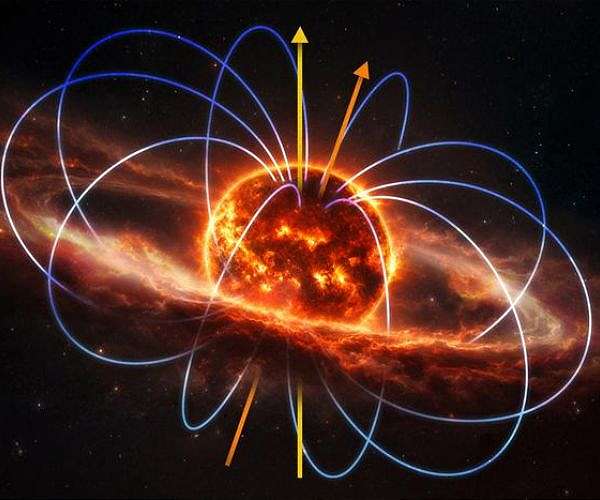
illustration only

M dwarf plasma torus offers window into space weather and planetary habitability

by Clarence Oxford
Los Angeles CA (SPX) Jan 08, 2026

Carnegie researcher Luke Bouma is using a naturally occurring plasma structure around certain young M dwarf stars as a kind of space weather station to investigate how stellar particles shape planetary environments and potential habitability. M dwarfs are smaller, cooler and dimmer than the Sun and commonly host at least one Earth-sized rocky planet, many of which are either too hot for liquid water or subjected to frequent flares and intense radiation that can strip or alter planetary atmospheres.

Bouma noted that stars affect their planets through both light and streams of particles such as stellar winds and magnetic storms, but the particle component remains difficult to characterize for distant systems. "Stars influence their planets. That's obvious. They do so both through light, which we're great at observing, and through particles-or space weather-like solar winds and magnetic storms, which are more challenging to study at great distances," Bouma explained. "And that's very frustrating, because we know in our own Solar System that particles can sometimes be more important for what happens to planets."

Because astronomers cannot place instruments around far-off stars, Bouma and collaborator Moira Jardine of the University of St Andrews focused on a class of young, rapidly rotating M dwarfs called complex periodic variables that show recurring dips in brightness. Observers had seen these regular dimmings for some time but did not know whether they arose from starspots or from orbiting material close to the stellar surface. "For a long time, no one knew quite what to make of these oddball little blips of dimming," Bouma said. "But we were able to demonstrate that they can tell us something about the environment right above the star's surface."

To resolve the origin of the dimming, Bouma and Jardine created what Bouma calls spectroscopic movies of one such complex periodic variable to track how material near the star absorbs light over time. The data indicated that the dips are produced by large clumps of relatively cool plasma trapped in the star's magnetosphere and carried around with the star by its magnetic field, forming a doughnut-shaped torus with dense clumps on opposite sides of the star. "Once we understood this, the blips in dimming stopped being weird little mysteries and became a space weather station," Bouma exclaimed. "The plasma torus gives us a way to know what's happening to the material near these stars, including where it's concentrated, how it's moving, and how strongly it is influenced by the star's magnetic field."

Bouma and Jardine estimate that at least 10 percent of M dwarfs in their early stages could host similar plasma tori. These natural probes can help astronomers assess how stellar particle environments are structured around young stars and how this particle flow may influence the conditions and atmospheres of any nearby planets.

A key next step is to determine whether the plasma torus material originates from the star itself, for example through outflows or flares, or from an external source associated with planetary material. "This is a great example of a serendipitous discovery, something we didn't expect to find but that will give us a new window into understanding planet-star relationships," Bouma concluded. "We don't know yet if any planets orbiting M dwarfs are hospitable to life, but I feel confident that space weather is going to be an important part of answering that question."

Research Report:A Plasma Torus around a Young Low-mass Star

Related Links
Carnegie Institution for Science
Lands Beyond Beyond - extra solar planets - news and science
Life Beyond Earth

Subscribe Free To Our Daily Newsletters
Tweet

RELATED CONTENT
The following news reports may link to other Space Media Network websites.
EXO WORLDS
Rogue planet mass pinned down for the first time
Tokyo, Japan (SPX) Jan 06, 2026
Peking University, January 2, 2026: A coordinated observation campaign using space- and ground-based telescopes has yielded the first precise mass measurement of a rogue planet, confirming that one long-standing candidate is indeed a planet. Unlike planets in the Solar System, rogue planets travel through space without orbiting a host star. Over the last decade, astronomers have identified about a dozen rogue planet candidates through brief microlensing events, when a compact object passes in fron ... read more

EXO WORLDS
Second ESCAPADE spacecraft completes key trajectory fix on path to Mars

China launches twin Shijian-29 satellites to test space-target detection tech

ESA reaches new benchmark in autonomous formation flying

Overseas scholars drawn to China's scientific clout, funding

EXO WORLDS
North Korea tests hypersonic missiles, says nuclear forces ready for war

Starfighters completes supersonic tests for GE Aerospace ramjet program

Galileo satellites ride Ariane 6 to boost Europe navigation resilience

AI systems proposed to boost launch cadence reliability and traffic management

EXO WORLDS
Sandblasting winds sculpt Mars landscape

Thin ice may have protected lake water on frozen Mars

Curiosity's Nevado Sajama postcard captures Mars on the eve of conjunction

Wind-Sculpted Landscapes: Investigating the Martian Megaripple 'Hazyview'

EXO WORLDS
China harnesses nationwide system to drive spaceflight and satellite navigation advances

Shenzhou 21 crew complete eight hour spacewalk outside Tiangong station

Foreign satellites ride Kinetica 1 on new CAS Space mission

Experts at Hainan symposium call for stronger global space partnership

EXO WORLDS
Time-expanded network model cuts complexity in mega constellation launch planning

Southern Launch to Host Lux Aeterna Re-Entries South Australia

Smart modeling framework targets 6G spectrum chaos in space air and ground networks

K2 Space raises 250m to scale Mega class high power satellites

EXO WORLDS
Essential Strategies for Enhancing Data Integrity and Compliance in Today's Business Environment

Momentus to flight test 3D printed fuel tank on Vigoride 7

Satellites lined up for shared space computing power networks

Planet delivers first light image from Pelican 6 satellite capturing Lhasa Gonggar Airport

EXO WORLDS
Deep Arctic gas hydrate mounds host ultra deep cold seep ecosystem

Joint ground- and space-based observations reveal Saturn-mass rogue planet

ALMA views giant dusty disk in Gomezs Hamburger with signs of early giant planet formation

We finally know how the most common types of planets are created

EXO WORLDS
Jupiter's moon Europa has a seafloor that may be quiet and lifeless

Uranus and Neptune may be rock rich worlds

SwRI links Uranus radiation belt mystery to solar storm driven waves

Looking inside icy moons

Subscribe Free To Our Daily Newsletters


The content herein, unless otherwise known to be public domain, are Copyright 1995-2024 - Space Media Network. All websites are published in Australia and are solely subject to Australian law and governed by Fair Use principals for news reporting and research purposes. AFP, UPI and IANS news wire stories are copyright Agence France-Presse, United Press International and Indo-Asia News Service. ESA news reports are copyright European Space Agency. All NASA sourced material is public domain. Additional copyrights may apply in whole or part to other bona fide parties. All articles labeled "by Staff Writers" include reports supplied to Space Media Network by industry news wires, PR agencies, corporate press officers and the like. Such articles are individually curated and edited by Space Media Network staff on the basis of the report's information value to our industry and professional readership. Advertising does not imply endorsement, agreement or approval of any opinions, statements or information provided by Space Media Network on any Web page published or hosted by Space Media Network. General Data Protection Regulation (GDPR) Statement Our advertisers use various cookies and the like to deliver the best ad banner available at one time. All network advertising suppliers have GDPR policies (Legitimate Interest) that conform with EU regulations for data collection. By using our websites you consent to cookie based advertising. If you do not agree with this then you must stop using the websites from May 25, 2018. Privacy Statement. Additional information can be found here at About Us.