





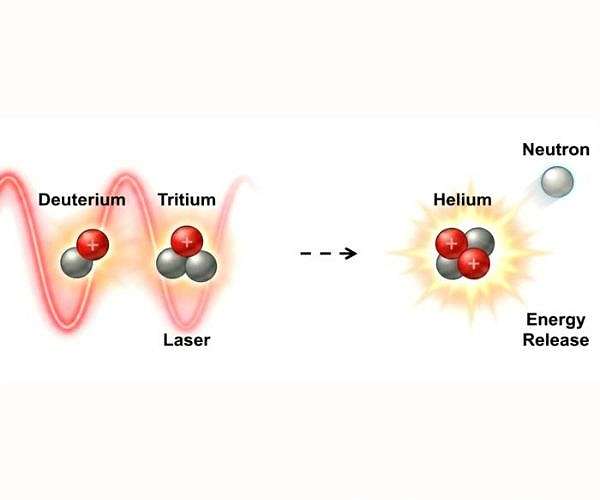
The research team, led by Assistant Professor Jintao Qi of Shenzhen Technology University with collaborators Professor Zhaoyan Zhou of the National University of Defense Technology and Professor Xu Wang of the Graduate School of the China Academy of Engineering Physics, analyzed how external laser fields affect nuclear fusion dynamics. In their framework, the laser does not replace thermal heating but acts as an assisting mechanism that modifies the relative motion of nuclei and increases the probability of quantum tunneling through the Coulomb barrier under given temperature conditions.
The study compares the influence of high frequency lasers such as X ray free electron lasers with that of low frequency lasers like near infrared solid state systems across a wide parameter range. Despite the higher energy carried by individual X ray photons, the calculations indicate that low frequency lasers enhance fusion more effectively under comparable conditions because they can drive multi photon processes involving very large numbers of absorbed and emitted photons during a nuclear encounter.
This multi photon interaction broadens the effective collision energy distribution of the reacting nuclei. Instead of a narrow range of collision energies set purely by the thermal environment, the presence of the laser field produces a wider distribution with an increased weight at higher effective energies. That redistribution can significantly raise the tunneling probability through the Coulomb barrier even when the initial kinetic energy of the nuclei is low.
Using the deuterium tritium fusion reaction as a benchmark, the authors quantify how strong low frequency laser fields change reaction probabilities at low energies. For collisions at 1 keV, where the bare fusion probability is normally extremely small, a low frequency laser with photon energy of 1.55 eV and intensity of 10^20 W/cm2 boosts the calculated fusion probability by three orders of magnitude. When the intensity rises to 5 x 10^21 W/cm2, the enhancement reaches nine orders of magnitude relative to the field free case.
In practical terms, this means that the effective fusion cross section at 1 keV with intense low frequency laser assistance can approach the cross section that would otherwise require a collision energy of about 10 keV without any laser field. The analysis therefore suggests a possible route to narrowing the gap between low temperature and high temperature fusion conditions by engineering the energy distribution of colliding nuclei rather than relying solely on higher thermal temperatures.
The work organizes laser assisted fusion behavior into a unified theoretical framework that spans different laser frequencies and intensities. Within this framework, intense laser fields emerge as tools that can in principle relax some of the stringent temperature requirements associated with controlled fusion while still operating within conventional fusion fuel cycles such as deuterium tritium.
The present model concentrates on an idealized system of two nuclei interacting in an external laser field, a simplification that allows detailed exploration of the fundamental mechanisms. The authors emphasize that realistic fusion plasmas involve many body effects, complex laser plasma interactions, and various channels for energy dissipation that must be incorporated before firm conclusions can be drawn about experimental implementation.
Future work will extend the theory to more realistic plasma environments where collective behavior, screening, and energy transport may alter or amplify the predicted enhancements. The researchers also point to the growing availability of high intensity laser facilities worldwide as a motivation to refine theoretical tools that connect idealized models with actual experimental conditions.
By clarifying how intense laser fields can reshape collision energy distributions and tunneling probabilities, the study adds to the emerging field of laser nuclear physics. The authors argue that their results provide theoretical guidance for designing future experiments that probe laser assisted fusion and assess whether such schemes can contribute to lower temperature routes toward practical fusion energy.
The full paper, titled Theory of laser assisted nuclear fusion, appears in the journal Nuclear Science and Techniques. The article can be accessed via the DOI link 10.1007/s41365-025-01879-x.
Research Report:Theory of laser-assisted nuclear fusion
Related Links
Shenzhen Technology University
Powering The World in the 21st Century at Energy-Daily.com
| Subscribe Free To Our Daily Newsletters |
| Subscribe Free To Our Daily Newsletters |








