





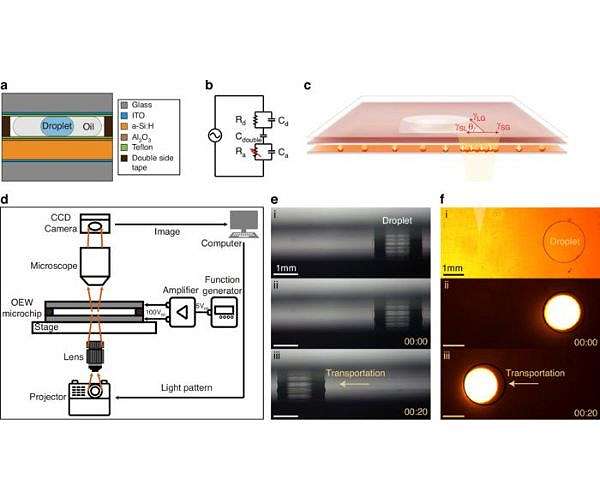
In the reported system, projected light patterns interact with an optoelectrowetting (OEW) structure to create virtual electrodes on the microchip surface instead of relying on fixed, lithographically defined metal electrodes. Localized illumination changes the wettability of selected regions, guiding droplets to deform, shrink, and detach in a controlled way as the light pattern evolves. This approach allows the same hardware platform to support different dispensing behaviors simply by reprogramming the illumination pattern.
Droplet based microfluidic systems already play a central role in biochemical assays, diagnostics, and drug discovery because they reduce reagent consumption and improve reaction control compared with traditional tube based methods. However, conventional electrowetting systems depend on rigid electrode layouts, which limit flexibility and require complex fabrication steps. Many optical control methods offer greater spatial freedom but often produce inconsistent droplet sizes and poor reproducibility, largely because droplet necking and pinch off occur randomly, leading to large volume errors especially below hundreds of nanoliters.
To address these limitations, a team from the Southern University of Science and Technology, working with the Aerospace Information Research Institute, designed an OEW based droplet dispensing system that uses programmable light patterns to precisely control droplet formation. Their work, published on November 28, 2025 in the journal Microsystems and Nanoengineering, introduces a dynamic light guided strategy that enables reliable dispensing of nanoliter droplets with tunable volumes. By projecting carefully tailored optical patterns onto a microfluidic chip, the system achieves accurate droplet shaping, separation, and transport while maintaining high precision and strong reproducibility in small volume liquid handling.
The core innovation lies in the dynamic light pattern used to actively manage droplet deformation and pinch off during dispensing. Instead of having the droplet follow a fixed electrode geometry, the system generates virtual electrodes using light, which can be reconfigured in real time. A specially designed necking light pattern stabilizes the liquid bridge that forms between the parent droplet and the emerging daughter droplet, reducing the randomness that typically accompanies droplet breakup.
During operation, the parent droplet first extends under the influence of the illumination pattern, forming a liquid bridge. The system then applies a controlled back pumping step that reshapes the liquid to match the imposed light pattern, effectively slowing down the pinch off process. By moderating the breakup dynamics in this way, the platform suppresses random splitting behavior and significantly improves volume accuracy.
Systematic optimization of light pattern geometry, applied voltage, and necking position allowed the researchers to demonstrate high precision in droplet generation. For droplets around 36 nanoliters in volume, they reported a minimum relative error of 0.45 percent and a coefficient of variation of 2.49 percent. These values indicate that the system can produce nearly identical droplets repeatedly, even at volumes where many existing methods struggle to maintain consistency.
The OEW based platform also proved highly flexible, accurately dispensing droplets over a broad size range while keeping errors below commonly accepted thresholds for microfluidic experiments. This tunability means that a single device can support different biochemical protocols that require distinct droplet volumes without hardware changes, relying only on adjustments to the light patterns and operating conditions.
To demonstrate practical utility, the researchers carried out polymerase chain reaction (PCR) amplification in droplets generated on the chip. They showed that PCR performance in these on chip droplets matched that of manually pipetted samples, even when the reaction volumes were below 200 nanoliters. This result indicates that the light guided dispensing system can reliably support sensitive biochemical reactions at very small scales without compromising reaction quality.
According to the corresponding author, the work shows that light can be used not only to move droplets but also to precisely define their final volume. By controlling the entire dispensing process with programmable optical patterns, the system removes many sources of randomness that limit conventional microfluidic platforms. The ability to produce uniform nanoliter droplets with such low volume error opens up new opportunities for automated biochemical workflows where consistency and miniaturization are critical.
The light guided droplet dispensing strategy offers a versatile solution for lab on a chip platforms targeting molecular diagnostics, drug screening, and organ on a chip research. Its capability to handle sub 200 nanoliter volumes reliably addresses a long standing gap between conventional pipetting and fully automated microfluidic systems. Because the technique avoids complex electrode fabrication steps, it also simplifies device design and enhances scalability for potential commercial implementation.
More broadly, the study underscores how optical control can transform digital microfluidics into a flexible, reconfigurable tool for precision chemistry and biology. By decoupling droplet control from fixed hardware layouts and shifting it to software defined light fields, the approach could support rapid reconfiguration of experimental protocols across clinical testing, pharmaceutical development, and high throughput biochemical analysis.
Research Report:A high-precision nanoliter droplet dispensing system based on optoelectrowetting with tunable droplet volume
Related Links
Aerospace Information Research Institute, Chinese Academy of Sciences
Computer Chip Architecture, Technology and Manufacture
Nano Technology News From SpaceMart.com
| Subscribe Free To Our Daily Newsletters |
| Subscribe Free To Our Daily Newsletters |








