24/7 Space News
STELLAR CHEMISTRY
Jets from black hole drive record coronal gas stream in nearby galaxy
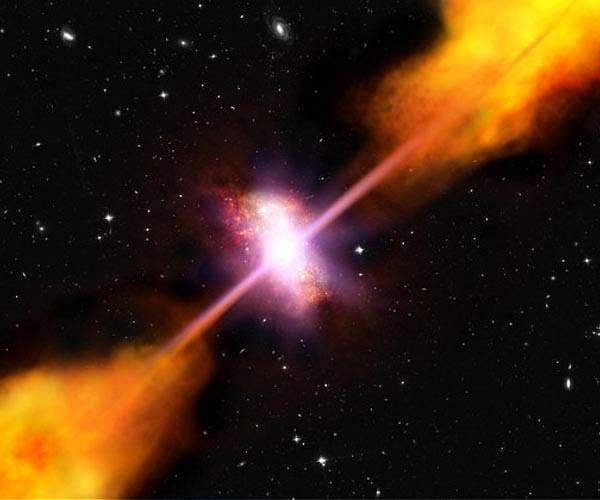
illustration only

Jets from black hole drive record coronal gas stream in nearby galaxy

by Clarence Oxford
Los Angeles CA (SPX) Jan 09, 2026

Astronomers at the University of California, Irvine have identified the largest-known stream of super-heated gas in the universe flowing out of a nearby disk galaxy called VV 340a, with their findings reported in Science. The gas, traced using data from NASA's James Webb Space Telescope, emerges from both sides of the galaxy as two elongated nebulae powered by an active supermassive black hole at the galaxy's center, with each nebula extending at least three kiloparsecs, comparable to the roughly three-kiloparsec thickness of the galaxy's disk.

In most galaxies, highly energized gas associated with active black holes remains confined within several tens of parsecs of the central black hole, but in VV 340a the structure is larger by a factor of 30 or more. "In other galaxies, this type of highly energized gas is almost always confined to several tens of parsecs from a galaxy's black hole, and our discovery exceeds what is typically seen by a factor of 30 or more," said lead author Justin Kader, a UC Irvine postdoctoral researcher in physics and astronomy.

The team combined observations from multiple facilities, including radio images from the Karl G. Jansky Very Large Array near San Agustin, New Mexico, which show a pair of large-scale plasma jets emerging from either side of VV 340a. These jets arise as gas falling into the active supermassive black hole encounters extreme temperatures and magnetic fields, energizing material and ejecting it from the galaxy, and on larger scales the jets trace a helical pattern that signals jet precession, a gradual change in the jet's orientation over time.

"This is the first observation of a precessing kiloparsec-scale radio jet in a disk galaxy," said Kader. "To our knowledge, this is the first time we have seen a kiloparsec, or galactic-scale, precessing radio jet driving a massive coronal gas outflow." The researchers propose that as the jets propagate outward they interact with and push surrounding galactic material, heating it to form coronal line gas, a hot, highly ionized plasma normally confined to the compact inner region around active supermassive black holes and rarely observed extending deep into or beyond the host galaxy.

Kader estimated that the kinetic power carried by the outflowing coronal gas is equivalent to 10 quintillion hydrogen bombs detonating every second. "We found the most extended and coherent coronal gas structure to date," said senior co-author Vivian U, a former UC Irvine research astronomer now at Caltech's Infrared Processing and Analysis Center. "We expected JWST to open up the wavelength window where these tools for probing active supermassive black holes would be available to us, but we had not expected to see such highly collimated and extended emission in the first object we looked at. It was a nice surprise."

Observations from the Keck II Telescope in Hawaii revealed additional gas extending to about 15 kiloparsecs from the active black hole, which the authors interpret as cooler material marking the fossil record of past jet - galaxy interactions. This debris likely traces earlier episodes in which the jet expelled gas from the galaxy's inner regions, leaving behind large-scale structures that complement the currently observed coronal outflow.

Webb's infrared instruments, operating from a solar orbit about one million miles from Earth, were central to detecting the coronal line emission from VV 340a, a dusty system that obscures much of its interior from visible light observatories such as Keck. Infrared observations penetrate the dust, revealing the hot plasma flowing out of the galaxy, and the study concludes that the jet removes enough gas each year to equal the mass of 19 suns, substantially depleting the galaxy's reservoir of star-forming material.

"What it really is doing is significantly limiting the process of star formation in the galaxy by heating and removing star-forming gas," said Kader. A comparable jet has not been identified in the Milky Way, though Kader noted evidence that the Milky Way's central supermassive black hole experienced an active feeding event about two million years ago, which ancient Homo erectus observers on Earth might have seen in the night sky.

With the precessing jet and its associated coronal outflow now characterized in VV 340a, Kader and U plan to examine other galaxies for similar signatures to better understand how galaxies like the Milky Way evolve. "We are excited to continue exploring such never-before-seen phenomena at different physical scales of galaxies using observations from these state-of-the-art tools, and we can't wait to see what else we will find," U said. The project received funding from NASA and the National Science Foundation.

Research Report:A precessing jet from an active galactic nucleus drives gas outflow from a disk galaxy

Related Links
University of California - Irvine
Stellar Chemistry, The Universe And All Within It

Subscribe Free To Our Daily Newsletters
Tweet

RELATED CONTENT
The following news reports may link to other Space Media Network websites.
STELLAR CHEMISTRY
Milky Way black hole flare leaves X ray echoes in nearby gas cloud
Los Angeles CA (SPX) Jan 07, 2026
Our galaxy's supermassive black hole is among the faintest known, yet new observations indicate it was far more active in the recent past on cosmic timescales. Sagittarius A*, at the Milky Way's center, appears to have produced a powerful X ray flare within the last few hundred to 1,000 years, leaving an observable imprint in surrounding gas. Michigan State University researcher Stephen DiKerby and colleagues used the XRISM space telescope to measure X rays from a giant molecular cloud close to th ... read more

STELLAR CHEMISTRY
Second ESCAPADE spacecraft completes key trajectory fix on path to Mars

China launches twin Shijian-29 satellites to test space-target detection tech

ESA reaches new benchmark in autonomous formation flying

Overseas scholars drawn to China's scientific clout, funding

STELLAR CHEMISTRY
North Korea tests hypersonic missiles, says nuclear forces ready for war

Starfighters completes supersonic tests for GE Aerospace ramjet program

Galileo satellites ride Ariane 6 to boost Europe navigation resilience

AI systems proposed to boost launch cadence reliability and traffic management

STELLAR CHEMISTRY
Sandblasting winds sculpt Mars landscape

Thin ice may have protected lake water on frozen Mars

Curiosity's Nevado Sajama postcard captures Mars on the eve of conjunction

Wind-Sculpted Landscapes: Investigating the Martian Megaripple 'Hazyview'

STELLAR CHEMISTRY
China harnesses nationwide system to drive spaceflight and satellite navigation advances

Shenzhou 21 crew complete eight hour spacewalk outside Tiangong station

Foreign satellites ride Kinetica 1 on new CAS Space mission

Experts at Hainan symposium call for stronger global space partnership

STELLAR CHEMISTRY
Time-expanded network model cuts complexity in mega constellation launch planning

Southern Launch to Host Lux Aeterna Re-Entries South Australia

Smart modeling framework targets 6G spectrum chaos in space air and ground networks

K2 Space raises 250m to scale Mega class high power satellites

STELLAR CHEMISTRY
From Space Missions to Media Buying How Automation Is Redefining Complex Systems

Essential Strategies for Enhancing Data Integrity and Compliance in Today's Business Environment

Momentus to flight test 3D printed fuel tank on Vigoride 7

Satellites lined up for shared space computing power networks

STELLAR CHEMISTRY
Deep Arctic gas hydrate mounds host ultra deep cold seep ecosystem

Joint ground- and space-based observations reveal Saturn-mass rogue planet

ALMA views giant dusty disk in Gomezs Hamburger with signs of early giant planet formation

We finally know how the most common types of planets are created

STELLAR CHEMISTRY
Jupiter's moon Europa has a seafloor that may be quiet and lifeless

Uranus and Neptune may be rock rich worlds

SwRI links Uranus radiation belt mystery to solar storm driven waves

Looking inside icy moons

Subscribe Free To Our Daily Newsletters


The content herein, unless otherwise known to be public domain, are Copyright 1995-2024 - Space Media Network. All websites are published in Australia and are solely subject to Australian law and governed by Fair Use principals for news reporting and research purposes. AFP, UPI and IANS news wire stories are copyright Agence France-Presse, United Press International and Indo-Asia News Service. ESA news reports are copyright European Space Agency. All NASA sourced material is public domain. Additional copyrights may apply in whole or part to other bona fide parties. All articles labeled "by Staff Writers" include reports supplied to Space Media Network by industry news wires, PR agencies, corporate press officers and the like. Such articles are individually curated and edited by Space Media Network staff on the basis of the report's information value to our industry and professional readership. Advertising does not imply endorsement, agreement or approval of any opinions, statements or information provided by Space Media Network on any Web page published or hosted by Space Media Network. General Data Protection Regulation (GDPR) Statement Our advertisers use various cookies and the like to deliver the best ad banner available at one time. All network advertising suppliers have GDPR policies (Legitimate Interest) that conform with EU regulations for data collection. By using our websites you consent to cookie based advertising. If you do not agree with this then you must stop using the websites from May 25, 2018. Privacy Statement. Additional information can be found here at About Us.