24/7 Space News
STELLAR CHEMISTRY
Milky Way stars mapped as major source of ghost particle flux at Earth
illustration only

Milky Way stars mapped as major source of ghost particle flux at Earth

by Robert Schreiber
Berlin, Germany (SPX) Jan 09, 2026

Neutrinos, often called ghost particles, are elementary particles that are electrically neutral, extremely light, and interact only rarely with other matter. Trillions pass through Earth and the human body every second without leaving a trace, which makes them difficult to detect but valuable as probes of regions of the universe that are otherwise hidden.

Researchers at the University of Copenhagen have developed the most detailed model so far of neutrinos produced by stars across the Milky Way and of how many of these particles reach Earth. The model provides a galaxy-wide estimate of the neutrino flux from stellar nuclear reactions and traces where in the galactic disk these particles originate. The work has been published in Physical Review D.

"For the first time, we have a concrete estimate of how many of these particles reach Earth, where in the galaxy they come from, and how their energy is distributed. Because ghost particles come straight from the core of stars, they can tell us things that light and other radiation cannot," says lead author of the new study, postdoc Pablo Martinez-Mirave from the Niels Bohr Institute.

To construct the map, the team combined advanced stellar models with positional and population data from ESA's Gaia space telescope to identify where in the Milky Way neutrinos mainly originate. This approach allowed them to calculate the neutrino production of stars of different masses and ages and then integrate these contributions over the full stellar population of the galaxy.

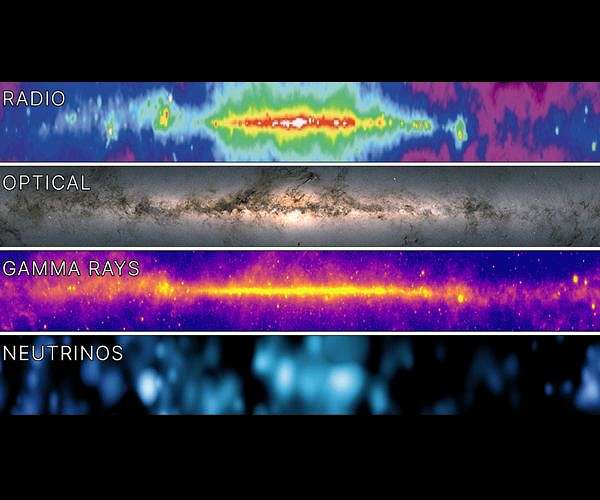
The study shows that most stellar neutrinos that reach Earth come from the crowded region around the galactic center, where the density of stars is highest, with especially strong contributions from regions a few thousand light-years from our planet. Stars with masses comparable to or higher than the Sun dominate the emission, and this directional dependence means detectors will see the strongest signal when they observe toward the center of the galaxy.

This new mapping offers a practical tool for experiments that aim to detect galactic neutrinos using large detectors placed deep underground or under ice or water. With the flux distribution now quantified, observatories can refine their observing strategies and improve the chances of separating a Milky Way neutrino signal from other background sources. "Now we know more precisely where to look for Galactic neutrinos. Our results show that most neutrinos are produced in stars that are as massive or more massive than the Sun. This means that the best chance of detecting neutrino signals is when looking towards the galactic centre, where the signal is the strongest," explains Pablo Martinez-Mirave.

The mapping also clarifies how neutrino emission depends on stellar properties. The results indicate that younger, more massive stars generate the highest neutrino output, while lower-mass and older stars contribute at lower levels across a wide energy spectrum. Most of the particles arise from nuclear reactions in stellar cores, with an additional contribution from thermal processes inside stars.

Unlike light, X-rays, or gamma rays, neutrinos can travel enormous distances almost unaffected by intervening matter and fields, preserving information about the environments in which they were created. For decades, measurements of solar neutrinos have provided insight into conditions deep inside the Sun, and the researchers suggest that a similar approach, extended to the entire stellar population of the galaxy, could eventually reveal details of stellar life cycles and galactic structure that are not accessible through electromagnetic observations alone.

"Neutrinos carry information straight from the interior of stars. If we learn to harness them, they can give us new insights into stellar life cycles and the structure of our galaxy in a way no other source can," says senior author of the study, Professor Irene Tamborra from the Niels Bohr Institute. Because neutrinos are expected to propagate over galactic distances with only minimal alteration, they also offer a sensitive way to test the limits of known physics.

The researchers point out that even small discrepancies between observed neutrino behavior and standard model predictions could indicate new physical phenomena. "Because neutrinos are barely affected, we have clear expectations of how they should behave on their long journey to Earth. So even tiny deviations in their behaviour would be a strong clue to new, unknown physics," says Irene Tamborra. "With neutrinos, it's like dimming the lights in a room and suddenly seeing what was hidden in the dark - and with this new model, we now have both a map and a compass to start navigating it."

According to the team, the model provides a baseline for interpreting future signals from current and next-generation neutrino observatories. As detectors improve in sensitivity and directional capability, the map of stellar neutrinos from the Milky Way could help separate different neutrino populations, such as those from the Sun, distant supernovae, or other high-energy cosmic events, and refine understanding of how stars throughout the galaxy contribute to the overall neutrino background at Earth.

Research Report:Neutrinos from stars in the Milky Way

Related Links
University of Copenhagen
Stellar Chemistry, The Universe And All Within It

Subscribe Free To Our Daily Newsletters
Tweet

RELATED CONTENT
The following news reports may link to other Space Media Network websites.
STELLAR CHEMISTRY
Milky Way black hole flare leaves X ray echoes in nearby gas cloud
Los Angeles CA (SPX) Jan 07, 2026
Our galaxy's supermassive black hole is among the faintest known, yet new observations indicate it was far more active in the recent past on cosmic timescales. Sagittarius A*, at the Milky Way's center, appears to have produced a powerful X ray flare within the last few hundred to 1,000 years, leaving an observable imprint in surrounding gas. Michigan State University researcher Stephen DiKerby and colleagues used the XRISM space telescope to measure X rays from a giant molecular cloud close to th ... read more

STELLAR CHEMISTRY
Second ESCAPADE spacecraft completes key trajectory fix on path to Mars

China launches twin Shijian-29 satellites to test space-target detection tech

ESA reaches new benchmark in autonomous formation flying

Overseas scholars drawn to China's scientific clout, funding

STELLAR CHEMISTRY
North Korea tests hypersonic missiles, says nuclear forces ready for war

Starfighters completes supersonic tests for GE Aerospace ramjet program

Galileo satellites ride Ariane 6 to boost Europe navigation resilience

AI systems proposed to boost launch cadence reliability and traffic management

STELLAR CHEMISTRY
Sandblasting winds sculpt Mars landscape

Thin ice may have protected lake water on frozen Mars

Curiosity's Nevado Sajama postcard captures Mars on the eve of conjunction

Wind-Sculpted Landscapes: Investigating the Martian Megaripple 'Hazyview'

STELLAR CHEMISTRY
China harnesses nationwide system to drive spaceflight and satellite navigation advances

Shenzhou 21 crew complete eight hour spacewalk outside Tiangong station

Foreign satellites ride Kinetica 1 on new CAS Space mission

Experts at Hainan symposium call for stronger global space partnership

STELLAR CHEMISTRY
Time-expanded network model cuts complexity in mega constellation launch planning

Southern Launch to Host Lux Aeterna Re-Entries South Australia

Smart modeling framework targets 6G spectrum chaos in space air and ground networks

K2 Space raises 250m to scale Mega class high power satellites

STELLAR CHEMISTRY
From Space Missions to Media Buying How Automation Is Redefining Complex Systems

Essential Strategies for Enhancing Data Integrity and Compliance in Today's Business Environment

Momentus to flight test 3D printed fuel tank on Vigoride 7

Satellites lined up for shared space computing power networks

STELLAR CHEMISTRY
Deep Arctic gas hydrate mounds host ultra deep cold seep ecosystem

Joint ground- and space-based observations reveal Saturn-mass rogue planet

ALMA views giant dusty disk in Gomezs Hamburger with signs of early giant planet formation

We finally know how the most common types of planets are created

STELLAR CHEMISTRY
Jupiter's moon Europa has a seafloor that may be quiet and lifeless

Uranus and Neptune may be rock rich worlds

SwRI links Uranus radiation belt mystery to solar storm driven waves

Looking inside icy moons

Subscribe Free To Our Daily Newsletters


The content herein, unless otherwise known to be public domain, are Copyright 1995-2024 - Space Media Network. All websites are published in Australia and are solely subject to Australian law and governed by Fair Use principals for news reporting and research purposes. AFP, UPI and IANS news wire stories are copyright Agence France-Presse, United Press International and Indo-Asia News Service. ESA news reports are copyright European Space Agency. All NASA sourced material is public domain. Additional copyrights may apply in whole or part to other bona fide parties. All articles labeled "by Staff Writers" include reports supplied to Space Media Network by industry news wires, PR agencies, corporate press officers and the like. Such articles are individually curated and edited by Space Media Network staff on the basis of the report's information value to our industry and professional readership. Advertising does not imply endorsement, agreement or approval of any opinions, statements or information provided by Space Media Network on any Web page published or hosted by Space Media Network. General Data Protection Regulation (GDPR) Statement Our advertisers use various cookies and the like to deliver the best ad banner available at one time. All network advertising suppliers have GDPR policies (Legitimate Interest) that conform with EU regulations for data collection. By using our websites you consent to cookie based advertising. If you do not agree with this then you must stop using the websites from May 25, 2018. Privacy Statement. Additional information can be found here at About Us.