





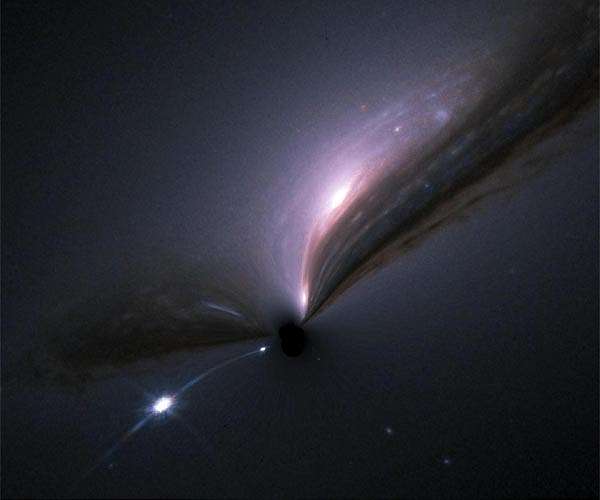
The observations show super heated gas erupting from both sides of the galaxy in the form of two elongated nebulae powered by an active supermassive black hole at the galaxy's center. Each nebula extends for at least three kiloparsecs, or thousands of light years, making the outflow comparable in scale to the three kiloparsec thick disk of VV 340a itself.
"In other galaxies, this type of highly energized gas is almost always confined to several tens of parsecs from a galaxy's black hole, and our discovery exceeds what is typically seen by a factor of 30 or more," said lead author Justin Kader, a UC Irvine postdoctoral researcher in physics and astronomy. According to the team, such an extreme structure has not been seen before in a disk galaxy.
Radio wave images from the Karl G. Jansky Very Large Array observatory near San Agustin, New Mexico, revealed a pair of large scale plasma jets emerging from either side of VV 340a. These jets form as gas falling toward the central supermassive black hole reaches extreme temperatures and magnetic field strengths, which then channel material outward at high speed and energize the surrounding gas.
At larger distances from the galaxy's core, the ejecting jets trace out a helical shape that indicates jet precession, a gradual change in the jets' orientation over time similar to the wobble of a spinning top. "This is the first observation of a precessing kiloparsec scale radio jet in a disk galaxy," Kader said. "To our knowledge, this is the first time we have seen a kiloparsec, or galactic scale, precessing radio jet driving a massive coronal gas outflow."
As the jets propagate outward, they appear to couple strongly with material in the host galaxy, pushing it away from the center and exciting it into a highly energized state. The interaction creates what astronomers call coronal line gas, a hot, highly ionized plasma named by analogy with the outer atmosphere, or corona, of the sun. This super heated coronal gas is normally confined to the compact inner regions around active supermassive black holes and is rarely observed extending far into, much less beyond, the host galaxy.
The kinetic power carried by the outflowing coronal gas is enormous. Kader likened it to the energy output of about 10 quintillion hydrogen bombs detonating every second, a level sufficient to alter the evolution of the galaxy. Senior co author Vivian U, formerly a UC Irvine research astronomer and now an associate scientist at Caltech's Infrared Processing and Analysis Center, emphasized that the team did not expect to see such a coherent, collimated, and extended coronal gas structure in the first object they examined with Webb.
"We found the most extended and coherent coronal gas structure to date," U said. "We expected JWST to open up the wavelength window where these tools for probing active supermassive black holes would be available to us, but we had not expected to see such highly collimated and extended emission in the first object we looked at. It was a nice surprise."
The researchers built up a detailed picture of the jets and the coronal line emission by combining observations from multiple telescopes operating at different wavelengths. Spectroscopic data from the Keck II Telescope in Hawaii, part of the W. M. Keck Observatory administered by the University of California, showed additional gas extending out to about 15 kiloparsecs from the active black hole.
This more distant, cooler gas appears to be a fossil record of the jets' past interactions with the galaxy, recording earlier episodes in which the jet ejected material from the galactic center. The extended structures suggest that the central engine has been active for a significant period, repeatedly disturbing the interstellar medium of VV 340a.
The Webb telescope contributed crucial observations of the coronal gas using its infrared instruments. Orbiting the sun about one million miles from Earth, Webb is the largest space telescope ever built and is designed to study the universe at infrared wavelengths. Its sensitivity at these wavelengths allows it to detect phenomena that would remain hidden to telescopes operating in visible light.
VV 340a contains large amounts of dust that block visible light from the galaxy's interior, limiting what facilities like Keck can see. Infrared light, however, passes through much of the dust, so Webb's images revealed the coronal line gas erupting from the galaxy that had been obscured at shorter wavelengths. With this view, the extent and structure of the super heated gas outflow became clear.
The team estimates that the jet is removing enough gas from VV 340a each year to make about 19 stars with masses similar to the sun. By heating and expelling star forming gas, the outflow can significantly limit the rate at which new stars form in the galaxy and may help shut down or regulate its growth over cosmic time.
"What it really is doing is significantly limiting the process of star formation in the galaxy by heating and removing star forming gas," Kader said. The work provides a direct example of how energy released by a central black hole can affect an entire galaxy.
No similar precessing, kiloparsec scale jet appears to exist in the Milky Way today. Kader noted, however, that there is evidence our galaxy's own supermassive black hole experienced an active feeding event about two million years ago. That episode may have produced bright features in the sky that early human ancestors, such as Homo erectus, could have seen at night.
With the discovery of the precessing jet and its associated outflowing gas in VV 340a, Kader and U see an opportunity to better understand how galaxies evolve. They plan to search for the same phenomenon in other galaxies using Webb and complementary observatories, looking for additional examples of large scale, precessing jets and their impact on their hosts.
"We are excited to continue exploring such never before seen phenomena at different physical scales of galaxies using observations from these state of the art tools, and we can't wait to see what else we will find," U said. The project received funding support from NASA and the National Science Foundation.
Research Report:The most coherent coronal outflow in the universe traced by a precessing jet in the disk galaxy VV 340a
Related Links
Department of Physics and Astronomy at UCIrvine
Stellar Chemistry, The Universe And All Within It
| Subscribe Free To Our Daily Newsletters |
| Subscribe Free To Our Daily Newsletters |








