24/7 Space News
SOLAR DAILY
India's solar-panel boom: full throttle today, uncertain tomorrow

India's solar-panel boom: full throttle today, uncertain tomorrow

By Philippe ALFROY
Mundra, India (AFP) Jan 25, 2026

The race for green energy is on. India, driven by soaring electricity demand and a push to reduce reliance on China, is rapidly producing solar panels, fuelling a booming yet uncertain market.

At the Adani Group's factory in Mundra, in India's western state of Gujarat, assembly lines churn out photovoltaic panels around the clock.

Up to 10,000 a day come off the line, with most sent straight to Khavda, further north, where the Indian conglomerate is finishing what will be the world's largest solar park.

But Adani Solar's CEO, Muralee Krishnan, says operations are "actually lagging".

"Our capacity needs to be fully used -- we should work 48 hours a day."

The intensity is matched by other major producers in the world's most populous nation.

At the Tata conglomerate factory in Tirunelveli, in the southern state of Tamil Nadu, 4,000 mostly women employees also work non-stop shifts.

"They operate 24/7, so you get better yield, better efficiency, better productivity," said Praveer Sinha, CEO of Tata Power.

"You cannot stop the production line... there is a rush to produce to maximise the output."

With the twin imperatives of development and lower carbon emissions, India has set itself ambitious renewable energy targets.

Last year, it said half its electricity-generation capacity was now "green", five years ahead of the timeline set in the Paris Agreement on lowering emissions.

But 75 percent of electricity is still generated by coal-fired power plants, with inflexible operations and long-term coal power purchase agreements hampering renewable uptake.

- 'Make in India' -

There are signs of change.

Last year, coal-fired power generation fell three percent, only the second full-year drop recorded in half a decade, according to the Centre for Research on Energy and Clean Air.

Renewable capacity of 230 gigawatts (GW) is set to rise to 500 GW by 2030, including 280 GW of solar.

But Prime Minister Narendra Modi has placed another constraint on the industry: "Make in India."

That means there is no question of importing solar panels from China, which supplies 90 percent of the world's market.

All public tenders require "local" production, which India supports with substantial subsidies that have attracted big businesses.

Tata, a pioneer in solar panels since the 1990s, has been joined by Adani and Reliance, which have built state-of-the-art, highly automated factories.

"The quality of the product is very, very critical," said Ashish Khanna, CEO Adani Green Energy.

"When you are building a project of this size, you also need to be very reassured of the supply chain. We cannot have a disruption or interruption in that particular process."

But for now, the technology and raw materials still come from China.

And Beijing has complained to the World Trade Organization over the subsidies and restrictions on its solar panels.

The solar push is so intense that Adani is considering silicon mining to secure a key raw material, company insiders say, and there are suggestions Tata Power is eyeing in-house silicon-wafer production.

- 'A huge market' -

Growth in the sector is already staggering, with solar manufacturing capacity expected to soon exceed 125 GW, according to consultancy Wood Mackenzie said.

But that is triple current domestic demand, according to Wood Mackenzie analyst Yana Hryshko.

Government incentives have "been highly effective in spurring factory announcements, but the industry is now seeing warning signs of rapid overcapacity", Hryshko said in a report last year.

The sector's long-term sustainability may therefore depend on exports, with some companies already targeting global markets.

"Solar is a huge market: the world will see it doubling, from 2,000 GW to 4,000 GW in four years," said Ashish Khanna, head of the International Solar Alliance.

"The question is now -- will Indian manufacturers be globally competitive compared to China?"

Tejpreet Chopra, from the private power company Bharat Light and Power, points out that "the problem is that it's cheaper to import from China than to buy local".

And the level of manufacturing in China "is so much higher that it's very difficult to match", he added.

The sector also faces "geopolitical" headwinds from US President Donald Trump's tariffs, with Chopra adding that they make it "very difficult to sell to the United States".

Despite these challenges, the head of Tata Power, which does not yet export, remains convinced his business has a bright future.

"We strongly believe," said Praveer Sinha, "that solar will play a very important role in the renewable space of India."

pa/pjm/dan

Adani

TATA POWER COMPANY

Related Links
All About Solar Energy at SolarDaily.com

Subscribe Free To Our Daily Newsletters
Tweet

RELATED CONTENT
The following news reports may link to other Space Media Network websites.
SOLAR DAILY
Rare Mojave milkvetch thrives amid Gemini solar array
Los Angeles CA (SPX) Jan 19, 2026
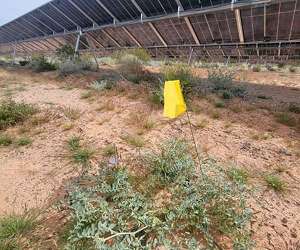
Surveys at one of the largest solar energy facilities in the Mojave Desert indicate that a rare annual plant is not only persisting but flourishing under a construction approach designed to preserve desert soils and seedbanks. Researchers monitoring the Gemini Solar Project northeast of Las Vegas documented a sharp increase in the number and size of threecorner milkvetch plants two years after panel installation compared with preconstruction conditions. The work, led by ecologist Tiffany Pereira o ... read more

SOLAR DAILY
Tourists hit record in Japan, despite plunge from China

What happens when fire ignites in space? 'A ball of flame'

ISS astronauts splash down on Earth after first-ever medical evacuation

NASA Back for Seconds with New Food System Design Challenge

SOLAR DAILY
Elon Musk hints at buying Ryanair amid Starlink spat

Fueling research in nuclear thermal propulsion

Firefly prepares Alpha Block II upgrade for Flight 8

PH-1 test flight advances Chinese reusable suborbital spacecraft plans

SOLAR DAILY
Ancient deltas reveal vast Martian ocean across northern hemisphere

Tiny Mars' big impact on Earth's climate

The electrifying science behind Martian dust

Sandblasting winds sculpt Mars landscape

SOLAR DAILY
Tiangong science program delivers data surge

China tallies record launch year as lunar and asteroid plans advance

China harnesses nationwide system to drive spaceflight and satellite navigation advances

Shenzhou 21 crew complete eight hour spacewalk outside Tiangong station

SOLAR DAILY
ThinkOrbital raises seed funding to advance orbital defense and construction systems

China outlines mega constellations in ITU satellite filings

Multiple satellite filings demonstrate transparency, responsibility and ambition: China Daily editorial

Disaster losses drop in 2025, picture still 'alarming': Munich Re

SOLAR DAILY
Plastics everywhere, and the myth that made it possible

Autonomous AI network boosts materials discovery efficiency

Saudi's Humain secures $1.2 bn to expand AI, digital infrastructure

Amazon expands 'sovereign cloud' in Europe

SOLAR DAILY
Berkeley Scientists set to home in on 100 signals from Seti at Home

Scientist wins 'Environment Nobel' for shedding light on hidden fungal networks

Pandora exoplanet mission checks in after launch

Mixed crystal phase of superionic water mapped inside giant planets

SOLAR DAILY
Jupiter's moon Europa has a seafloor that may be quiet and lifeless

Uranus and Neptune may be rock rich worlds

SwRI links Uranus radiation belt mystery to solar storm driven waves

Looking inside icy moons

Subscribe Free To Our Daily Newsletters


The content herein, unless otherwise known to be public domain, are Copyright 1995-2024 - Space Media Network. All websites are published in Australia and are solely subject to Australian law and governed by Fair Use principals for news reporting and research purposes. AFP, UPI and IANS news wire stories are copyright Agence France-Presse, United Press International and Indo-Asia News Service. ESA news reports are copyright European Space Agency. All NASA sourced material is public domain. Additional copyrights may apply in whole or part to other bona fide parties. All articles labeled "by Staff Writers" include reports supplied to Space Media Network by industry news wires, PR agencies, corporate press officers and the like. Such articles are individually curated and edited by Space Media Network staff on the basis of the report's information value to our industry and professional readership. Advertising does not imply endorsement, agreement or approval of any opinions, statements or information provided by Space Media Network on any Web page published or hosted by Space Media Network. General Data Protection Regulation (GDPR) Statement Our advertisers use various cookies and the like to deliver the best ad banner available at one time. All network advertising suppliers have GDPR policies (Legitimate Interest) that conform with EU regulations for data collection. By using our websites you consent to cookie based advertising. If you do not agree with this then you must stop using the websites from May 25, 2018. Privacy Statement. Additional information can be found here at About Us.