





Hydrogen sits at the top of the Periodic Table because its nucleus contains just one proton. That simplest form is known as protium. Like all elements, hydrogen can also appear in isotopic forms that carry the same number of protons but a different number of neutrons. Deuterium, the next-simplest hydrogen isotope, adds a single neutron to the one-proton nucleus, and nuclear physicists often refer to its nucleus as the deuteron.
Protons and neutrons form the cores of atoms in ordinary matter and themselves consist of quarks held together by gluons. While free protons are stable and readily available in hydrogen, free neutrons decay in around ten minutes, which prevents scientists from keeping them in the lab as isolated targets. To reach neutrons, researchers instead exploit isotopes like deuterium that bind a neutron and a proton together in one light nucleus.
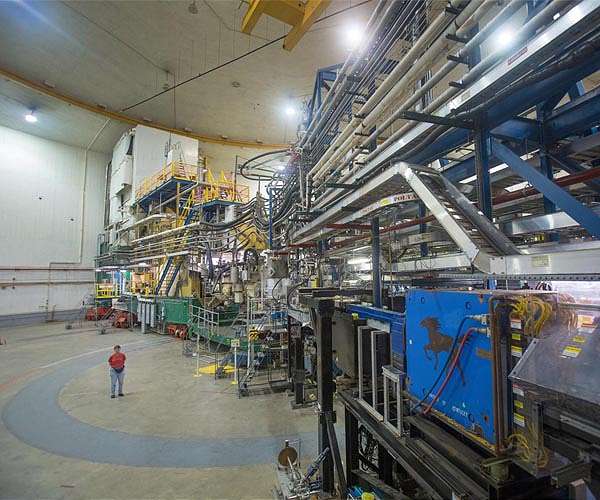
A recent experiment at Jefferson Lab measured how energetic electrons scatter from targets of both protium and deuterium. Using the Continuous Electron Beam Accelerator Facility, a DOE Office of Science user facility serving more than 1,650 nuclear physicists worldwide, the team directed a high-intensity electron beam onto hydrogen targets and then detected the scattered electrons with the Super High Momentum Spectrometer in Experimental Hall C.
By recording the energies and angles of the outgoing electrons, the collaboration determined a ratio of cross sections, or scattering probabilities, for deuteron versus proton over a wide range of kinematic settings. Cross sections quantify how likely it is that an electron will undergo a particular interaction with a target particle. Comparing the deuteron and proton cross sections reveals differences that can be traced back to the distribution of quarks and gluons inside the proton and neutron.
The underlying theory describing quark and gluon interactions is Quantum Chromodynamics. Within this framework, various models attempt to capture how quarks and gluons are distributed inside nucleons. Protons contain two up quarks and one down quark, while neutrons consist of two down quarks and one up quark, so their internal quark content differs in a systematic way. The deuteron-to-proton cross section ratio provides access to the neutron-to-proton ratio and thus to the relative probabilities of scattering from down quarks versus up quarks as a function of quark momentum in the valence quark region.
The new measurement delivers the most precise proton-deuteron cross section ratio so far in the kinematic region dominated by scattering from a single quark. Previous uncertainties on this type of observable ranged between ten and twenty percent, but the Jefferson Lab experiment has reduced the uncertainty to below five percent. That improvement allows theorists to refine global fits and models of quark distributions in both the proton and the neutron.
In addition to shrinking uncertainties, the intensity and energy reach of the CEBAF electron beam enabled the team to extend the data into higher kinematic regions. Access to higher energies and momentum transfers broadens the phase space over which the quark structure of nucleons can be tested. The new measurements are already being incorporated into the worldwide dataset used to study nucleon structure, thereby expanding the information available to the community.
Physicists involved in the project emphasize that these data complement many other nuclear structure measurements. They add crucial constraints to efforts that use scattering from light nuclei to decode the behavior of quarks inside nucleons and nuclei as a whole. According to the analysis team, the enhanced precision and reach of the dataset make it a valuable shared resource for nuclear physics research.
Because the experiment collected results over an increased kinematic range, the measurements can support diverse investigations. One planned application is the study of quark-hadron duality, in which the same processes can be described either at the level of fundamental quarks and gluons or in terms of composite hadrons such as protons and neutrons. The data also have implications for calculations of Quantum Chromodynamics backgrounds at facilities like the Large Hadron Collider and for other studies that depend on accurate knowledge of quark distributions.
The researchers conducting the analysis worked in close coordination with collaborations focused on related questions, including the EMC Effect program and the BONuS12 and MARATHON experiments. By comparing techniques, kinematic coverage and interpretations, they aim to place nuclear medium effects and other corrections in better perspective when extracting information about neutrons from nuclear targets.
Ultimately, the Jefferson Lab team anticipates that the combined insights from this experiment and complementary measurements will deepen understanding of neutron structure and the behavior of matter at the smallest accessible distance scales. The new hydrogen isotope scattering results showcase how targeted measurements with a powerful continuous electron beam can push the frontiers of precision in mapping the quark content of the building blocks of atoms.
Related Links
Thomas Jefferson National Accelerator Facility
Understanding Time and Space
| Subscribe Free To Our Daily Newsletters |
| Subscribe Free To Our Daily Newsletters |








