24/7 Space News
STELLAR CHEMISTRY
Hubble tracks Betelgeuse companion carving dense wake in giant star atmosphere
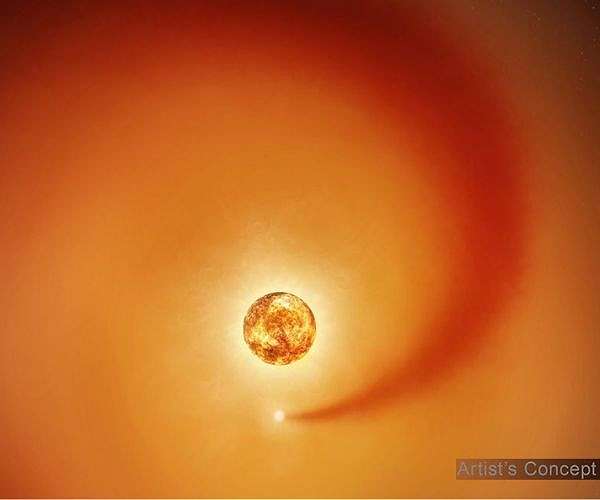
illustration only

Hubble tracks Betelgeuse companion carving dense wake in giant star atmosphere

by Clarence Oxford
Los Angeles CA (SPX) Jan 06, 2026

Using NASA's Hubble Space Telescope with ground-based observatories, astronomers have traced how Betelgeuse's recently identified companion star, Siwarha, disturbs gas in the red supergiant's extended atmosphere and produces a dense wake of material. The work, led by researchers at the Center for Astrophyphysics | Harvard and Smithsonian (CfA), links this wake to puzzling changes in Betelgeuse's brightness and atmosphere over the past several years.

The team reported its results at the 247th meeting of the American Astronomical Society in Phoenix and in a study accepted for publication in The Astrophysical Journal. By tracking Betelgeuse's light over nearly eight years, they followed the influence of the companion as it moves through the giant star's outer layers, providing direct evidence for a previously suspected secondary star.

Betelgeuse lies roughly 650 light-years away from Earth in the constellation Orion and is a red supergiant so large that more than 400 million Suns could fit inside. Its proximity and size make it one of the few stars whose surface and surrounding atmosphere can be resolved directly, turning it into a nearby laboratory for studying how massive stars age, shed mass, and approach the supernova stage.

Using Hubble together with ground-based telescopes at the Fred Lawrence Whipple Observatory and Roque de los Muchachos Observatory, the team identified a repeating pattern in Betelgeuse's behavior that matches the orbital motion of the companion. They saw changes in the star's spectrum and in the speed and direction of gases in its extended atmosphere caused by a trail of denser material, or wake, that appears just after the companion crosses in front of Betelgeuse about every 2,100 days, or six years, confirming theoretical models of a low-mass companion embedded in the star's outer atmosphere.

"It's a bit like a boat moving through water. The companion star creates a ripple effect in Betelgeuse's atmosphere that we can actually see in the data," said Andrea Dupree, an astronomer at the CfA, and the lead study author. "For the first time, we're seeing direct signs of this wake, or trail of gas, confirming that Betelgeuse really does have a hidden companion shaping its appearance and behavior."

For decades, astronomers have tracked changes in Betelgeuse's brightness and surface features to understand its irregular behavior, including an unexpected dimming event in 2020 linked to a major outburst and dust formation. Two distinct variability periods stand out: a shorter 400-day cycle now attributed to pulsations inside the star itself, and a longer 2,100-day secondary period that until recently lacked a clear explanation.

Earlier studies suggested that a low-mass companion orbiting deep within Betelgeuse's extended atmosphere could drive the long secondary period, and another team reported a possible detection, but evidence remained indirect. The new Hubble and ground-based data now provide firm, repeatable signatures of a companion disturbing the star's gas, resolving a key question about Betelgeuse's internal structure and evolution.

With Betelgeuse currently eclipsing its companion from our point of view, Siwarha is difficult to isolate directly in images, so astronomers instead track its dynamical impact on the surrounding gas. The companion orbits within Betelgeuse's extended atmosphere and carves a dense wake as it moves, even though the star itself would appear as a much smaller point compared with the supergiant, which spans hundreds of times the Sun's diameter.

Astronomers are planning new observing campaigns for the next time the companion moves back out from behind Betelgeuse around 2027, which will allow further tests of models of mass loss and binary interaction in massive stars. The Betelgeuse system has become a benchmark for understanding long-period variability in other giant and supergiant stars, where hidden companions and their wakes may also shape changes in brightness and spectra.

The Hubble Space Telescope has operated for more than three decades as an international project between NASA and ESA, with NASA's Goddard Space Flight Center managing the telescope and mission operations and Lockheed Martin Space supporting operations at Goddard. The Space Telescope Science Institute in Baltimore, operated by the Association of Universities for Research in Astronomy, conducts Hubble science operations for NASA.

Related Links
NASA Hubble Space Telescope
Stellar Chemistry, The Universe And All Within It

Subscribe Free To Our Daily Newsletters
Tweet

RELATED CONTENT
The following news reports may link to other Space Media Network websites.
STELLAR CHEMISTRY
NASA's Hubble Captures Andromeda's Dynamic Galactic Ecosystem
Los Angeles CA (SPX) Feb 28, 2025
The Andromeda galaxy, situated 2.5 million light-years from Earth, appears to the unaided eye as a dim, spindle-shaped formation comparable in size to the full Moon. However, beyond this faint glow lies a dynamic environment teeming with nearly three dozen small satellite galaxies orbiting Andromeda like a hive of bees. NASA's Hubble Space Telescope has provided an unprecedented view of this complex galactic system, conducting a comprehensive study that utilized data from over 1,000 Hubble orbits. ... read more

STELLAR CHEMISTRY
ESA reaches new benchmark in autonomous formation flying

Hydrogen peroxide thruster qualifies for ESA launcher attitude control

China launches twin Shijian-29 satellites to test space-target detection tech

Billionaire Trump nominee confirmed to lead NASA amid Moon race

STELLAR CHEMISTRY
AI systems proposed to boost launch cadence reliability and traffic management

China debuts Long March 12A reusable rocket in Jiuquan test flight

Japan's flagship H3 rocket fails to launch satellite

North Korea tests hypersonic missiles, says nuclear forces ready for war

STELLAR CHEMISTRY
Curiosity Blog, Sols 4750-4762: See You on the Other Side of the Sun

Wind-Sculpted Landscapes: Investigating the Martian Megaripple 'Hazyview'

NASA team presses MAVEN recovery before Mars solar conjunction

Perseverance rover cleared for long distance Mars exploration

STELLAR CHEMISTRY
China harnesses nationwide system to drive spaceflight and satellite navigation advances

Shenzhou 21 crew complete eight hour spacewalk outside Tiangong station

Foreign satellites ride Kinetica 1 on new CAS Space mission

Experts at Hainan symposium call for stronger global space partnership

STELLAR CHEMISTRY
Southern Launch to Host Lux Aeterna Re-Entries South Australia

Smart modeling framework targets 6G spectrum chaos in space air and ground networks

Time-expanded network model cuts complexity in mega constellation launch planning

K2 Space raises 250m to scale Mega class high power satellites

STELLAR CHEMISTRY
India space agency launches its heaviest satellite

Space ground fluid AI framework targets satellite powered 6G edge intelligence

Engineered interlayers boost satellite insulation and flexible electronics

Planet delivers first light image from Pelican 6 satellite capturing Lhasa Gonggar Airport

STELLAR CHEMISTRY
Deep Arctic gas hydrate mounds host ultra deep cold seep ecosystem

Joint ground- and space-based observations reveal Saturn-mass rogue planet

Hubble pinpoints asteroid smash ups in nearby Fomalhaut system

Evolution study finds history and environment shifts can steer species in very different directions

STELLAR CHEMISTRY
Uranus and Neptune may be rock rich worlds

SwRI links Uranus radiation belt mystery to solar storm driven waves

Looking inside icy moons

Saturn moon mission planning shifts to flower constellation theory

Subscribe Free To Our Daily Newsletters


The content herein, unless otherwise known to be public domain, are Copyright 1995-2024 - Space Media Network. All websites are published in Australia and are solely subject to Australian law and governed by Fair Use principals for news reporting and research purposes. AFP, UPI and IANS news wire stories are copyright Agence France-Presse, United Press International and Indo-Asia News Service. ESA news reports are copyright European Space Agency. All NASA sourced material is public domain. Additional copyrights may apply in whole or part to other bona fide parties. All articles labeled "by Staff Writers" include reports supplied to Space Media Network by industry news wires, PR agencies, corporate press officers and the like. Such articles are individually curated and edited by Space Media Network staff on the basis of the report's information value to our industry and professional readership. Advertising does not imply endorsement, agreement or approval of any opinions, statements or information provided by Space Media Network on any Web page published or hosted by Space Media Network. General Data Protection Regulation (GDPR) Statement Our advertisers use various cookies and the like to deliver the best ad banner available at one time. All network advertising suppliers have GDPR policies (Legitimate Interest) that conform with EU regulations for data collection. By using our websites you consent to cookie based advertising. If you do not agree with this then you must stop using the websites from May 25, 2018. Privacy Statement. Additional information can be found here at About Us.