





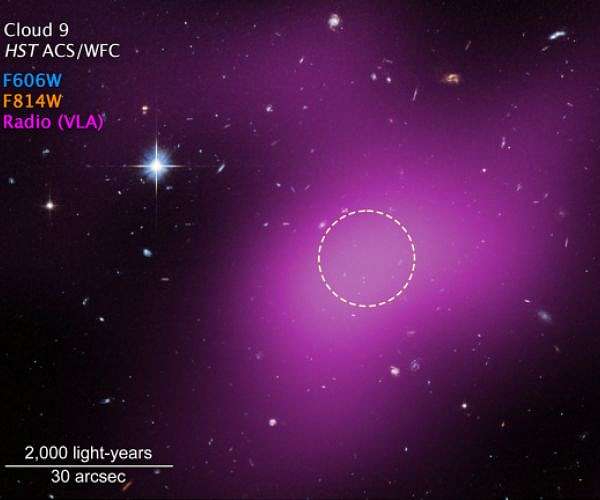
Program principal investigator Alejandro Benitez-Llambay of the Milano-Bicocca University in Milan, Italy, described Cloud-9 as "a tale of a failed galaxy," noting that seeing no stars in the system provides the evidence that it matches long-standing theoretical predictions for a primordial building block of a galaxy that stalled before star formation. The results, led by Gagandeep Anand of the Space Telescope Science Institute (STScI), were published in The Astrophysical Journal Letters and presented at the 247th meeting of the American Astronomical Society in Phoenix.
Team member Andrew Fox of AURA/STScI for the European Space Agency said the cloud offers "a window into the dark universe" because its mass is dominated by dark matter that does not emit light. Cloud-9 allows researchers to study a dark-matter-dominated structure directly through its neutral hydrogen gas, instead of relying on starlight.
Cloud-9 lies about 14 million light-years from Earth on the outskirts of the nearby spiral galaxy Messier 94 (M94). Radio observations from the Five-hundred-meter Aperture Spherical Telescope (FAST) in Guizhou, China first detected the hydrogen cloud, and follow-up measurements with the Green Bank Telescope and the Very Large Array (VLA) in the United States confirmed its presence.
High-resolution VLA data, displayed in magenta in composite images, trace diffuse radio emission from neutral hydrogen and show the extent of the cloud. The peak of this radio emission marked the area where researchers concentrated their search for stars using Hubble. Within that region, Hubble's Advanced Camera for Surveys (ACS) found no stars associated with the cloud, and the few objects visible inside the VLA contour are background galaxies.
Before the Hubble campaign, astronomers could still interpret Cloud-9 as a very faint dwarf galaxy whose stars were too dim for ground-based telescopes to detect. Lead author Anand explained that ground-based observatories did not reach the sensitivity needed to rule out an extremely faint stellar population, but ACS imaging now shows that "there's nothing there," confirming that the cloud is truly starless.
RELHICs such as Cloud-9 are thought to be small dark-matter halos that collected some primordial hydrogen gas but never enough to ignite star formation. Astronomers view them as a way to probe the early stages of galaxy assembly at the low-mass end, where theory predicts many more dark-matter halos than the number of luminous dwarf galaxies that are actually observed. Cloud-9's properties imply a population of similar small, dark-matter-dominated structures in the nearby universe that remain undetected in starlight.
Scientists have examined hydrogen clouds near the Milky Way for many years, but those structures generally appear larger and more irregular than Cloud-9. In contrast, Cloud-9 is relatively compact and nearly spherical, which makes it stand out from previously known hydrogen clouds.
The neutral hydrogen core of Cloud-9 spans about 4,900 light-years in diameter. By measuring the radio waves emitted by the hydrogen, researchers estimate the cloud contains roughly one million times the mass of the Sun in hydrogen gas. Assuming the gas pressure balances the gravity of the surrounding dark-matter halo, they calculate a dark-matter mass of about five billion solar masses.
These characteristics place Cloud-9 close to a theoretical threshold for galaxy formation. If the halo mass were significantly higher than roughly five billion solar masses, the gas would likely have collapsed and formed stars, producing a dwarf galaxy similar to many others seen near larger galaxies. If the halo were much less massive, environmental processes such as ram-pressure stripping in intergalactic space could have removed or ionized its gas, leaving little neutral hydrogen behind.
Because Cloud-9 lies near this mass "sweet spot," it appears to persist as a long-lived, starless RELHIC. The object provides a case study of a dark-matter halo and its gas without the complicating effects of stellar feedback, making it useful for testing models of how small halos evolve.
Observationally, finding such failed galaxies is difficult because bright nearby galaxies and foreground stars can overpower the faint signal from low-mass gas clouds. These systems are also susceptible to environmental processes that strip or heat their gas as they move through the surrounding medium, which further limits their numbers and detectability.
Cloud-9 was first flagged three years ago in a FAST radio survey targeting gas structures around M94. The survey cataloged multiple hydrogen features, and this particular cloud received its name because it was the ninth entry in that list. High-resolution radio mapping later showed slight distortions in the gas distribution, suggesting that Cloud-9 is physically associated with M94 and may be interacting with the galaxy.
The cloud may eventually form a galaxy if it can acquire additional mass, although the mechanisms that might drive such growth remain under study. If Cloud-9's halo were to exceed the approximate five-billion-solar-mass threshold, its gas could collapse and initiate star formation; if it were reduced below that range, the gas might disperse or become ionized, erasing the neutral hydrogen signature. For now, it appears stable as a starless relic.
The lack of stars in Cloud-9 provides a rare view of the intrinsic properties of dark-matter-dominated gas clouds. Researchers expect that future deep radio and optical surveys will uncover more RELHICs and other failed galaxies, offering additional tests of dark-matter physics and early galaxy formation.
Research Report: The First RELHIC? Cloud-9 is a Starless Gas Cloud
Related Links
NASA Hubble Space Telescope Mission
Stellar Chemistry, The Universe And All Within It
| Subscribe Free To Our Daily Newsletters |
| Subscribe Free To Our Daily Newsletters |








