24/7 Space News
STELLAR CHEMISTRY
Fly through Webbs cosmic vistas celebrates four years of James Webb discoveries
Watch video here

Fly through Webbs cosmic vistas celebrates four years of James Webb discoveries

by Robert Schreiber
Berlin, Germany (SPX) Dec 30, 2025
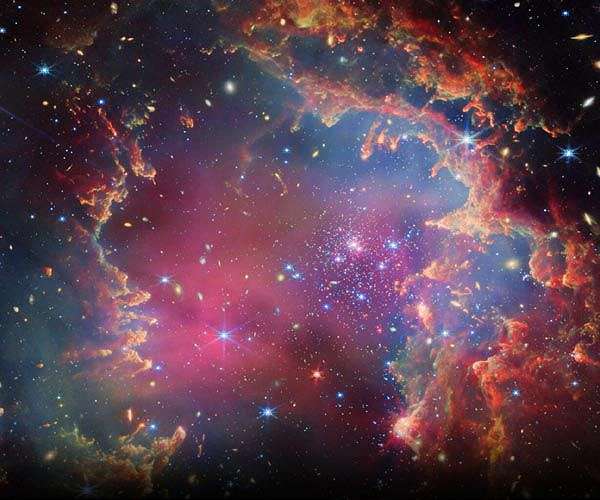
On the fourth launch anniversary of the NASA ESA CSA James Webb Space Telescope, the European Space Agency has released a 43 minute fly through video built from many of Webbs best known images, presented as a single continuous journey across the cosmos. The compilation revisits a wide range of Webb observations, arranging them as a sequence of progressive zooms that simulate a flight through different regions of the Universe in a virtual starship.

The opening sequences guide viewers through the Milky Way, diving into colourful emission nebulae and dense star forming clouds where young stars are still embedded in gas and dust. These passages showcase how Webbs near and mid infrared instruments penetrate obscuring material to reveal newly formed stars and the intricate filaments and knots that trace their surrounding environments. Well known stellar nurseries such as the Carina Nebula "cosmic cliffs," the Pillars of Creation in the Eagle Nebula and the Orion Nebula serve as archetypes for these nebular fly throughs, illustrating the kinds of regions featured in the tour.

From there, the virtual camera leaves the Galaxy and moves into fields crowded with distant galaxies, including interacting systems where tidal forces distort spiral arms and generate long streams of stars and gas. Compact groups like Stephans Quintet provide classic examples of these scenes, where Webb resolves shock fronts, dust lanes and active galactic nuclei that stand out in the infrared. The motion of the camera, combined with Webbs high spatial resolution, maintains sharp detail even as the view pushes from wide fields down into small scale structures within each galaxy.

Later segments focus on massive galaxy clusters that act as gravitational lenses, bending and magnifying light from even more distant background galaxies. In these regions, elongated arcs and multiple images trace the distribution of mass in clusters similar to SMACS 0723 and related systems that Webb has observed in depth. Some of these fields capture light that has travelled for more than 10 billion years, illustrating how Webb connects visually spectacular scenes with measurements of galaxy evolution in the early Universe.

Throughout the 43 minute sequence, the camera path is designed to guide the viewer smoothly from one target to the next, using pans, rotations and deep zooms to create a sense of three dimensional depth from two dimensional images. The production draws on the work of specialist visualisation teams, who process Webb's calibrated infrared data, map different wavelengths to visible colours and construct longform animations that preserve scientific integrity while maximising clarity for non specialists.

The video also serves as a visual recap of Webbs first four years in space. Launched on an Ariane 5 rocket from Europes Spaceport in French Guiana on 25 December 2021 and beginning science operations in mid 2022, Webb has built an image library spanning nearby star forming regions, planetary nebulae, interacting galaxies and deep extragalactic fields. These datasets provide the raw material for the anniversary fly through, which functions both as an outreach piece and as a reminder of the mission's breadth, from the solar neighbourhood out to some of the most distant galaxies currently observable.

Fly through Webbs cosmic vistas is available via ESAs multimedia portal, where the full resolution version can be streamed or downloaded, and through the agencys official YouTube channel embedded on the same page. Viewers can pause to inspect individual frames, revisit favourite regions and use the material for educational or outreach purposes under ESA's multimedia usage guidelines. Even without an official, frame by frame target list, the production stands as an "eye candy" special built from Webbs greatest hits, offering a sustained visual immersion in the telescope's most striking views.

Watch video here

Related Links
European Space Agency / ESA Webb
Stellar Chemistry, The Universe And All Within It

Subscribe Free To Our Daily Newsletters
Tweet

RELATED CONTENT
STELLAR CHEMISTRY
CoDICE instrument returns first-light particle data for IMAP mission
Los Angeles CA (SPX) Dec 17, 2025
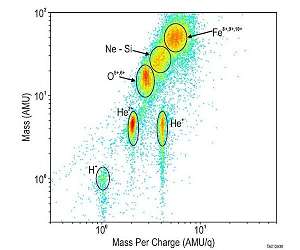
December 16, 2025 - Southwest Research Institute's Compact Dual Ion Composition Experiment (CoDICE) instrument aboard NASA's Interstellar Mapping and Acceleration Probe (IMAP) spacecraft has begun returning first-light particle measurements. IMAP launched in September to help researchers better understand the boundary of the heliosphere, the magnetic bubble that surrounds and protects our solar system. IMAP will map the structure of this heliospheric boundary and examine how it interacts with the ... read more

STELLAR CHEMISTRY
ESA reaches new benchmark in autonomous formation flying

Hydrogen peroxide thruster qualifies for ESA launcher attitude control

China launches twin Shijian-29 satellites to test space-target detection tech

Billionaire Trump nominee confirmed to lead NASA amid Moon race

STELLAR CHEMISTRY
AI systems proposed to boost launch cadence reliability and traffic management

China debuts Long March 12A reusable rocket in Jiuquan test flight

Japan's flagship H3 rocket fails to launch satellite

North Korea tests hypersonic missiles, says nuclear forces ready for war

STELLAR CHEMISTRY
Curiosity Blog, Sols 4750-4762: See You on the Other Side of the Sun

Wind-Sculpted Landscapes: Investigating the Martian Megaripple 'Hazyview'

NASA team presses MAVEN recovery before Mars solar conjunction

Perseverance rover cleared for long distance Mars exploration

STELLAR CHEMISTRY
China harnesses nationwide system to drive spaceflight and satellite navigation advances

Shenzhou 21 crew complete eight hour spacewalk outside Tiangong station

Foreign satellites ride Kinetica 1 on new CAS Space mission

Experts at Hainan symposium call for stronger global space partnership

STELLAR CHEMISTRY
Southern Launch to Host Lux Aeterna Re-Entries South Australia

Smart modeling framework targets 6G spectrum chaos in space air and ground networks

Time-expanded network model cuts complexity in mega constellation launch planning

K2 Space raises 250m to scale Mega class high power satellites

STELLAR CHEMISTRY
India space agency launches its heaviest satellite

Space ground fluid AI framework targets satellite powered 6G edge intelligence

Engineered interlayers boost satellite insulation and flexible electronics

Planet delivers first light image from Pelican 6 satellite capturing Lhasa Gonggar Airport

STELLAR CHEMISTRY
Deep Arctic gas hydrate mounds host ultra deep cold seep ecosystem

Joint ground- and space-based observations reveal Saturn-mass rogue planet

Hubble pinpoints asteroid smash ups in nearby Fomalhaut system

Evolution study finds history and environment shifts can steer species in very different directions

STELLAR CHEMISTRY
Uranus and Neptune may be rock rich worlds

SwRI links Uranus radiation belt mystery to solar storm driven waves

Looking inside icy moons

Saturn moon mission planning shifts to flower constellation theory


The content herein, unless otherwise known to be public domain, are Copyright 1995-2026 - SpaceDaily.com. All websites are published in Australia and are solely subject to Australian law and governed by Fair Use principals for news reporting and research purposes. AFP, UPI and IANS news wire stories are copyright Agence France-Presse, United Press International and Indo-Asia News Service. ESA news reports are copyright European Space Agency. All NASA sourced material is public domain. Additional copyrights may apply in whole or part to other bona fide parties. All articles labeled "by Staff Writers" include reports supplied to Space Media Network by industry news wires, PR agencies, corporate press officers and the like. Such articles are individually curated and edited by Space Media Network staff on the basis of the report's information value to our industry and professional readership. Advertising does not imply endorsement, agreement or approval of any opinions, statements or information provided by Space Media Network on any Web page published or hosted by Space Media Network. General Data Protection Regulation (GDPR) Statement Our advertisers use various cookies and the like to deliver the best ad banner available at one time. All network advertising suppliers have GDPR policies (Legitimate Interest) that conform with EU regulations for data collection. By using our websites you consent to cookie based advertising. If you do not agree with this then you must stop using the websites from May 25, 2018. Privacy Statement. Additional information can be found here at About Us.
Subscribe Free To Our Daily Newsletters