24/7 Space News
STELLAR CHEMISTRY
CoDICE instrument returns first-light particle data for IMAP mission
illustration only

CoDICE instrument returns first-light particle data for IMAP mission

by Clarence Oxford
Los Angeles CA (SPX) Dec 17, 2025
December 16, 2025 - Southwest Research Institute's Compact Dual Ion Composition Experiment (CoDICE) instrument aboard NASA's Interstellar Mapping and Acceleration Probe (IMAP) spacecraft has begun returning first-light particle measurements. IMAP launched in September to help researchers better understand the boundary of the heliosphere, the magnetic bubble that surrounds and protects our solar system.

IMAP will map the structure of this heliospheric boundary and examine how it interacts with the local interstellar environment beyond the solar system. As the spacecraft travels toward its operational orbit, it will serve as a cartographer for the heliosphere, characterizing how the solar wind shapes this large bubble in space.

In addition to supplying CoDICE, Southwest Research Institute managed the IMAP payload, coordinating the development and delivery of all 10 mission instruments contributed by multiple institutions. All of the instruments have now achieved first-light observations as IMAP continues its cruise to its final observing location.

"IMAP features the next generation of instruments designed to give us a more complete picture of the interaction between the interstellar medium and the solar wind," said SwRI's Susan Pope, the mission's payload manager. "This will provide a better understanding of our place in the universe."

CoDICE measures the distribution and composition of interstellar pickup ions, particles that make it through the heliospheric filter. The instrument will also characterize solar wind ions and determine the mass and composition of highly energized solar particles associated with flares and coronal mass ejections.

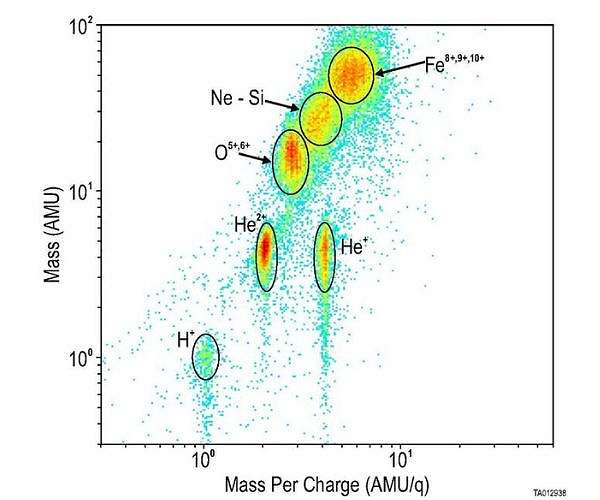
"The CoDICE instrument performed just as expected, identifying particles from different origins by measuring protons as well as rarer ion species such as interstellar helium ions, and solar wind oxygen and iron ions," said Dr. Mihir Desai, an IMAP co-investigator and part of the CoDICE leadership team.

The heliosphere is created by the constant flow of particles from the Sun known as the solar wind, which separates the solar system from the interstellar medium, the accumulated outflows of other stars. IMAP's instruments will collect and analyze particles that cross this boundary and will examine the physical processes that accelerate particles throughout the heliosphere and beyond. These energetic particles and cosmic rays can harm astronauts and space-based technologies.

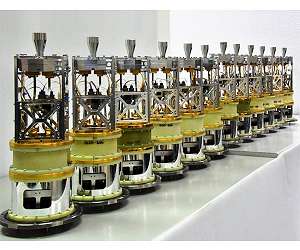
"Initially developed through the Institute's internal research and development program and then matured through the IMAP mission, CoDICE combines the capabilities of multiple instruments into one patented sensor," said SwRI's Dr. Stefano Livi, who led its development. "The 22-pound instrument is about the size of a 5-gallon paint bucket and has a unique and beautiful thermal management design."

Spacecraft and their instruments must operate through large temperature variations between direct sunlight and deep-space cold, and CoDICE incorporates a dedicated thermal-control approach to maintain performance. The half of the instrument that continuously faces the Sun has a reflective gold-colored surface to deflect incoming heat, while the opposite side uses a matte black surface to absorb heat and help stabilize the instrument's temperature.

With all of IMAP's instruments operating, the mission is close to completing its commissioning phase. IMAP has entered a science demonstration phase following commissioning and is preparing for routine science operations scheduled to begin on Feb. 1, 2026, once the spacecraft reaches its target orbit around the Sun - Earth Lagrange Point 1, about one million miles sunward of Earth.

By studying how the solar wind and stellar winds interact, IMAP will contribute to NASA's heliophysics fleet that examines how the Sun affects the space environment near Earth and across the solar system. Missions observing the Sun, near-Earth space, and the heliosphere's boundary form a system observatory that helps clarify the processes that drive space weather and supports efforts to forecast conditions throughout the solar system.

Dr. David McComas of Princeton University serves as IMAP's principal investigator. The Johns Hopkins University Applied Physics Laboratory in Laurel, Maryland, built the spacecraft and operates the mission, which is the fifth mission in NASA's Solar Terrestrial Probes program portfolio managed by the agency's Goddard Space Flight Center.

Related Links
Southwest Research Institute
Stellar Chemistry, The Universe And All Within It

Subscribe Free To Our Daily Newsletters
Tweet

RELATED CONTENT
STELLAR CHEMISTRY
ALMA completes band two receiver chain with low noise amplifiers
Berlin, Germany (SPX) Dec 17, 2025
The Atacama Large Millimeter/Submillimeter Array (ALMA) in the Chilean Andes is one of the most powerful radio telescope facilities used to probe cold and distant regions of the universe. Researchers use it to study how stars, planets, galaxies and potential precursors of life form by measuring millimeter and submillimeter radiation from cold molecular clouds. These molecular clouds are interstellar gas clouds with temperatures of only a few tens of Kelvin, where stars form once density and temperature ... read more

STELLAR CHEMISTRY
ESA reaches new benchmark in autonomous formation flying

Hydrogen peroxide thruster qualifies for ESA launcher attitude control

China launches twin Shijian-29 satellites to test space-target detection tech

Billionaire Trump nominee confirmed to lead NASA amid Moon race

STELLAR CHEMISTRY
AI systems proposed to boost launch cadence reliability and traffic management

China debuts Long March 12A reusable rocket in Jiuquan test flight

Japan's flagship H3 rocket fails to launch satellite

North Korea tests hypersonic missiles, says nuclear forces ready for war

STELLAR CHEMISTRY
Curiosity Blog, Sols 4750-4762: See You on the Other Side of the Sun

Wind-Sculpted Landscapes: Investigating the Martian Megaripple 'Hazyview'

NASA team presses MAVEN recovery before Mars solar conjunction

Perseverance rover cleared for long distance Mars exploration

STELLAR CHEMISTRY
China harnesses nationwide system to drive spaceflight and satellite navigation advances

Shenzhou 21 crew complete eight hour spacewalk outside Tiangong station

Foreign satellites ride Kinetica 1 on new CAS Space mission

Experts at Hainan symposium call for stronger global space partnership

STELLAR CHEMISTRY
Southern Launch to Host Lux Aeterna Re-Entries South Australia

Smart modeling framework targets 6G spectrum chaos in space air and ground networks

Time-expanded network model cuts complexity in mega constellation launch planning

K2 Space raises 250m to scale Mega class high power satellites

STELLAR CHEMISTRY
India space agency launches its heaviest satellite

Space ground fluid AI framework targets satellite powered 6G edge intelligence

Engineered interlayers boost satellite insulation and flexible electronics

Planet delivers first light image from Pelican 6 satellite capturing Lhasa Gonggar Airport

STELLAR CHEMISTRY
Deep Arctic gas hydrate mounds host ultra deep cold seep ecosystem

Joint ground- and space-based observations reveal Saturn-mass rogue planet

Hubble pinpoints asteroid smash ups in nearby Fomalhaut system

Evolution study finds history and environment shifts can steer species in very different directions

STELLAR CHEMISTRY
Uranus and Neptune may be rock rich worlds

SwRI links Uranus radiation belt mystery to solar storm driven waves

Looking inside icy moons

Saturn moon mission planning shifts to flower constellation theory


The content herein, unless otherwise known to be public domain, are Copyright 1995-2026 - SpaceDaily.com. All websites are published in Australia and are solely subject to Australian law and governed by Fair Use principals for news reporting and research purposes. AFP, UPI and IANS news wire stories are copyright Agence France-Presse, United Press International and Indo-Asia News Service. ESA news reports are copyright European Space Agency. All NASA sourced material is public domain. Additional copyrights may apply in whole or part to other bona fide parties. All articles labeled "by Staff Writers" include reports supplied to Space Media Network by industry news wires, PR agencies, corporate press officers and the like. Such articles are individually curated and edited by Space Media Network staff on the basis of the report's information value to our industry and professional readership. Advertising does not imply endorsement, agreement or approval of any opinions, statements or information provided by Space Media Network on any Web page published or hosted by Space Media Network. General Data Protection Regulation (GDPR) Statement Our advertisers use various cookies and the like to deliver the best ad banner available at one time. All network advertising suppliers have GDPR policies (Legitimate Interest) that conform with EU regulations for data collection. By using our websites you consent to cookie based advertising. If you do not agree with this then you must stop using the websites from May 25, 2018. Privacy Statement. Additional information can be found here at About Us.
Subscribe Free To Our Daily Newsletters