24/7 Space News
TECH SPACE
Light driven process prints biocompatible plastic electrodes
illustration only

Light driven process prints biocompatible plastic electrodes

by Robert Schreiber
Linkoping, Sweden (SPX) Dec 16, 2025

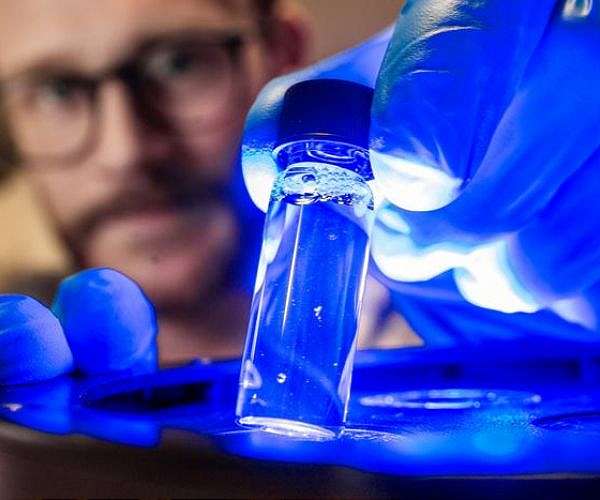
Researchers at Linkoping University and Lund University have demonstrated that visible light can drive the formation of conductive polymer electrodes from water based solutions without hazardous chemicals. The method produces electrodes on many different substrates, including glass, textiles and even skin, which supports new types of electronic and medical sensor applications.

The work is based on conjugated polymers, a class of conductive plastics that combine the electrical behavior of metals and semiconductors with the mechanical properties of polymers. In the new approach, specially designed water soluble monomers undergo polymerisation when exposed to visible light, eliminating the need for strong or toxic reagents and avoiding harmful ultraviolet exposure.

In use, a solution containing the monomers is deposited onto a surface and exposed to a patterned light source, such as a laser or other visible light illumination, which defines the electrode geometry. The unpolymerised solution is then rinsed away, leaving behind patterned electrodes whose shapes are set by the light exposure.

"I think this is something of a breakthrough. It's another way of creating electronics that is simpler and doesn't require any expensive equipment," says Xenofon Strakosas, assistant professor at the Laboratory of Organic Electronics, LOE, at Linkoping University. According to the team, the use of visible light from simple LED lamps, such as party lights, is sufficient to drive the polymerisation.

The resulting material conducts both electrons and ions, allowing direct coupling to biological systems. "The electrical properties of the material are at the very forefront. As the material can transport both electrons and ions, it can communicate with the body in a natural way, and its gentle chemistry ensures that tissue tolerates it - a combination that is crucial for medical applications," says Tobias Abrahamsson, researcher at LOE and lead author of the article in Angewandte Chemie.

To evaluate the method in a biological context, the researchers photo patterned electrodes directly on the skin of anaesthetised mice. These polymer electrodes recorded low frequency brain activity with better performance than traditional metal EEG electrodes, demonstrating improved signal quality in this frequency range.

Because the process works on many surfaces and does not rely on aggressive solvents, the team points to potential use in wearable sensors integrated into garments and in large scale production of organic electronic circuits. The combination of visible light processing, aqueous chemistry and substrate versatility suggests a route toward scalable bioelectronic interfaces and soft electronic devices.

Research Report:Visible-Light-Driven Aqueous Polymerization Enables in Situ Formation of Biocompatible, High-Performance Organic Mixed Conductors for Bioelectronics

Related Links
Linkoping University
Space Technology News - Applications and Research

Subscribe Free To Our Daily Newsletters
Tweet

RELATED CONTENT
The following news reports may link to other Space Media Network websites.
TECH SPACE
EU agrees recycled plastic targets for cars
Brussels, Belgium (AFP) Dec 12, 2025
Car manufacturers in Europe will have to include more recycled plastics in new vehicles under new EU rules agreed on by the bloc's countries and lawmakers on Friday. European Union governments and parliament representatives reached an early morning deal to mandate that at least 25 percent of plastics used in cars, trucks and motorcycles has been recycled. Carmakers will have to meet the mandatory target in 10 years, with an intermediate 15 percent goal in six years, according to the European Cou ... read more

TECH SPACE
ISS to change commanders before Soyuz crew leaves orbit

Lodestar Space wins SECP support to advance AI satellite awareness system

Micro nano robots aim to cut carbon buildup in closed life support systems

NASA extends ISS National Lab management contract through 2030

TECH SPACE
EU dismisses 'completely crazy statements' after Musk attack

Space shuttle design study maps path to breakthrough inventions

Sea based rocket net recovery platform enters service for Chinese reusable launchers

EU hits Musk's X with 120-mn-euro fine, sparking US ire

TECH SPACE
Martian butterfly crater reveals low angle impact and buried lava history

Bacterial partnership offers pathway to produce Mars regolith bricks for future habitats

Chinese team runs long term Martian dust cycle simulation with GoMars model

NASA rover hears electric crackles inside Mars dust devils

TECH SPACE
Wenchang spaceport hits record cadence with double-digit launches in 2025

China consolidates new commercial space regulator and industry roadmap

Beijing space lab targets orbital data centers for AI era

China supports private space firms to expand global reach

TECH SPACE
Applied Aerospace and PCX create US flight and space hardware group

EIB launches Space TechEU finance program for European space sector

MDA Space plans C250 million senior unsecured note issue maturing 2030

Iridium wins five year US Space Force contract to upgrade EMSS infrastructure

TECH SPACE
Data centers: a view from the inside

Amazon says will invest $35bn in India by 2030

EU agrees recycled plastic targets for cars

Microsoft announces $17.5 bn investment in India, its 'largest ever' in Asia

TECH SPACE
The bacteria that wont wake up found in spacecraft cleanrooms

Subaru OASIS survey uncovers massive planet and brown dwarf

Supernova mixing traced as source of key life elements

TRAPPIST 1 flares mapped to probe planetary habitability

TECH SPACE
SwRI links Uranus radiation belt mystery to solar storm driven waves

Looking inside icy moons

Saturn moon mission planning shifts to flower constellation theory

Could these wacky warm Jupiters help astronomers solve the planet formation puzzle?

Subscribe Free To Our Daily Newsletters


The content herein, unless otherwise known to be public domain, are Copyright 1995-2024 - Space Media Network. All websites are published in Australia and are solely subject to Australian law and governed by Fair Use principals for news reporting and research purposes. AFP, UPI and IANS news wire stories are copyright Agence France-Presse, United Press International and Indo-Asia News Service. ESA news reports are copyright European Space Agency. All NASA sourced material is public domain. Additional copyrights may apply in whole or part to other bona fide parties. All articles labeled "by Staff Writers" include reports supplied to Space Media Network by industry news wires, PR agencies, corporate press officers and the like. Such articles are individually curated and edited by Space Media Network staff on the basis of the report's information value to our industry and professional readership. Advertising does not imply endorsement, agreement or approval of any opinions, statements or information provided by Space Media Network on any Web page published or hosted by Space Media Network. General Data Protection Regulation (GDPR) Statement Our advertisers use various cookies and the like to deliver the best ad banner available at one time. All network advertising suppliers have GDPR policies (Legitimate Interest) that conform with EU regulations for data collection. By using our websites you consent to cookie based advertising. If you do not agree with this then you must stop using the websites from May 25, 2018. Privacy Statement. Additional information can be found here at About Us.