





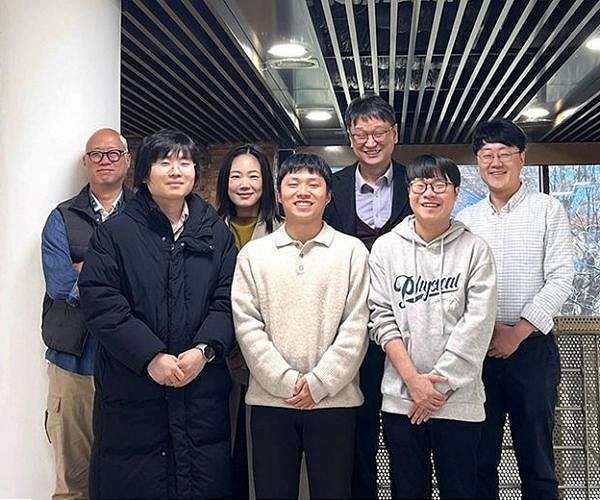
A research team led by Professor Yongsoo Yang from the Department of Physics at KAIST, in collaboration with Professors SungBin Lee, Heejun Yang, and Yeongkwan Kim and colleagues at Stanford University, has now directly visualized how CDW amplitude order develops and changes inside a quantum material for the first time.
The process is akin to filming the freezing of a lake - where some areas ice over first while others remain liquid. Here, the team observed electrons self-organizing at cryogenic temperatures near -253 C, resolving details more than 100,000 times smaller than the width of a human hair. The resulting maps revealed that CDW order forms inhomogeneously across the crystal, with well-ordered regions interspersed with disordered ones.
Intriguingly, localized CDW regions persisted even above the nominal transition temperature, where long-range order is expected to melt. These residual pockets indicate that CDW transitions occur gradually rather than abruptly, through partial loss of spatial coherence.
Since CDWs often coexist or compete with other electronic states, this framework offers a new route to investigate how collective electronic order emerges and evolves in real space.
As Dr. Yang explains, "Until now, the spatial coherence of charge density waves was largely inferred indirectly. Our approach allows us to directly see how electronic order changes across both space and temperature, and to pinpoint the factors that stabilize or disrupt it."
The research - conducted with Seokjo Hong, Jaewhan Oh, and Jemin Park of KAIST as co-first authors - was published in Physical Review Letters on January 6, under the title "Spatial correlations of charge density wave order across the transition in 2H-NbSe2."
Funding was provided by the National Research Foundation of Korea (NRF) through the Individual Basic Research, Basic Research Laboratory, and Nanomaterial Technology Development programs under the Korean Government (MSIT).
Research Report:Spatial correlations of charge density wave order across the transition in 2H-NbSe2
Related Links
The Korea Advanced Institute of Science and Technology (KAIST)
Understanding Time and Space
| Subscribe Free To Our Daily Newsletters |
| Subscribe Free To Our Daily Newsletters |








