24/7 Space News
TIME AND SPACE
It started with a cat: How 100 years of quantum weirdness powers today's tech
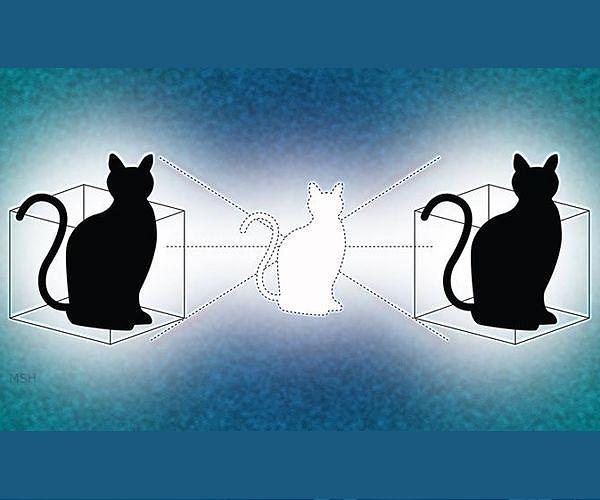
illustration only

It started with a cat: How 100 years of quantum weirdness powers today's tech

by Lesley Henton for TAMU News
College Station, TX (SPX) Jan 21, 2026
A hundred years ago, quantum mechanics was a radical theory that baffled even the brightest minds. Today, it's the backbone of technologies that shape our lives, from lasers and microchips to quantum computers and secure communications.

In a sweeping new perspective published in Science, Dr. Marlan Scully, a university distinguished professor at Texas A and M University, traces the journey of quantum mechanics from its quirky beginnings to its role in solving some of science's toughest challenges.

"Quantum mechanics started as a way to explain the behavior of tiny particles," said Scully, who is also affiliated with Princeton University. "Now it's driving innovations that were unimaginable just a generation ago."

Few scientists have shaped quantum mechanics as profoundly as Scully. He co-authored the seminal textbook "Quantum Optics," which has guided generations of physicists. His work on coherent nanoscale laser spectroscopy opened doors to studying molecules at atomic resolution, while his pioneering ideas on quantum heat engines challenge classical thermodynamic limits, hinting at future energy breakthroughs.

Thought experiment to real-world impact

When Erwin Schrodinger introduced his famous cat paradox in 1935 - suggesting a cat could be both alive and dead, until observed - it was meant to illustrate the strangeness of quantum theory. "That 'quantum weirdness' is no longer just a philosophical puzzle," said Scully. "It's the foundation of quantum computing, quantum cryptography and even gravitational wave detection."

Early pioneers like Schrodinger and Werner Heisenberg laid the groundwork with wave mechanics and matrix mechanics, two competing ways to describe quantum systems. These ideas eventually merged into quantum field theory, which explains how particles interact with electromagnetic and nuclear forces.

These ideas built on Niels Bohr's early model of the atom, which pictured electrons orbiting the nucleus like planets around the sun - a concept that helped set the stage for quantum theory.

The power of coherence

One of the most transformative concepts to emerge is quantum coherence, which describes how particles such as atoms and photons stay connected and act in harmony, even if they're far apart.

This principle gave birth to the laser, a technology once dismissed as impossible. Today, lasers are everywhere: in barcode scanners, eye surgery and cutting-edge research.

Quantum coherence also makes possible quantum entanglement, a phenomenon Albert Einstein famously called "spooky action at a distance." Entanglement allows particles to share information via subtle quantum features that power quantum encryption and boost the sensitivity of instruments like LIGO, which detects ripples in spacetime.

Beyond the Carnot Limit

Perhaps the most mind-bending application is the quantum heat engine. Classical engines are bound by the Carnot Limit - the maximum efficiency dictated by thermodynamics. But by harnessing quantum coherence, researchers can design engines that outperform this limit. "It's a striking example of how quantum principles can rewrite the rules of classical physics," Scully said.

Biology and black holes

Quantum mechanics isn't just for physicists. It's creeping into biology, where techniques like coherent Raman spectroscopy allow scientists to map viruses at the nanoscale.

It's also reshaping our understanding of the cosmos. Concepts like string theory and quantum gravity aim to unify quantum mechanics with Einstein's theory of relativity, a challenge that has stumped scientists for decades.

And scientists have struggled to explain turbulence - the chaotic swirling of air or liquid - for centuries. Turbulence affects things like airplane safety, weather and climate. Now by studying superfluid helium, which behaves in strange quantum ways, researchers are finding patterns that could improve storm forecasts and climate models, and even make flights safer.

The next century of quantum

Despite its triumphs, quantum mechanics still holds many mysteries. Can gravity be quantized (i.e., does gravity behave like other forces at the quantum level)? How might quantum computers revolutionize medicine and materials science? What secrets of the cosmos will be uncovered by quantum technologies?

Scully believes the answers lie in continued exploration. "At the start of the 20th century, many thought physics was complete," he said. "Now, in the 21st century, we know the adventure is just beginning."

Research Report:One hundred years of quantum mechanics

Related Links
Texas A and M University
Understanding Time and Space

Subscribe Free To Our Daily Newsletters
Tweet

RELATED CONTENT
TIME AND SPACE
Scientists uncover new quantum state that could power future technologies
Houston TX (SPX) Jan 15, 2026
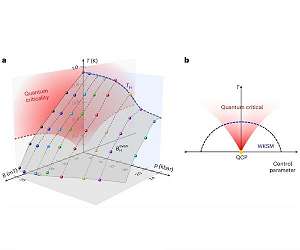
Scientists have discovered a new quantum state of matter that connects two significant areas of physics, potentially leading to advancements in computing, sensing and materials science. A study published in Nature Physics Jan. 14, co-led by Rice University's Qimiao Si, brings together quantum criticality, where electrons fluctuate between different phases, and electronic topology, which describes a form of quantum organization based on the wave behavior of electrons. The researchers found that str ... read more

TIME AND SPACE
NASA astronaut stuck in space for nine months retires

Tourists hit record in Japan, despite plunge from China

What happens when fire ignites in space? 'A ball of flame'

ISS astronauts splash down on Earth after first-ever medical evacuation

TIME AND SPACE
NASA moves moon rocket to launch pad ahead of Artemis 2 mission

Starfighters completes key wind tunnel campaign for STARLAUNCH 1 air launch vehicle

Interstellar raises major Series F funding to expand launch and satellite business

Major equity deal backs Gilmour Space expansion of sovereign launch capability

TIME AND SPACE
Ancient deltas reveal vast Martian ocean across northern hemisphere

Tiny Mars' big impact on Earth's climate

The electrifying science behind Martian dust

Sandblasting winds sculpt Mars landscape

TIME AND SPACE
China prepares offshore test base for reusable liquid rocket launches

Retired EVA workhorse to guide China's next-gen spacesuit and lunar gear

Tiangong science program delivers data surge

China tallies record launch year as lunar and asteroid plans advance

TIME AND SPACE
Aerospacelab expands Pulsar navigation constellation work with new Xona satellite order

ThinkOrbital raises seed funding to advance orbital defense and construction systems

China outlines mega constellations in ITU satellite filings

Multiple satellite filings demonstrate transparency, responsibility and ambition: China Daily editorial

TIME AND SPACE
Seismic networks offer new way to track space junk reentering atmosphere

Comtech wins multi-million dollar follow-on contract for civil space components

China lofts AlSat 3A imaging craft for Algeria

China starts large scale production of T1000 carbon fiber

TIME AND SPACE
Hidden magma oceans could shield rocky exoplanets from harmful radiation

Cosmic dust chemistry forges peptide building blocks in deep space

Hidden magma oceans could shield rocky exoplanets from harmful radiation

Icy cycles may have driven early protocell evolution

TIME AND SPACE
Computer models let scientists peer into the mystery beneath Jupiter's clouds

Polar weather on Jupiter and Saturn hints at the planets' interior details

Europa ice delamination may deliver nutrients to hidden ocean

Birth conditions fixed water contrast on Jupiters moons


The content herein, unless otherwise known to be public domain, are Copyright 1995-2026 - SpaceDaily.com. All websites are published in Australia and are solely subject to Australian law and governed by Fair Use principals for news reporting and research purposes. AFP, UPI and IANS news wire stories are copyright Agence France-Presse, United Press International and Indo-Asia News Service. ESA news reports are copyright European Space Agency. All NASA sourced material is public domain. Additional copyrights may apply in whole or part to other bona fide parties. All articles labeled "by Staff Writers" include reports supplied to Space Media Network by industry news wires, PR agencies, corporate press officers and the like. Such articles are individually curated and edited by Space Media Network staff on the basis of the report's information value to our industry and professional readership. Advertising does not imply endorsement, agreement or approval of any opinions, statements or information provided by Space Media Network on any Web page published or hosted by Space Media Network. General Data Protection Regulation (GDPR) Statement Our advertisers use various cookies and the like to deliver the best ad banner available at one time. All network advertising suppliers have GDPR policies (Legitimate Interest) that conform with EU regulations for data collection. By using our websites you consent to cookie based advertising. If you do not agree with this then you must stop using the websites from May 25, 2018. Privacy Statement. Additional information can be found here at About Us.
Subscribe Free To Our Daily Newsletters