24/7 Space News
STELLAR CHEMISTRY
ALMA completes band two receiver chain with low noise amplifiers
illustration only

ALMA completes band two receiver chain with low noise amplifiers

by Robert Schreiber
Berlin, Germany (SPX) Dec 17, 2025

The Atacama Large Millimeter/Submillimeter Array (ALMA) in the Chilean Andes is one of the most powerful radio telescope facilities used to probe cold and distant regions of the universe. Researchers use it to study how stars, planets, galaxies and potential precursors of life form by measuring millimeter and submillimeter radiation from cold molecular clouds. These molecular clouds are interstellar gas clouds with temperatures of only a few tens of Kelvin, where stars form once density and temperature conditions are suitable.

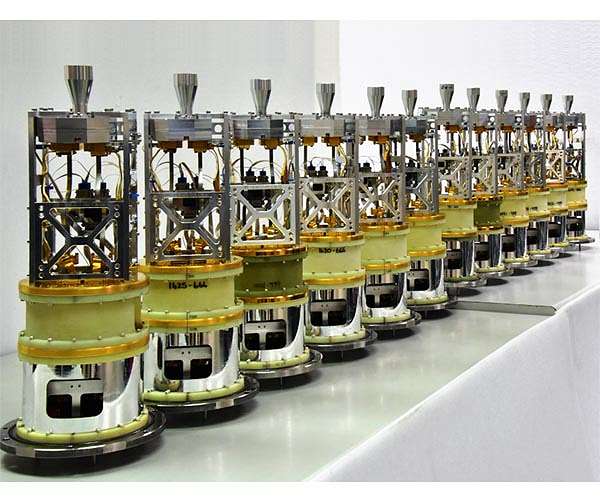
ALMA operates 66 individual parabolic antennas with diameters of 12 meters or 7 meters, each equipped with high-frequency receivers that together span ten wavelength ranges between 6 and 8.6 millimeters, corresponding to 35 - 50 GHz, and between 0.3 and 0.4 millimeters, corresponding to 787 - 950 GHz. For Band 2, covering wavelengths from 2.6 to 4.5 millimeters, or 67 - 116 GHz, the Fraunhofer Institute for Applied Solid State Physics IAF and the Max Planck Institute for Radio Astronomy (MPIfR) have now supplied 145 low-noise amplifiers. With these modules installed, all ALMA bands are equipped for the first time.

With ALMA's Band 2 capability, astronomers expect to examine the cold interstellar medium in more detail, including the mixture of dust, gas, radiation and magnetic fields that gives rise to star formation. The upgraded receivers will also support closer studies of complex organic molecules in nearby galaxies, regarded as precursors to biological building blocks, and allow more detailed observations of planet-forming disks.

"The performance of receivers depends largely on the performance of the first high-frequency amplifiers installed in them," explains Dr. Fabian Thome, head of the subproject at Fraunhofer IAF. "Our technology is characterized by an average noise temperature of 22 K, which is unmatched worldwide." With the new low-noise amplifiers, signals can be amplified more than 300-fold in the first stage, improving sensitivity to faint millimeter and submillimeter emission. "This enables the ALMA receivers to measure millimeter and submillimeter radiation from the depths of the universe much more precisely and obtain better data. We are incredibly proud that our LNA technology is helping us to better understand the origins of stars and entire galaxies."

"This is a wonderful recognition of our fantastic collaboration with Fraunhofer IAF, which shows that our amplifiers are not only 'made in Germany' but also the best in the world," says Prof. Dr. Michael Kramer, executive director at MPIfR.

At the core of the Band 2 amplifiers are monolithic microwave integrated circuits based on metamorphic high-electron-mobility transistors that Fraunhofer IAF developed using indium gallium arsenide compound semiconductor material. This technology produces low-noise amplifiers with low noise temperatures, which strengthen the astronomical signal while adding little background noise and therefore increase receiver sensitivity. As their name suggests, low-noise amplifiers enhance incoming signals by increasing their amplitude while minimizing added interference.

The European Southern Observatory commissioned Fraunhofer IAF and MPIfR to develop and deliver the Band 2 low-noise amplifier modules for ALMA, which ESO operates together with international partners. Fraunhofer IAF designed and manufactured the MMICs, conducted room-temperature tests and selected suitable chips, while MPIfR managed module assembly and qualification. Qualification included cryogenic measurements at 15 K to confirm that the modules meet ESO requirements for use in the ALMA Band 2 receivers.

ALMA was built on the Chajnantor Plateau in the Atacama Desert at an altitude of about 5000 meters above sea level to improve the accuracy of radio astronomical measurements. At this high and dry site, millimeter and submillimeter radiation from distant cosmic regions passes through less atmospheric water vapor and is therefore less attenuated than at lower, more humid locations.

The observatory is jointly operated by ESO, the US National Science Foundation and the Japanese National Institutes of Natural Sciences in cooperation with the Republic of Chile. ESO supports ALMA on behalf of its member countries, including Belgium, Denmark, Germany, Finland, France, Great Britain, Ireland, Italy, the Netherlands, Austria, Poland, Portugal, Spain, Sweden, Switzerland, the Czech Republic and Chile. The US National Science Foundation contributes in collaboration with the National Research Council of Canada and the Taiwanese National Science Council, while the Japanese National Institutes of Natural Sciences work with Academia Sinica in Taiwan and the Korea Astronomy and Space Science Institute.

Related Links
Fraunhofer Institute for Applied Solid State Physics IAF
Stellar Chemistry, The Universe And All Within It

Subscribe Free To Our Daily Newsletters
Tweet

RELATED CONTENT
The following news reports may link to other Space Media Network websites.
STELLAR CHEMISTRY
Roman space telescope passes key construction milestone ahead of launch window
Los Angeles CA (SPX) Dec 12, 2025
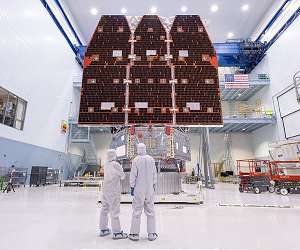
NASA has completed assembly of the Nancy Grace Roman Space Telescope, joining the inner and outer sections of the observatory in the largest clean room at the agency's Goddard Space Flight Center in Greenbelt, Maryland, on Nov. 25, 2025. The mission is scheduled to launch no later than May 2027, with teams currently working to be ready for a launch opportunity as early as fall 2026 on a SpaceX Falcon Heavy rocket from NASA's Kennedy Space Center in Florida. After final environmental and performance test ... read more

STELLAR CHEMISTRY
ISS to change commanders before Soyuz crew leaves orbit

Lodestar Space wins SECP support to advance AI satellite awareness system

Micro nano robots aim to cut carbon buildup in closed life support systems

NASA extends ISS National Lab management contract through 2030

STELLAR CHEMISTRY
Musk signals plan to launch IPO for SpaceX

Southern Launch to host INNOSPACE missions from South Australian spaceports

Rocket Lab completes first dedicated JAXA mission with Electron launch

Neutron Hungry Hippo fairing completes qualification ahead of first launch

STELLAR CHEMISTRY
GoMars model simulates Martian dust storms to improve mission safety

NASA JPL Unveils Rover Operations Center for Moon, Mars Missions

Ancient Martian brines left bromine rich fingerprints in jarosite minerals

Maven stays silent after routine pass behind Mars

STELLAR CHEMISTRY
Experts at Hainan symposium call for stronger global space partnership

Foreign satellites ride Kinetica 1 on new CAS Space mission

Triple Long March launches mark record day for Chinese space program

China prepares Qingzhou cargo ship for low cost resupply flights

STELLAR CHEMISTRY
Smart modeling framework targets 6G spectrum chaos in space air and ground networks

K2 Space raises 250m to scale Mega class high power satellites

Private capital targets mission-critical software power and platforms in new space economy

Beyond Gravity positions new modular satellite platform for European LEO missions

STELLAR CHEMISTRY
Galactic Slots: Space-Themed Games with Out-of-This-World Bonus Features

X-MAT introduces X-FOAM: A game-changing ceramic foam for extreme environments

Bible 1.0: How Ancient Canon Became Our First Large Language Models

Digital twin successfully launched and deployed into space

STELLAR CHEMISTRY
RISTRETTO spectrograph cleared for Proxima b atmospheric hunt

Clues to the migration path of hot Jupiters in their orbits

Can scientists detect life without knowing what it looks like

Ultra hot super Earth shows dense atmosphere over magma ocean

STELLAR CHEMISTRY
Uranus and Neptune may be rock rich worlds

SwRI links Uranus radiation belt mystery to solar storm driven waves

Looking inside icy moons

Saturn moon mission planning shifts to flower constellation theory

Subscribe Free To Our Daily Newsletters


The content herein, unless otherwise known to be public domain, are Copyright 1995-2024 - Space Media Network. All websites are published in Australia and are solely subject to Australian law and governed by Fair Use principals for news reporting and research purposes. AFP, UPI and IANS news wire stories are copyright Agence France-Presse, United Press International and Indo-Asia News Service. ESA news reports are copyright European Space Agency. All NASA sourced material is public domain. Additional copyrights may apply in whole or part to other bona fide parties. All articles labeled "by Staff Writers" include reports supplied to Space Media Network by industry news wires, PR agencies, corporate press officers and the like. Such articles are individually curated and edited by Space Media Network staff on the basis of the report's information value to our industry and professional readership. Advertising does not imply endorsement, agreement or approval of any opinions, statements or information provided by Space Media Network on any Web page published or hosted by Space Media Network. General Data Protection Regulation (GDPR) Statement Our advertisers use various cookies and the like to deliver the best ad banner available at one time. All network advertising suppliers have GDPR policies (Legitimate Interest) that conform with EU regulations for data collection. By using our websites you consent to cookie based advertising. If you do not agree with this then you must stop using the websites from May 25, 2018. Privacy Statement. Additional information can be found here at About Us.