





The research team from UC Irvine's Department of Earth System Science analyzed satellite observations from 2004 to 2024 to quantify how long nitrous oxide remains in the atmosphere. They conclude that the current mean lifetime of N2O is about 117 years, but that it is decreasing at roughly 1.4 percent per decade, equivalent to a reduction of about one and a half years in lifetime every ten years.
The scientists attribute this shift to climate driven changes in the stratosphere, including altered circulation patterns and temperature structure. As increasing carbon dioxide warms the lower atmosphere and cools the stratosphere, transport pathways and chemical reaction rates change, accelerating the movement of nitrous oxide into regions where it is destroyed by sunlight and reactions with excited oxygen atoms.
Nitrous oxide is the third most important long lived greenhouse gas after carbon dioxide and methane, and it is now the dominant ozone depleting substance originating from human activities. Atmospheric N2O concentrations reached roughly 337 parts per billion in 2024 and are rising at about 3 percent per decade, combining emissions from agriculture, industry and natural sources such as soils and the ocean.
The study emphasizes that projecting future nitrous oxide levels requires understanding both emissions and the evolving strength of the stratospheric sink. The stratosphere, extending from about 10 to 50 kilometers above Earth's surface, is where ultraviolet radiation and chemical reactions remove N2O from the atmosphere. About 90 percent of nitrous oxide loss occurs through photolysis by sunlight in the middle and upper stratosphere, between roughly 25 and 40 kilometers altitude, while the remaining 10 percent is removed by reaction with excited oxygen atoms.
During this loss process, some nitrous oxide molecules form nitrogen oxides that catalyze ozone destruction, reinforcing N2O's status as the most important human emitted ozone depleting substance in the post chlorofluorocarbon era. This follows the successful phaseout of CFCs under the Montreal Protocol, which built on Nobel Prize winning work by UC Irvine scientists F. Sherwood Rowland and Mario Molina on stratospheric ozone chemistry.
The authors report that the observed decrease in nitrous oxide lifetime is large enough to affect how different greenhouse gas emissions scenarios translate into atmospheric N2O levels. When they extrapolate the trend to 2100, the resulting change in projected nitrous oxide abundance is comparable to the difference between several of the Intergovernmental Panel on Climate Change Shared Socioeconomic Pathways, which are used to represent high and moderate emissions futures.
In one example, the team shows that if the current trend in lifetime shortening continues, projected N2O concentrations by the end of the century would fall by an amount similar to shifting from a high emissions pathway such as SSP3-7.0 to more moderate scenarios like SSP1-2.6 or SSP2-4.5, even if emissions themselves did not change. This finding means that uncertainties in stratospheric chemistry and dynamics can rival uncertainties in emissions when it comes to future nitrous oxide levels.
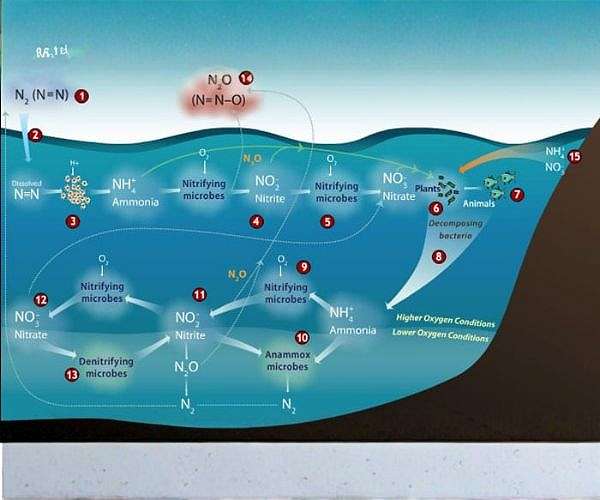
The study notes that nitrous oxide builds up in the lower atmosphere from natural processes in soils and ocean waters as well as from human activities including fertilizer use, fossil fuel burning and industrial production. Global circulation then carries this gas into the tropical stratosphere, where radiative and chemical processes control its eventual destruction and its contribution to nitrogen oxide formation and ozone loss.
The researchers argue that comprehensive chemistry climate model experiments are now needed to explore the full feedback chain linking nitrous oxide, nitrogen oxides, ozone and N2O photolysis, and to capture regional variations in stratospheric circulation and interactions with other changes in atmospheric composition. They also call for refined projections under different climate scenarios that explicitly include the evolving nitrous oxide lifetime.
According to the UC Irvine team, the work reveals an important gap in current Earth system models and international climate assessments. They conclude that climate driven changes in stratospheric chemistry and transport must be incorporated into future global warming potential calculations for N2O, assessments of ozone recovery, and policy discussions under the Paris Agreement that address agricultural and industrial emissions of this long lived greenhouse gas.
Research Report:Projecting nitrous oxide over the 21st century, uncertainty related to stratospheric loss
Related Links
University of California - Irvine
Earth Observation News - Suppiliers, Technology and Application
| Subscribe Free To Our Daily Newsletters |
| Subscribe Free To Our Daily Newsletters |








