





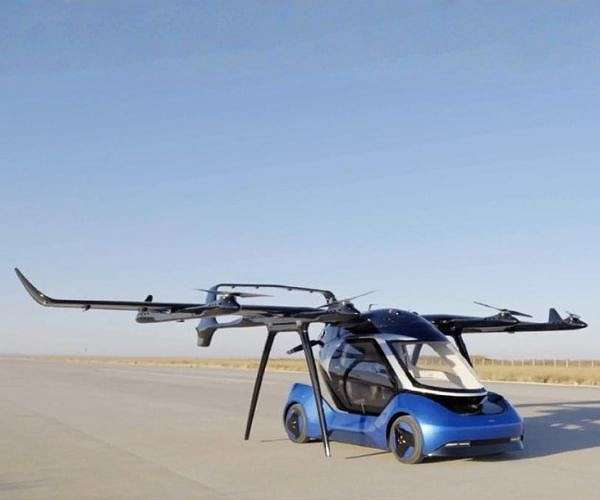
The prototype uses a configuration that merges elements of air vehicles and automobiles to operate as both a car and an aircraft. Developers describe the design as a flying car concept intended to move seamlessly between road and air operations without a complete change of vehicle.
The vehicle consists of wings, a central cabin and a chassis that together form two main modules. The airborne module is designed to detach from the road going base and conduct short range flights before reuniting with the ground component for conventional driving.
According to project details, the airborne module can carry two passengers at speeds of around 150 kilometers per hour. It is intended to fly at altitudes below 3,000 meters, placing it in the low altitude airspace envelope that regulators are opening for new aviation services.
The road going module uses a fully electric intelligent chassis to provide ground mobility. Engineers have set a target driving range of more than 300 kilometers, allowing the vehicle to operate as an everyday car when not in flight mode.
Program managers at the ninth academy say the system is being positioned as multipurpose low altitude equipment rather than a niche demonstration platform. They argue that a hybrid road air vehicle could help bridge gaps between existing transport modes in congested urban regions and mountainous terrain.
Potential applications identified by the developer include passenger transport across short to medium distances where road links are indirect, as well as point to point transfers to and from transport hubs. The team also points to logistics operations where the cargo volume is modest but rapid delivery is important.
Emergency support has been listed as another use case, with the aircraft able to reach isolated communities or incident sites more quickly than vehicles restricted to roads. The combination of flight capability and road mobility is seen as useful in regions where infrastructure damage or topography limits access.
The maiden flight in Chongqing is part of a broader effort by Chinese aerospace institutions to adapt space and missile technologies for civilian uses. The ninth academy, which traditionally focuses on launch vehicle and spacecraft systems, is using its experience in lightweight structures, avionics and power systems to support the program.
China has identified low altitude airspace as a growth area for civil aviation, with eVTOL concepts playing a central role in planning documents. The flying car demonstrator from China Aerospace Science and Technology Corporation adds to a growing list of projects that aim to put piloted and autonomous air taxis into regular service over the coming decade.
Further flight tests are expected to refine handling, safety systems and integration between the airborne and road going modules. Certification pathways, operational rules and infrastructure requirements for such dual mode vehicles will also need to be defined before any commercial deployment.
Related Links
China Aerospace Science and Technology Corporation
Car Technology at SpaceMart.com
| Subscribe Free To Our Daily Newsletters |

| Subscribe Free To Our Daily Newsletters |








