24/7 Space News
STELLAR CHEMISTRY
China Sky Eye tracks binary-triggered fast radio burst activity
illustration only

China Sky Eye tracks binary-triggered fast radio burst activity

by Riko Seibo
Tokyo, Japan (SPX) Jan 19, 2026

An international team of astronomers has obtained the first decisive evidence that at least some fast radio bursts originate in binary stellar systems rather than from isolated objects. The work centers on an active repeating fast radio burst source about 2.5 billion light years away that shows a sudden and transient change in its magnetic environment consistent with material expelled from a stellar companion.

Fast radio bursts are powerful millisecond flashes of radio emission that arrive from distant galaxies and typically show nearly 100 percent linear polarisation. Because the polarised waves pass through magnetised plasma on their journey, their polarisation angle rotates with radio frequency, an effect known as Faraday rotation that is quantified by the rotation measure. By tracking how this measure changes over time, astronomers can probe conditions in the immediate vicinity of the burst source.

Using the Five-hundred-meter Aperture Spherical Telescope in Guizhou, widely known as the China Sky Eye, researchers monitored a repeating source designated FRB 220529A for roughly 17 months. For most of that period the source appeared relatively unremarkable, emitting bursts whose polarisation and rotation measure remained stable within expected ranges for an active repeater.

Near the end of 2023, the data set revealed an abrupt rise in the rotation measure by more than two orders of magnitude, followed by a rapid decline over about two weeks back to its previous level. The team describes this short-lived magnetic excursion as an RM flare, a brief episode in which the Faraday rotation suddenly spikes before recovering. Such behaviour points to a dense, magnetised plasma clump crossing the line of sight between the source and Earth.

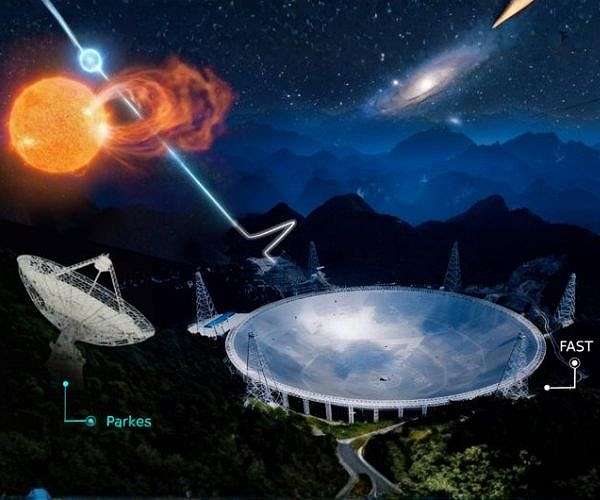
The scientists interpret this transient plasma screen as the product of a coronal mass ejection launched from a companion star in a binary system hosting the fast radio burst engine. In this scenario, a magnetised cloud from the companion moves across the narrow beam from the fast radio burst source, sharply boosting the rotation measure until the cloud disperses or moves clear. The inferred properties of the plasma are consistent with coronal mass ejections from the Sun and other stars in the Milky Way.

Although the companion star itself cannot be directly resolved at such a large distance, its influence becomes visible through meticulous, long term monitoring with the China Sky Eye and complementary observations from Australia's Parkes radio telescope. The binary interpretation provides a natural explanation for the timescale and amplitude of the RM flare without invoking exotic environments or rare intervening structures. It also links fast radio bursts more closely to known stellar processes.

The study supports a unified physical picture in which all fast radio bursts arise from highly magnetised neutron stars known as magnetars. In this framework, binary companions help shape the surrounding plasma and geometry so that some magnetars are more likely to produce frequently repeating radio bursts. Binary interactions may alter how radiation escapes, modulate activity, or occasionally inject additional material that temporarily changes the magnetic conditions, as seen in the RM flare.

The China Sky Eye fast radio burst Key Science Programme, co led by researchers at The University of Hong Kong and collaborating Chinese institutions, has been monitoring repeating sources since 2020 to search for such subtle environmental changes. FRB 220529A emerged as a key target because of its sustained activity and the ability to revisit it over many months, allowing rare transient signatures like the RM flare to be identified with confidence.

The discovery relied on extensive observing campaigns and coordination across facilities, including dedicated key science time on the China Sky Eye, a director's discretionary time program, and principal investigator projects on both the Chinese and Australian telescopes. The collaboration involves scientists from The University of Hong Kong, Purple Mountain Observatory, Yunnan University, the National Astronomical Observatories of the Chinese Academy of Sciences and other partners, bringing together expertise in observation, theory and data analysis.

According to the team, continued long term monitoring of repeating fast radio bursts will be crucial for determining how common binary environments are among these mysterious sources. As more RM flares or related signatures are detected, astronomers expect to refine models of magnetar powered bursts, constrain the range of binary configurations and better understand how stellar activity and plasma structures shape the observed signals. The new result marks a major step toward linking fast radio bursts to concrete astrophysical systems rather than treating them as isolated cosmological flashes.

Research Report: A sudden change and recovery in the magnetic environment around a repeating fast radio burst

Related Links
The University of Hong Kong
Stellar Chemistry, The Universe And All Within It

Subscribe Free To Our Daily Newsletters
Tweet

RELATED CONTENT
The following news reports may link to other Space Media Network websites.
STELLAR CHEMISTRY
Record gamma ray burst traced to dusty massive host galaxy
Los Angeles CA (SPX) Dec 09, 2025
Gamma ray bursts rank among the most energetic explosions known, usually flashing and fading within seconds or minutes, but on 2 July 2025 astronomers detected GRB 250702B, a source that produced repeated bursts for over seven hours and now stands as the longest gamma ray burst yet observed. Space based observatories, including NASAs Fermi Gamma ray Space Telescope, first recorded the gamma rays, localized the source in X rays, and triggered coordinated follow up at other wavelengths to determine its na ... read more

STELLAR CHEMISTRY
Explore the World with These Travel Tips

The Quiet Transformation of GPS - What's Coming by 2026

NASA Back for Seconds with New Food System Design Challenge

New orbital mapping system targets Earth Moon libration traffic

STELLAR CHEMISTRY
NASA moves moon rocket to launch pad ahead of Artemis 2 mission

PH-1 test flight advances Chinese reusable suborbital spacecraft plans

GE and Lockheed validate compact rotating detonation ramjet for hypersonic missiles

Firefly prepares Alpha Block II upgrade for Flight 8

STELLAR CHEMISTRY
Ancient deltas reveal vast Martian ocean across northern hemisphere

Tiny Mars' big impact on Earth's climate

The electrifying science behind Martian dust

Sandblasting winds sculpt Mars landscape

STELLAR CHEMISTRY
Tiangong science program delivers data surge

China tallies record launch year as lunar and asteroid plans advance

China harnesses nationwide system to drive spaceflight and satellite navigation advances

Shenzhou 21 crew complete eight hour spacewalk outside Tiangong station

STELLAR CHEMISTRY
China outlines mega constellations in ITU satellite filings

ThinkOrbital raises seed funding to advance orbital defense and construction systems

Aerospacelab expands Pulsar navigation constellation work with new Xona satellite order

Multiple satellite filings demonstrate transparency, responsibility and ambition: China Daily editorial

STELLAR CHEMISTRY
The decentralized future of space transactions

How IVRT Testing Ensures Consistent Product Quality

The Silent Partner - How Machine Learning Quietly Powers Modern Space Operations

Why Space Theme Slots Are Popular with Canadian Casino Players

STELLAR CHEMISTRY
Frozen hydrogen cyanide crystals may have helped spark early chemistry for life

Pandora exoplanet mission checks in after launch

Mixed crystal phase of superionic water mapped inside giant planets

Berkeley Scientists set to home in on 100 signals from Seti at Home

STELLAR CHEMISTRY
Jupiter's moon Europa has a seafloor that may be quiet and lifeless

Uranus and Neptune may be rock rich worlds

SwRI links Uranus radiation belt mystery to solar storm driven waves

Looking inside icy moons

Subscribe Free To Our Daily Newsletters


The content herein, unless otherwise known to be public domain, are Copyright 1995-2024 - Space Media Network. All websites are published in Australia and are solely subject to Australian law and governed by Fair Use principals for news reporting and research purposes. AFP, UPI and IANS news wire stories are copyright Agence France-Presse, United Press International and Indo-Asia News Service. ESA news reports are copyright European Space Agency. All NASA sourced material is public domain. Additional copyrights may apply in whole or part to other bona fide parties. All articles labeled "by Staff Writers" include reports supplied to Space Media Network by industry news wires, PR agencies, corporate press officers and the like. Such articles are individually curated and edited by Space Media Network staff on the basis of the report's information value to our industry and professional readership. Advertising does not imply endorsement, agreement or approval of any opinions, statements or information provided by Space Media Network on any Web page published or hosted by Space Media Network. General Data Protection Regulation (GDPR) Statement Our advertisers use various cookies and the like to deliver the best ad banner available at one time. All network advertising suppliers have GDPR policies (Legitimate Interest) that conform with EU regulations for data collection. By using our websites you consent to cookie based advertising. If you do not agree with this then you must stop using the websites from May 25, 2018. Privacy Statement. Additional information can be found here at About Us.